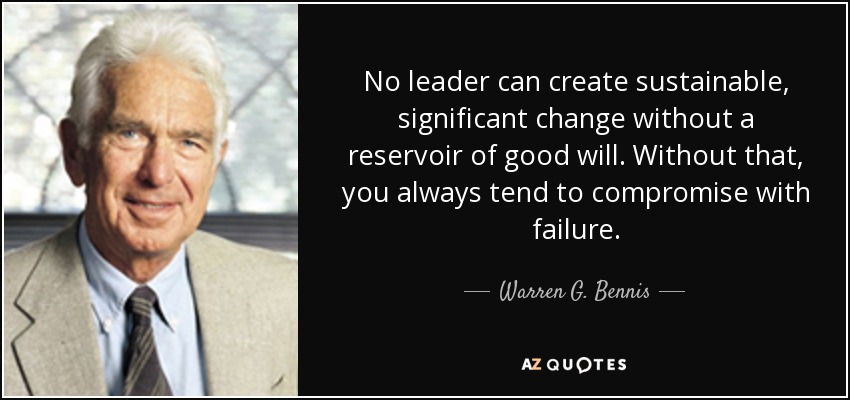
No leader can create sustainable, significant change without a reservoir of good will. Without that, you always tend to compromise with failure.
Lasting solutions are always difficult to come to. But they will have to persevere. I've been repeating ad nauseam that we in Burma we are weak with regard to the culture of negotiated compromises, that we have to develop the ability to achieve such compromises.
I say that when you have perceived or attained the goal, compromises, renunciations, do not exist. If you have seen the goal, compromise ceases to exist. It is then a question of a different attitude.
I should say that all compromise is a "stepping down" of the Truth, is trying to reduce something which cannot be reduced, and that for anyone who has understood life these compromises are impossible.
The rules of war and business are the same. Victory and success are the same. In one it's life and/or death in the other it is success or failure. There really is little room for compromise of "gray matter".
Domestic and supranational regulatory capture leads to two things: on the one hand, to an inequality spiral where the rich get richer because they can influence rulemaking and rule application in their favor; on the other hand, it also leads to instability. This is so because the relatively few organizations capable of influencing supranational rulemaking through the lobbying of major governments have diverse interests. This will, in some cases, lead to compromises. But it will also lead to spheres of influence.
In the United States at present the 'culture wars' of the last thirty years have now produced a horrid stand-off which compels you all into a binary either/or with all kinds of spin-offs. This is deeply unhealthy. The trouble is that the way the system is set up in order to get in and try to change it you have to be (a) a millionaire, (b) someone who can work inside the system long-term, (c) someone prepared to make deals and compromises... Which does rule out the vast majority of committed Christians.
If you want to know for sure that you are on the right path, here's your clue: You're not put in a position where you feel like you have to negotiate your sense of integrity, which is an act of betrayal. You don't feel like you have to compromise who you are.
I can see both trends among the youths: people who are ready for a constructive, critical and active presence, and others who are ready to become invisible Muslims and to compromise to be accepted. I put my hope in the former and pray for the latter.
There's going to be no more compromise on issues where there should not be compromise. Enough with appeasement or apology and mollifying, all that. To hell with all that. I'm just going to fight my corner.
You can't assume if you do something contentious that people will be on your side. The moment violence enters the story, the story changes. Then the question is, "How do you face up to violence?" And then you have to have a no-compromise position. And this is quite simply a lesson we learn in the school playground.
Whenever you're doing two things at once, you're compromising them both.
I think that we're guided by the motto in "essentials unity, non essentials liberty and in all things charity." So if pastors compromise essential Christian doctrine, I think that there is a biblical warrant for naming them.
I'd make - before I'd elect somebody - I'd make him do town meetings and face the people and then I would insist that the person not run on a platform of no compromising. The meaningful thing that the leaders could do would be to be dedicated to a discussion across the isle, to vote their consciences and not to follow the strict party line. I think that would lead to sensible decisions.
By the time of Andi Parhamovich death, I had already grown skeptical of the Iraq war. What her death made me realize was what the actual price was. Going through that kind of loss and seeing how devastating it was on her family and friends made me decide that I was only going to write about things that I really believed in. I'm not going to compromise on that.
Loyalty saves us from the self-advantaging compromising of important relations - such as friendship, marital and professional commitments, group memberships, and so on. But as the Aristotelians would put it, its expression requires phronesis - wisdom not to allow it to compromise other important virtues ,there is something to the ancient doctrine of the unity of the virtues. I believe that is true of all virtues, but especially of the executive virtues - such as industriousness, sincerity, conscientiousness, and courage - which may become detached from substantive goods.
You need to be able to agree from time to time if we're going to get anywhere. Once you have started a civil dialogue, it's a much smoother road to compromise. The key thing to remember is it's a daily practice.
Don't compromise quickly. Women are more likely to automatically take the first offer on the table because we're more likely to feel "lucky" to be employed at all. But remember, negotiation isn't necessarily one round: you can come back with other asks, even if those things aren't money.
In the long run, you have to have patience and integrity and a plan. You can't compromise your vision. I'm a bit of a control freak, brutal when it comes to my art because I believe it's the best way of doing it, for me. My stubbornness has given us the chance to play in some amazing places that most people never would have been allowed to play in. If I don't put a value on my work, then nobody else is going to.
I think whenever Ahmadinejad opens his mouth in forums, especially in front of the U.N. General Assembly, those that are listening, especially Western officials, European, American, even Chinese and Russian officials, I think, after listening to Ahmadinejad, they have even less confidence that there exists a mature political leadership in Iran which is amenable to some type of a diplomatic compromise.
It was a very different Republican Party in 2013. And so I think particularly the House Republicans are more confrontational, less willing to compromise even than the Republican class of '94.
The thing that is different I think from the years ago, when I was covering the shutdown at the Clinton White House. Then, it was a different political landscape. At that point, a third of House Republicans in the 1995 shutdown were in congressional districts that had been won by Bill Clinton. 7 percent of House Republicans are in congressional districts that were won by Barack Obama shows you how much more partisan the whole country is. A lot of the bridges that used to be used to reach a deal when you needed to reach a compromise have been blown up in the past years.
I trust microphones, speakers and recordings less and less, and no longer buy into the idea that I can recreate at home, or in my earphones, the experience of hearing live acoustic instruments. The orchestra is already a set of speakers that react differently to each player, each room and each concert - it's that high level of uncertainly and unrepeatability that I like. The music is just soaked into the walls of a room straight from the instruments - and it's a one-off deal. The alternative - left speaker, right speaker - is kind of a compromise.
Democracy is our commitment. It is our great legacy, a legacy we simply cannot compromise. Democracy is in our DNA. I have seen the strength of democracy. If there were no democracy then someone like me, Modi, a child born in a poor family, how would he sit here? This is the strength of democracy.
Dignity of women is our collective responsibility. There should be no compromise in this matter. There should be no erosion in the law and order situation. We have to revive the family culture in which a woman is respected and considered equal, her dignity encouraged.
Follow AzQuotes on Facebook, Twitter and Google+. Every day we present the best quotes! Improve yourself, find your inspiration, share with friends
or simply: