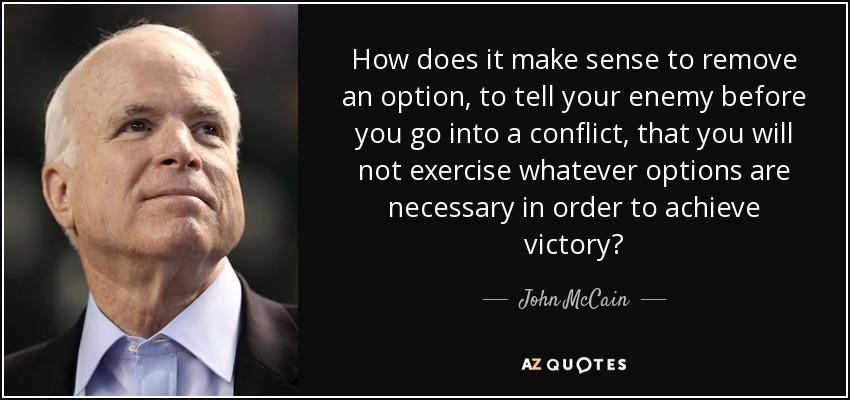
How does it make sense to remove an option, to tell your enemy before you go into a conflict, that you will not exercise whatever options are necessary in order to achieve victory?
It seems to me that the darkness that has troubled you ... comes from one very serious source. Without wanting to be in conflict with the truth and with the will of God, we are actually going against God's will and His teaching.
Our efforts to counter hatred, intolerance, and indifference must continue simultaneously at individual and structural levels. We must try to influence for good the minds and hearts of individual people through dialogue and confidence building. These efforts must be reinforced by our efforts to create just structures in society to support the ongoing work of negotiations in the human community. Only then will we have a chance to negate the terrible consequences of the tremendous conflicts facing humankind today.
The intellectual and moral failures common to America's general officer corps in Vietnam and Iraq constitute a crisis in American generalship. Any explanation that fixes culpability on individuals is insufficient. No one leader, civilian or military, caused failure in Vietnam or Iraq. Different military and civilian leaders in the two conflicts produced similar results. In both conflicts, the general officer corps designed to advise policymakers, prepare forces and conduct operations failed to perform its intended functions.
Based on information from the Pentagon and estimates by analysts such as former Reagan Pentagon official Lawrence Korb, the costs of restoring destroyed and damaged Army and Marine Corps equipment is now estimated to be close to $30 billion, and it will grow by an additional $14 billion for every additional year we stay in Iraq. Even if these funds were available tomorrow, it would take years to restore the forces to the state they were in at the outset of the conflict.
When you are in conflict with someone, there is one factor that can make the difference between damaging your relationship and deepening it. That factor is attitude. We don't get to know people when they come to us; we must go to them to find out what they are like.
Self-esteem is the result of recognizing our personal power; awe and wonder come from recognizing our lack of it. Both are true, and in an exceptional life there is no conflict between them.
Looked at objectively, it is clear that the overwhelming majority of civilian deaths resulting from political violence are produced by what should be understood as "state terror." Terrorism also serves as an excuse to avoid diplomacy and the peaceful resolution of conflict.
I get most my information about what's happening in the United States from reports and studies, which are often in conflict with what you read on the editorial pages, or handouts from right wing institutions like the American Enterprise Institute.
Compared to Americans, Canadians are often more gentle in their approach to things. They're much more apologetic. There's less room for conflict.
There are times when things are clear in your head and your heart and everything comes all aligned and it's easy and it just feels good to do something. But most of the time it's not like that. Most of the time there's conflict between your head and your heart.
The criticisms that are often presented to us by some in the conservative Jewish community about our Palestinian version are: first, that the U.S. is not in conflict with "Palestine" (quotes are theirs) and second, that Conflict Kitchen should counter the Palestinian viewpoints it presents with pro-Israeli viewpoints, otherwise we are spreading dangerous propaganda.
If we are not in conflict with Palestine than why are they so afraid of us presenting Palestinian voices? Of course the answer is obvious, and we see it throughout the U.S. and the world, controlling the master narrative of Israel means vigilantly controlling the narrative about Palestine.
Wars and conflicts begin in the mind, then they are expressed in words and then executed through physical action, so personal transformation is intricately connected with the social and political transformation.
Each of us needs to eliminate our anger, fear and greed. The roots of social conflicts and political tensions are in personal anger, fear and greed.
The minute you start arming people in these conflict zones, things don't go as expected. We also need to look at precedent before making these decisions. Instead of listening to Muammar Qaddafi's rhetoric, we should look at how he's behaved. The fact is he's been making concessions recently. He gave up his nuclear weapons. He allowed hundreds of Americans to evacuate Tripoli. Did he crack down on his people who revolted? Yes, but that's not so unusual.
It was tricky [to write about Israelis], because everyone has an opinion about the Arab - Israeli conflict, and when I first started writing these stories, I was working for an Arab - Israeli human rights group. It was during the Second Intifada. It was this totally violent and intense time, and I think there's a part of me where I don't know how to write about that situation without getting my politics out of my messages, and that's something that was important for me not to do in this book.
I was interested in writing something that has meaning in the larger context of global conflicts anywhere.
What many fail to realize is that being attached to what we think we want and don't have while resisting what is happening in the moment is the cause, not the cure, of much personal suffering and interpersonal conflict.
Women, we tend to become whole people by venturing outside of the home, learning to aspire, to achieve, to deal with conflict - all these qualities that are wrongly called masculine.
I founded the King Hussein Foundation after my husband's death in 1999, to build on his humanitarian vision and legacy in the country and abroad, through programs promoting education and leadership, economic empowerment, tolerance, cross-cultural dialogue, and media that enhances mutual understanding and respect among different cultures across conflict lines.
I have been a long-time advocate for a just Arab-Israeli peace and for Palestinian refugees. Today, as you are aware, Turkey, Lebanon, and Jordan and Iraq are being overwhelmed by those fleeing the conflict in Syria, often with nothing but the clothes on their backs. Many are severely tortured - abused women and their traumatized children whose husbands, fathers, and brothers have been killed or permanently disabled.
It's funny, people often ask me, "Why do you do bike tours where it takes three times the effort and you make one-third of the money?" My answer is that I'm trying to do it ethically. What does that mean, exactly? That conflict is a big part of my art.
I would like to say is that to be truly American and represent American ideals you need to consider yourself a citizen of the world. American policy has gone contrary to that ideal. The Bush Administration is bent on making the world submit to "Americanism" instead of becoming a member of the world community. This orchestration comes from the very top of the Administration and has pushed America into a corner. So, rather than trying to humbly mix with the rest of the world, we are forcing ourselves upon it. We seem to create conflicts with everyone.
He is someone who is involved in the Israeli-Palestinian conflict in a fundamental way. Let's start with who Dani Dayan is. He was the former head of one of the main settler councils, the Yesha Council, which is a kind of umbrella organization for settlements in the occupied West Bank. Now, you know, for some countries this might not be an issue, but Brazil has made a point of its policies on the Israeli-Palestinian issue.
Follow AzQuotes on Facebook, Twitter and Google+. Every day we present the best quotes! Improve yourself, find your inspiration, share with friends
or simply: