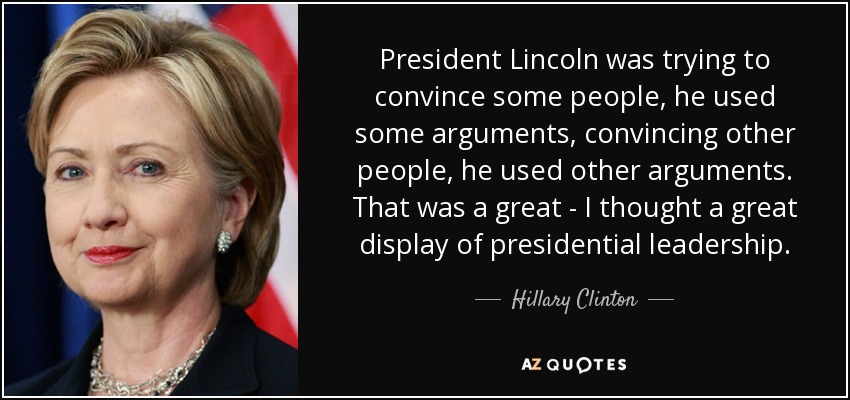
President Lincoln was trying to convince some people, he used some arguments, convincing other people, he used other arguments. That was a great - I thought a great display of presidential leadership.
Everybody can doubt, and they are free to doubt, and I don't want to convince anyone.
We don't have to convince people how screwed they are.
Everything has been for the [President] election for the last couple of months. Since the Democratic National Convention, it's been a dead run to get out as much content as possible and do as much as possible. Then, I go back to writing the screenplay I was working on, which is an original piece - a period piece that I will hopefully finish a couple of months after that, and hopefully I can convince some unsuspecting fool studio to buy.
I would go to trials a lot in Boston, as best I could. And it's incredible that, like, lawyers that had a good case weren't dramatic at all. Lawyers that had a horrible case would sing and dance and do whatever it took to convince the jury or the judge that this guy was innocent. So that was a cool thing to see because that made me believe that what the script [of From The Hip] was doing was totally believable. Now, maybe not ordinary. But it could happen.
I feel like being on Broadway will convince my mother that my theater degree was worth it.
[Lyndon Baines Johnson ] technique in negotiation would be that he'd lean into you and take away your personal space, it didn't matter your party affiliation when he was trying to convince you of something.
In certain ways, I think the work in the Evangelical community has been the most interesting and the most promising. Partly because Evangelical congregations may be harder to convince about issues but, on the other hand, are more likely to do something about it.
[Political actions] has to happen on the local and state level; we have to convince our cities to join the growing number of more than 200 American cities who have signed on to the mayor's climate campaign.
There's a tendency for people who believe passionately in something to be so convinced of their rightness that if they just repeat themselves a lot at the person, that will convince them. And that hasn't worked on things like immigration or trade deals.
Because we had to convince the scientific members of Transylvania that with the procedure I was using on the creature, Dr. Frankenstein could be taught to be a civilized human being, what I called a man about town. Instead of a monster who's going to kill their children, it was someone who could sing and dance.
I guess that is the strange part of the human brain that people have studied for eons - is hatred and self-hatred. You can convince people that the problem is not coming from the top but is, rather, being created by the people who are being oppressed.
So what you do [under apartheid system] is you convince black people that the reason they are being oppressed is because there are some within their community who just can't behave. And if only they could behave, then everyone else would have more freedoms and liberties, which, of course, is not true.
Faith is the lack of evidence, and it shouldn't be that difficult to convince people that the right reason to believe something is that there is evidence for it. People do not innately go for this view, but nevertheless it is not that difficult to teach.
I do object to the assumption that anything that might be outside of nature is ruled out of the conversation. That's an impoverished view of the kinds of questions we humans can ask, such as "Why am I here?", "What happens after we die?", "Is there a God?" If you refuse to acknowledge their appropriateness, you end up with a zero probability of God after examining the natural world because it doesn't convince you on a proof basis.
When people laugh at your institutions and convince you that you have to adopt theirs - adopt their dress, adopt their taste in food - you are a prisoner to those people.
One of the hardest things in politics is to convince people to do things now that will have a good effect 20 or 30 years from now because politicians tend to have a short-term view. They are more attentive to things that people care about today.
It's a lot easier to convince uninformed people than it is to convince politicians.
At the end of the day, how many ads did it take to convince you to use Facebook or Twitter? It wasn't marketing or advertising that convinced you to use these services. It was their value.
If you were making poetry out of convictions - trying to convince other people - you were in the territory of rhetoric, and that wasn't the territory of poetry. I think that's pretty smart. I think that it doesn't need to be altogether true, but that was my starting place.
In March [1972] the unity of Pakistan depended on the suppression of the secessionists. But to carry it out with such brutality on the people instead of on those responsible wasn't necessary. That's not the way to convince poor people who've been told that with the Six Points there'll be no more hurricanes, no more floods, no more hunger. I spoke out against such methods more emphatically than anyone else, and when no one dared do so.
I've been around enough to realise that there are two things that once people have them, they don't want to give up, and it's extremely difficult to convince them to give up: one is privileges, and the other is subsidies.
It may be that [Erwin Rommel] believed it to be possible to convince [Adolf] Hitler to go away and to end the war, but Hitler never dreamed of doing something like that.
A beloved student of mine told me she believed the earth was approximately 6,000 years old. She was smart, she was thoughtful, and she was wrong. But I couldn't discount her - I respected her too much. So I debated with her, using every bit of science and logic I had, but I still failed to convince her that the earth was billions of years old.
We should certainly not be perpetuating further harm to others or to the environment. Suppose that workers at ExxonMobil are trying to unionize. We have two choices: to help them improve their lives, or to keep away so that their lives will be worse. Neither choice has any effect on use of fossil fuels. So radical organizers can both help them unionize and improve their lives, and convince them to find a different way to survive and work for ending the use of fossil fuels.
Follow AzQuotes on Facebook, Twitter and Google+. Every day we present the best quotes! Improve yourself, find your inspiration, share with friends
or simply: