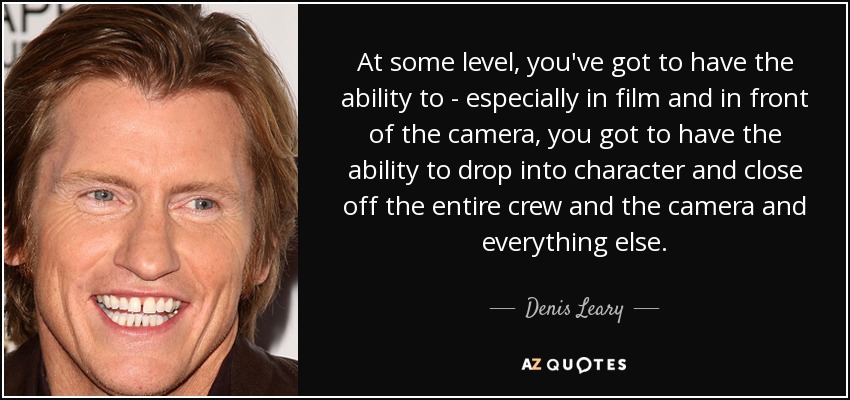
At some level, you've got to have the ability to - especially in film and in front of the camera, you got to have the ability to drop into character and close off the entire crew and the camera and everything else.
I did 50 takes on Robert Shaw assembling the Greener Gun on 'Jaws.' The shark wasn't working, so I just kept shooting to make the production report look like we were accomplishing something and to keep cast and crew from going crazy from boredom. It was a strategic indulgence.
I have my set rigged with the biggest sound system possible and have a mini jack for my iPod attached to my director's chair. I find playing music is a very direct way to communicate with actors and the crew, especially those crew members who are on the periphery of the set. I like dancing on set too, it's a good way to release tension.
I love that hip-hop can still provide jobs for niggas to get money and to put their crew on. I would never say that hip-hop is going down. It's cool, but it needs an adjustment. I think that hip-hop just needs a little fine-tuning.
When I was really young, I was reluctant to be perceived as bossy, and I thought that working with an ensemble was about generating a consensus all the time. Later on, I realized that it's actually generous to know what you want and to tell people what you want - actors, crew, everyone.
You can start a documentary with just a camera, as opposed to a fiction film where you need actors, a crew, a script, a lot more start-up resources. It may be self-perpetuating.
Most indie shoots, or any kind of film shooting, even TV, it's out of Los Angeles, unfortunately. I wish that would change, that people could work where their families are, across the board - crew, cast. I wish we could all stay here.
Going from a short to a feature is like going from crawling to flying. It's a big jump, really. Everything triples - size of crew, budget, shooting days, the cast. Not to mention the stakes - as a first time feature filmmaker so much rides on this film.
Being a military child, we moved a lot and we developed different vernaculars from moving from the south, to the Midwest, and seeing the world. Going from New York to California and from Jamaica Queens to the South, I was always the new kid, or had the army crew haircut. I expected people to pick up on me. My brother kinda stole all of my old jokes. He got his inspiration from me.
When I have hiring power, I try to work with women in my camera crew as much as possible.
I loved having a crew. I loved being the person who woke at six in the morning and knew where to put the camera. I loved watching the actresses cry, and to know that if you were clever and didn't do too many rehearsals, that it just came that way.
Both my parents work in film. They're crew. I love movies, and I just wanted to be involved. I got really lucky. I auditioned for a while and then started making films.
In the old days when I first was coming up, you would turn up on set in the morning with your coffee, script, and hangover and you would figure out what you were going to do with the day and how you were going to play the scenes. You would rehearse and then invite the crew in to watch the actors go through the scenes. The actors would go away to makeup and costume and the director and the DP would work out how they were going to cover what the actors had just done.
When a crew and a captain understand each other to the core, it takes a gale, and more than a gale, to put their ship ashore.
I think it's important for me, for my crew and for the audience to bring something new to each show. I have friends who have done the same act, word for word for word, for 20 years. I have a problem with that. I think the audience should see something new in each show.
The universe has fascinated mankind for many, many years, dating back to the very earliest episodes of Star Trek, when the brave crew of the Enterprise set out, wearing pajamas, to explore the boundless voids of space, which turned out to be as densely populated as Queens, New York. Virtually every planet they found was inhabited, usually by evil beings with cheap costumes and Russian accents, so finally the brave crew of the Enterprise returned to Earth to gain weight and make movies.
You need someone who has a really good way of enabling trust in the cast and crew, or the cast particularly, to allow them the confidence to stretch themselves to get the performance that you're going to need to provide all of the emotional up and downs in the film.
It was such an amazing experience to be able to spend nine days on a boat with these Greenpeace people. Some of them were scientists and some were crew members working on the ship. Just to hear their stories, like what drew them to Greenpeace in the first place and what they've been through. Every single second of the day they work to save the planet, which makes me as an actor feel quite insignificant.
In some ways I think it [the strike] was important. I'm not sure that "worth it" is the right term, but it was important. A lot of people lost a lot of things - I was greatly concerned for our crews. Those are the people who really sort of paid. A lot of us in quiet ways did everything that we could to help people pay mortgages.
I love Crews, but had been writing a long time before I knew of him. I learned of him because a friend thought we were similar. The reason we are is we were both heavily influenced by Flannery O'Conner. She was wonderful.
I believe in preparation. As you already know we had to deal with many crews, 2 cameras. Also as I said we had to get many different actors because they tried to tamper with the project. I just liked doing the movie how I envisioned it. I wanted it to be my own.
I haven't done it by myself at all. I've been surrounded by a really, really good crew of all ages. I think it's important to have a good age range in the crew so that some of us have experienced that period, or something close to that. But the script, of course, is really inspiring and you just have to trust that. Sometimes on film a glass can be as big as a car, so if the details are right, then they take up as much space on screen as the streets that we didn't have a chance to show as London really has changed since then.
As important as it is to learn the techniques of cinematography, you also have to learn how to deal with the movie set, with show business. I came up with a cinematographer who is very talented, but she was never quite able to handle everything else you have to do - dealing with the producer and the crew and the time frame that you have to follow.
I'm dedicated to bringing to life what the author is trying to portray. I try to make the producers cry and the crew laugh.
We were able to shoot in a lot of the locations where the mission actually happened and these guys existed, so that was kind of very affecting. We had a Czech crew and a lot of Czech actors. There's a great deal of authenticity to the project [Anthropoid], and Sean [Ellis] was very anxious that that was the case from the beginning.
Follow AzQuotes on Facebook, Twitter and Google+. Every day we present the best quotes! Improve yourself, find your inspiration, share with friends
or simply: