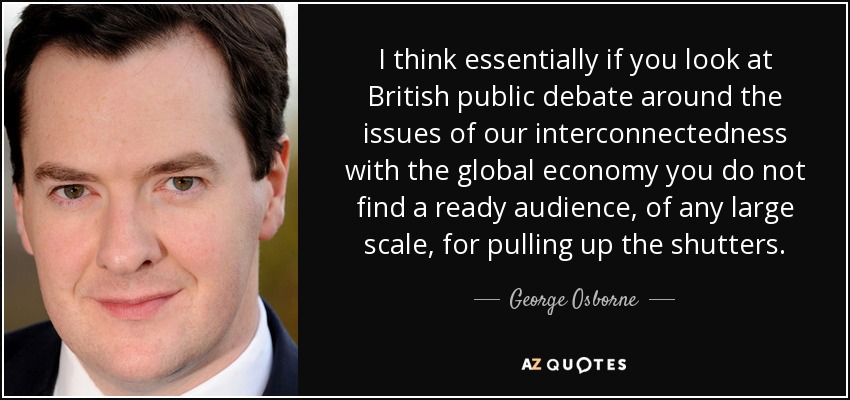
I think essentially if you look at British public debate around the issues of our interconnectedness with the global economy you do not find a ready audience, of any large scale, for pulling up the shutters.
I want the American Muslims to tell the leaders what they are telling me all the time. I want this internal debate to happen and the Muslims cannot just criticize the leadership without being involved. At the end of the day, you have the leadership you deserve.
Doing TV shows helps me a lot in my screenplay writing and filmmaking, especially since my TV shows are in different formats: comedy sketches, talk shows, debate programs, art variety shows, quiz shows. These enable me to meet interesting people with interesting stories and to learn about interesting subjects, all of which I can reflect into film.
I think that these are the kinds of things that we can debate vigorously. We don't have to ultimately divide over them and I think when we debate, we should do so in a collegial fashion, with a great deal of gentleness and humbleness, recognizing that we can learn from one another. Again, even with people who have moved over from the Kingdom of Christ to the kingdom of the cults, we need to treat them with love and with gentleness and with a heart to restore them to proper life and doctrine.
When George W.Bush attacked Afghanistan, it was widely hailed, and the failure of our war there wasn't understood. Within a few months of attacking Afghanistan, Bush clearly moved on to get ready for Iraq, long before Osama bin Laden or Al Qaeda were dispensed with. There was never any serious debate in the press about whether even the notion that every Taliban was our enemy was valid. A lot of assumptions about that war were never challenged.
Gore Vidal, Glenn Greenwald, Noam Chomsky, talk about how the U.S. became a national security state after World War II. Essentially there's this bipartisan foreign policy elite who've been calling the shots for the last few decades and they're clearly still in control regardless of how clownish or absurd they demonstrate themselves to be. There's no shaking their orthodoxy. To me it was the most depressing thing, these full-scale military interventions firsthand for a number of years, seeing how quickly we can get involved in another war with very little debate.
Trump is loose and obvious with his facial expressions. You could watch Donald Trump in a debate and not hear any of the words and you'll still get a sense for when he's pleased, when he's angry and when he's not.
The big frustration for me is that people are growing so cynical about politics that you see them basically shrug and say, "Oh, yeah. Who cares that Harper is shutting down debate? Who cares that he's building prisons, and everything? All the politicians are the same so why should we be outraged about one rather than the other?" And my point is Canadians need to wake up. This is not the Canada they'd recognize if they looked closely.
We need a leader who has a sense of balance, an understanding of the ebb and flow of history and a sense of our country's unique place in it. This is a foreign policy debate, and you cannot conduct foreign policy without a sense of what we are fighting for. And any President who can reduce the conduct of this country's affairs to a morning's attack by a bunch of demented fascists does not, in my view, understand what this great nation is all about.
There's a great debate going on, you know, on whether we're moving toward a system of giant oligopolies or a system of multiples of small businesses. Which is it? I think it's both. In every sector of the economy, we have giant brands that are trustworthy guides to what's good, and then a vast number of small groups, many of them project-based, sometimes folding and re-creating, that are offering products and services through those giant global brands.
In a fundamental sense, this debate about NAFTA is a debate about whether we will embrace these changes and create the jobs of tomorrow, or try to resist these changes, hoping we can preserve the economic structures of yesterday.
In the course of a healthy debate, we prioritize different goals, and the different means of reaching them. But without some common baseline of facts, without a willingness to admit new information and concede that your opponent might be making a fair point, and that science and reason matter - then we're going to keep talking past each other, and we'll make common ground and compromise impossible.
Many people like to think that their moral or political enemies are not just wicked or wrong - as if that were not enough - but stupid or idiotic too. We tend to find this attitude too in the contemporary religion debate. It might console those on each side of the debate to think of their opponents in these terms, but if we want to make real progress in understanding what is going on here, this approach cannot help.
The one hour live debate in the West Wing that we did was one of the most exciting times for me on stage or on camera, because anything could go wrong.
I'm trying to make people more alert that mere acceptance isn't a good enough indicator that something is ethical. You actually need to stop and think. Acceptance on the basis of ignorance or deceit is not the same thing as the acceptance on the basis of ongoing vigorous democratic debate.
Donald Trump insult women. We've seen him rate women on their appearance, ranking them from one to ten. We've seen him embarrass women on TV and on Twitter. We saw him after the first debate spend nearly a week denigrating a former Miss Universe in the harshest, most personal terms. So yes, this is who Donald Trump is.
I encourage all my colleagues to run for office themselves. But it has become extremely difficult in this system to become a prominent opposition politician. I no longer have any rivals to have a debate with. I need competition. And the people will soon tire of me. They say: Navalny, It's always just Navalny. We want to see someone new.
Britain is a great country. We can more or less say what we like, and we can walk down the street without anyone trying to kill us. I know it's tough for some people, but generally we live in a caring society. We live in a great country, but we're no longer a great power. Part of the problem with some elements of the European debate is that they hanker for the days when we were a great power. Those days are gone, and they went a long time ago.
I have constantly told people that I was Secretary of State and I was not going to get into a partisan debate. And I would vote my ballot in a secret way, as all Americans do. But I just want to acknowledge that after the election took place, it was a special time for Americans.
The plurality of German campaign formats, including the televised debates, reflect that we in Germany don't directly vote for a person like in the United States or in France, but for parties. We have a different system.
Great companies create an environment in which employees act like owners. They do this through clear communication, articulation of clear vision and priorities, coaching and openness to debate/discussion. I would argue that this type of environment helps people to be at their best - and helps the company to be at its best.
You can see why there are more people wanting to come from economically-distressed areas, and they can't all come to America. So it gets into the valid, legitimate debate over immigration as to how do we choose. Do we have a diversity lottery and take people from everywhere, do we base it more on merit?
My pieces usually are programmed on concerts in which the other works are standard repertoire. My music always sounds very different when it's on a concert of all contemporary music. It always seems to stick out at an odd angle. This also makes me think of a question I sometimes debate with my friends: does the music of a composer directly reflect that composer's personality? This is a difficult one, but I think it usually does.
I generally think debates within a party should not be treated as a scandal. They should be treated as a sign of strength, to be honest.
Shortly after her nomination was announced,[Betsy] DeVos tweeted, almost as if she had forgotten something important to say. And she said, I am not a supporter of the Common Core. Sandy Kress predicts that debate will die down soon enough.
Follow AzQuotes on Facebook, Twitter and Google+. Every day we present the best quotes! Improve yourself, find your inspiration, share with friends
or simply: