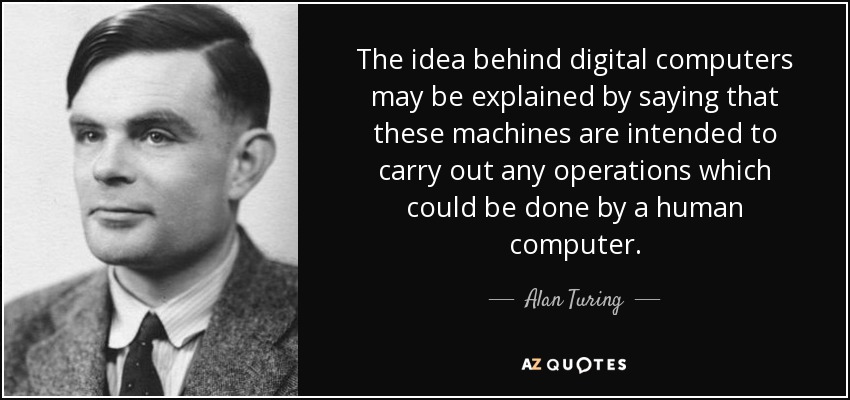
The idea behind digital computers may be explained by saying that these machines are intended to carry out any operations which could be done by a human computer.
I do think there's something about the digital age that is increasingly dehumanising us. We're in this very weird place where we're being pulled into experiences that aren't really experiences at all.
I'm actually a huge fan of digital as well. I appreciate how that technology opens the doors for filmmakers who never had access to that level of quality before. However, I do think film itself sets the standard for quality. You can talk about range, light, sensitive, resolution -- there's something about film that is undeniably beautiful, undeniably organic and natural and real.
If I have to shoot on digital, I will not make the film.
That has been the great achievement of our age: to so thoroughly flood the planet with megabits that every image and fact has become a digitized disembodied nothingness. With magnificent determination, our species has advanced from Stone Age to Industrial Revolution to Digital Emptiness. We've become weightless, in the bad sense of the word.
Much of the early engineering development of digital computers was done in universities. A few years ago, the view was commonly expressed that universities had played their part in computer design, and that the matter could now safely be left to industry. [...] Apart from the obvious functions of keeping in the public domain material that might otherwise be hidden, universities can make a special contribution by reason of their freedom from commercial considerations, including freedom from the need to follow the fashion.
Professor Wilkes is best known as the builder and designer of the EDSAC, the first computer with an internally stored program. Built in 1949, the EDSAC used a mercury delay line memory. He is also known as the author, with Wheeler and Gill, of a volume on "Preparation of Programs for Electronic Digital Computers" in 1951, in which program libraries were effectively introduced.
Being human in the digital world is about building a digital world for humans.
When developers of digital technologies design a program that requires you to interact with a computer as if it were a person, they ask you to accept in some corner of your brain that you might also be conceived of as a program.
A digital camera has to be kept in check like a racehorse.
[A digital snapshot] is meant primarily as a means of communication, and the images being sent are almost as ephemeral as speech, so rarely are they printed and made physical.
The digital and physical worlds are starting to come together more seamlessly - it's only the tip of the iceberg in terms of what's coming.
One paradox I have found is that, the more you use computers in picture-making, the more hand-made the picture becomes. Oddly, then, digital technology is leading, in my work at least, toward a greater reliance on handmaking because the assembly and montage of the various parts of the picture is done very carefully by hand.
There's digital fatigue. When you can do everything, you can actually do nothing.
The Ford Flex is a really, really cool car. You get inside and you have so much headroom and it's really comfortable to drive and it's real techy inside. You look at the screen and it's blue and you've got all kinds of controls. Everything is digital.
[I'm] looking for a good balance between digital and creative work.
In digital, you may have your big launch, but then you continue to work, and you continue to innovate and continue to enhance your platforms as you go along.
No matter what, I will always choose practical FX over digital ones. Blood spray pumps and squibs go a long way in convincing the audience that the carnage on screen happens right there, in a manner that digital have not achieved.
The main difference seems to be that, whereas photography still claims some sort of objectivity, digital imaging is an overtly fictional process. As a practice that is known to be capable of nothing but fabrication, digitization abandons even the rhetoric of truth that has been such an important part of photography's cultural success.
All these kids who are growing up on Skrillex and all this digital music- what are they gonna think when they hear rock'n'roll?
No more do we create cultural artifacts that are simply our furniture, but now it's our thoughts, our values, are embodied in this [digital] stuff.
As an evolutionary biologist, I have learned over the years that most people do not want to see themselves as lumbering robots programmed to ensure the survival of their genes. I don't think they will want to see themselves as digital computers either. To be told by someone with impeccable scientific credentials that they are nothing of the kind can only be pleasing.
"Motherboard," for me, has four different levels: the bottom part is the water, vegetation, and growth. The second part is the world with figures and animals; there's chaos and civilization. The third part is the digital zone - these red things are turning into really loud digital sounds. Then the fourth level is like ether and things turning into air. This idea of how we're becoming partly digitalized is really interesting to me.
Film still looks way better than digital.
Books are surviving in this intense, fragmented, hyper-accelerated present, and my sense and hope is that things will slow down again and people will want more time for a contemplative life. There is no way people can keep up this pace. No one is happy. Two or three hours to read should not be an unattainable thing, although I hope we get to that stage without needing a corporate sponsored app to hold our hand. The utopian in me has my fingers crossed that we haven't quite figured out the digital future just yet. After all, the one thing we know about people: they always surprise.
Follow AzQuotes on Facebook, Twitter and Google+. Every day we present the best quotes! Improve yourself, find your inspiration, share with friends
or simply: