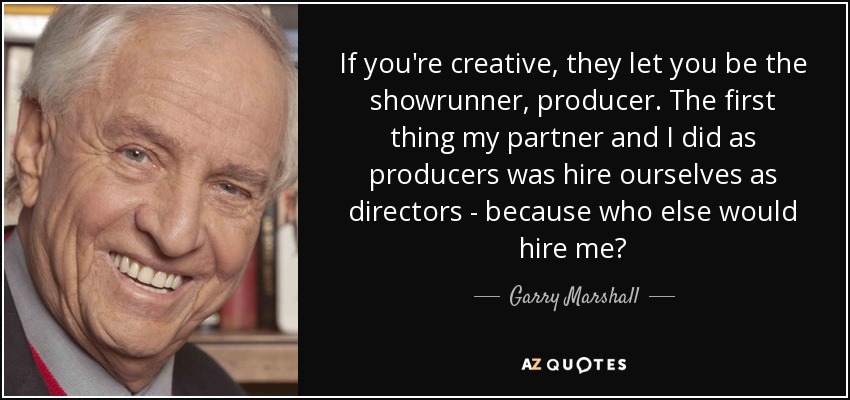
If you're creative, they let you be the showrunner, producer. The first thing my partner and I did as producers was hire ourselves as directors - because who else would hire me?
As you get older - for example, in our band we have members of our orchestra, like Carlos Enriquez and Ali Jackson and Walter Blanning. I taught them when they were in high school, and now they teach me.I'll regularly call Ali and say, "Man, can you break this rhythm down for me?" Or Carlos was actually our music director in Cuba, and he's been instrumental in a lot of my education, and I started to develop a saying with them, because they tease me all the time - you get older, you have that familiar relationship - I say, "You have to follow your young leadership, too."
In the old days when I first was coming up, you would turn up on set in the morning with your coffee, script, and hangover and you would figure out what you were going to do with the day and how you were going to play the scenes. You would rehearse and then invite the crew in to watch the actors go through the scenes. The actors would go away to makeup and costume and the director and the DP would work out how they were going to cover what the actors had just done.
You'll still work with some directors where that doesn't happen, and sometimes it's out of necessity because you're in a really complicated, choreographed fight scene and the whole thing is being prevised in a computer, so it's been decided months before, but I think that's sneaking into the way action scenes are shot.
I remember coming on my first set and it being a playground of things I wanted to ask questions about: cameras and lenses and what the lenses do, what's the focus puller doing and how does that work? Why is there less margin for error when there's less light? I was always asking questions and watching directors closely.
I was always waiting for the secret to be handed down to me. Ron Howard asked me what I was waiting for and I went, "Ron, I'm waiting to know the secret. I keep feeling there's some sort of secret that's going to passed on from a director." He went, "Oh no. There is none. You've just got to on and do it and make mistakes and figure it out."
As an actor and director, you have to take risks, even though I don't like saying that word. You can make a mistake.
I don't want to infantilize the actor; I want to empower the actor. Actors can be many things, but all of the really good ones are really great storytellers, and I'm interested in that. If you're not interested in that as a director then you better be Stanley Kurbrick.
I wanted to know as the director how the actors wanted to tell this story I wanted to know what they thought.
We're still at a point where women [directors] aren't allowed to be mad visionaries. We have to prove beyond a shadow of a doubt that we're responsible, that we can handle it, that we've got all our ducks in a row . . . most women who direct always come in on budget, always come in on schedule, and if they were wild and irresponsible it would not be put down to brilliance, but to a general flakiness.
It's always different, depending on the writer and the director. A collaborator like Graham Reznick delivers a fully finished piece, perfected in every way. Other writers direct the recording session and then leave quite a bit of the work to us.
I've wanted to make movies for so long. I learned most of what I know from director commentaries and behind the scenes featurettes and criterions.
When I read it and I realized that Michael Landon, Jr. was the director of it, I thought...this could work out well. This is not gonna be a hard stretch for me to get the character figured out at all. Outside of the billion dollars, I was living his life...chasing money down. It was a lot of fun.
It's depend of the communication, I think it's very important to let the director make his own vision of the character, not making a studio movie. Look the Dark Knight it's totally the vision of Nolan.
As an actor, I know immediately if I'm saying a word that doesn't feel right coming out of my mouth, and I know how to change it. But as a director watching something, or even as a writer reading a script, sometimes it's not always clear what needs to be fixed.
I've always had good relationships with directors. I'm one of those people where, if there's a good idea coming from the sound guy, I'll take it. Filmmaking is a collaborative effort, whether it's a first-time director or it's Mike Nichols. I think that's the standard that the great ones set.
To make good films, you have to have a good relationship and good collaboration as composer-director, composer-editor, composer-production designer-actor because you're working with the actors on screen.
Different directors have different techniques in the use of films. Cronenberg is very different in the way he works with film, and how he takes the audience into his films is different than how Peter Jackson would do that or Jon Stewart. So, if you go between those artists, you shift gears and you kind of fall into the working method of that film.
I usually work with the director and it's just a collaboration between me and the one person. I think you make good movies that way. If the director and the composer can have this common goal and this excitement about making something great, then you're going to do something good.
I loved making The Imitation Game and it's really gratifying to hear the audience's response to the character that I play. It was just a little thing that I did because I really liked the film and I liked Benedict [Cumberbatch] and I loved Morten's [director Morten Tyldum] previous film, Headhunters. For me, it was something I did thinking, "Wow, this is a lovely quality piece of work."
Writing a good movie brings a writer about as much fame as steering a bicycle. It gets him, however, more jobs. If his movie is bad it will attract only critical tut-tut for him. The producer, director and stars are the geniuses who get the hosannas when it's a hit. Theirs are also the heads that are mounted on spears when it's a flop.
If you, my fellow copywriters or art directors, want to win the award, devote your genius to making the cash register ring.
Jimmy [Dean] was the most talented and original actor I ever saw work. He was also a guerrilla artist who attacked all restrictions on his sensibility. Once he pulled a switchblade and threatened to murder his director. I imitated his style in art and in life. It got me in a lot of trouble.
I'm not a Hollywood director. I'm an in spite of Hollywood director.
When you do improv, you're everything. You're a performer, writer, and director, because you're moving the scene in the direction you want it to go, you're making it up as you go, and you're acting it.
Follow AzQuotes on Facebook, Twitter and Google+. Every day we present the best quotes! Improve yourself, find your inspiration, share with friends
or simply: