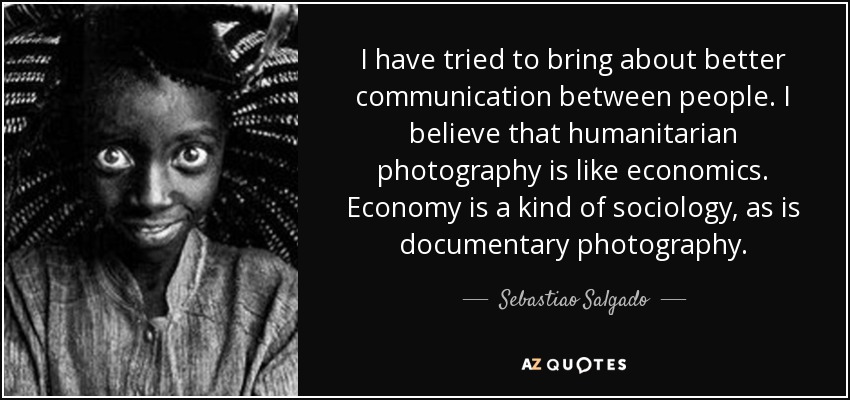
I have tried to bring about better communication between people. I believe that humanitarian photography is like economics. Economy is a kind of sociology, as is documentary photography.
I'm sometimes called a 'documentary photographer' but... a man operating under that definition could take a sly pleasure in the disguise. Very often I'm doing one thing when I'm thought to be doing another.
I want to venture into film more, and I think that a nice way to transition into doing that would be a documentary. I think it would be interesting to find one person that really fascinated me or maybe a band and travel with them, but I don't think I could do it like I used to do it.
It's impossible for one or two people to go out and shoot a narrative film; you need to have a cast, the person shooting sound, whatever. But you can legitimately have a couple people and go and do a documentary.
I have seen the Gore documentary 'An Inconvenient Truth,' just released in the States, and admired the acutely revolutionary delivery of the slideshow assisted talk he has now been giving for some 16 years.
These people [the Christians] watched the Flintstones as if it were a documentary.
I love devastating movies, documentaries and hummingbirds (yes, in that order).
I’ve long been a fan of IMAX nature documentaries, but Humpback Whales, directed by Greg MacGillivray, is something special.
The reason I call myself a documentary photographer is the idea of how photographs contain and participate in history.
If you care about the 2012 election and value the voices of regular Americans who lost hope in their hope and change candidate, this is one documentary you won't want to miss.
Among other things, drag queens are living testimony to the way women used to want to be, the way some people still want them to be, and the way some women still actually want to be. Drags are ambulatory archives of ideal moviestar womanhood. They perform a documentary service, usually consecrating their lives to keeping the glittering alternative alive and available for (not-too-close) inspection.
Mass entertainment in America has been dominated for a long time by the mode of documentary realism.
I think documentary filmmaking is a braver way to make films because it's real, and you're really there.
I think pulling off, pulling off a kind of fake documentary of me being a, you know, actual dictator would have been extremely difficult, if not impossible.
I watched Ricki Lake's documentary, 'The Business of Being Born,' and that led me to call a midwife, and not an ob-gyn, when I found out I had conceived. My delivery was not easy - they call it 'labor,' not 'a vacation!' - but I was incredibly grateful that I did it that way.
In documentaries, there's a truth that unfolds unnaturally, and you get to chronicle it. In narratives, you have to create the situations so that the truth will come out.
It's such a rich experience when you enter into a subject from a documentary point of view. It's hard for fiction to compete with that.
Documentaries - my God, there is so much going on in our country and in the world today that every time you open the newspaper or turn on the radio or watch the news on TV there is another documentary subject. We're getting the headlines for a second, shaped by corporate delivery most of the time, but what's really the story there?
Everything I've made - it doesn't mean they've all been good - but everything I've made so far, big or little, fiction or documentary, has been something that I've been really enthusiastic about.
Every time I see documentaries or infomercials about little kids with cancer, I just freak out. It affects me on the highest emotional level... Anytime I think about it, it makes me sadder than anything I can think of.
Right now I'm taking a break from hip-hop documentaries. But I would do it if things lined up.
I may be wrong, but the essential illustrative nature of most documentary photography, and the worship of the object per se, in our best nature photography, is not enough to satisfy the man of today, compounded as he is of Christ, Freud, and Marx.
I could sit and watch nature documentaries with Jenks and the kids the rest of the night if I wanted. And trust me, watching a dozen pixies scream as a crocodile chomped on a zebra was something not to be missed. They invariably cheered for the crocodile, not the zebra.
A remarkable documentary and the first in-depth record of many black women, slave and free.
I don't know that there were any rules for documentary photography. As a matter of fact, I don't think the term was even very precise. So as far as I'm concerned, the kind of photography I did in the FSA was the kind of photography I still do today, because it is based on passionate concern for the human condition. That is the basis of all the work that I do.
Follow AzQuotes on Facebook, Twitter and Google+. Every day we present the best quotes! Improve yourself, find your inspiration, share with friends
or simply: