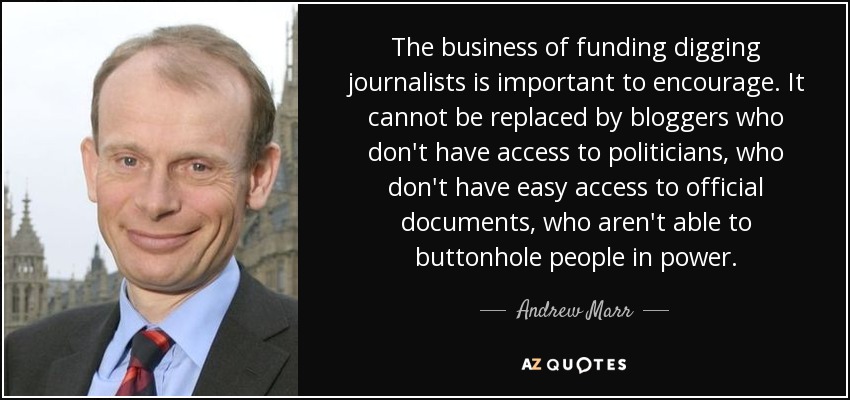
The business of funding digging journalists is important to encourage. It cannot be replaced by bloggers who don't have access to politicians, who don't have easy access to official documents, who aren't able to buttonhole people in power.
Does the U.S. Constitution stand for anything in an era of government excess? Can that founding document, which is supposed to restrain the power and reach of a centralized federal government, slow down the juggernaut of czars, health insurance overhaul and anything else this administration and Congress wish to do that is not in the Constitution?
Like the Bible-a document that often contradicts itself and from which one can construct sharply different arguments-theology is the product of human hands and hearts.
Records used to be documents, but now record companies want product.
Altering the Constitution has become the daily business of the Federal Government which the document is supposed to guide and limit. Both Congress and the judiciary assume, and exercise, countless powers they aren't entitled to.
The most successful revolutions aren't those that are celebrated with parades and banners, drums and trumpets, cannons and fireworks. The really successful revolutions are those that occur quietly, unnoticed, uncommemorated. We don't celebrate the day the United States Constitution was destroyed; it didn't happen on a specific date, and most Americans still don't realize it happened at all. We don't say the Constitution has ceased to exist; we merely say that it's a 'living document.' But it amounts to the same thing.
Every document, apparently ancient, coming from the proper repository or custody, and bearing on its face no evident marks of forger, the law presumes to be genuine, and devolves on the opposing party the burden of proving it to be otherwise.
The menu should be part of the entertainment, part of the dining experience. It's kind of like reading the 'Playbill' when you go to the theater. It should be an alluring and interactive document. Does it have burn marks on it from the candle? If you ever get a greasy menu with food stains on it, it's time to run like hell.
Deliberately, on every historic occasion, we piously fake events for the benefit of photographers, while the actual event often occurs in a different fashion; and we have the effrontery to call these artful dress rehearsals authentic historic documents.
When people look at a photograph, they believe it... My photographs crawl along that edge. I document the world, but from my own biased point of view.
What attracts me in photography is not so much a fine arts approach, but rather photographs as documents... All the ways in which human beings have documented the world in an attempt to order it, in an attempt to consume it or rule it or hang on to it in some sense.
... my father loved to take photographs of me. When I was nine I made my own costumes for a school play and I experienced becoming different characters. I loved to document myself as different images and I think my work evolved after this favorite activity. The photographs I exhibited in New York juxtaposed reality and fantasy. There was everyday life and fantasy was dismantling that reality.
A picture that is ghostly and silent can be more eloquent and less clichéd than a noisier photo-journalistic approach and I have attempted to make pictures that whilst they are not documentary in the traditional sense, they are still documents, like forensic traces.
When we were kids, growing up in the sixties, the only images we had of ourselves were either still photographs or 8mm movies.... Now we have video, digital cameras, MP3s, and a million other ways to document ourselves. But the still photograph continues to hold a sense of mystery and awe to me.
It sometimes happens that you just know... You have a feeling that things are coinciding, and that they operate and work on a number of levels - obviously visual aesthetics, but also content and narrative in terms of the bigger picture. When document and metaphor come together.
Photojournalist? With a few exceptions, those of us working as photojournalists might now more appropriately call ourselves illustrators. For, unlike real reporters, whose job it is to document what's going down, most of us go out in the world expecting to give form to the magazine, or to newspaper editor's ideas, using what's become over the years a pretty standardized visual language. So we search for what is instantly recognizable, supportive of the text, easiest to digest, or most marketable - more mundane realities be damned.
I've been studying sexism for many years, and it's much easier to document the existence of sexism than it is to document the existence of interventions that reduce it. It's really hard to find ways to change the way people see people in different groups. It should be our goal, and we're working for that, but it's hard.
"We, the people." It is a very elegant beginning. But when that document was completed on the 17th of September in 1787, I was not included in that "We, the people."
When I'm writing, it's about the page. It's not about the movie. It's not about cinema. It's about the literature of me putting my pen to paper and writing a good page and making it work completely as a document unto itself. That's my first artistic contribution. If I do my job right, by the end of the script, I should be having the thought, 'You know, if I were to just publish this now and not make it . . . I'm done.
The building housing America's military brass is a five-sided pentagon, but somehow, the people in it still manage to make it the squarest place on earth. The latest evidence? A current military document that lists homosexuality as a mental disorder in the same league as mental retardation - noting, of course, the one difference: retarded people can still get into heaven.
A photograph records both the thing in front of the camera and the conditions of its making... A photograph is also a document of the state of mind of the photographer. And if you were to extend the idea of the set-up photograph beyond just physically setting up the picture, I would argue that the photographer wills the picture into being.
I was very struck by the fact that Colin Powell said he would produce evidence and then never produced it. Then Tony Blair produced a document of seventy paragraphs, but only the last nine referred to the World Trade Center, and they were not convincing. So we have a little problem here: If they're guilty, where is the evidence? And if we can't hear the evidence, why are we going to war?
The picture itself is a document. How do you mean? We're looking at a document. It gives you clues.
Christians, above all people, should desire that their elected representatives submit to the Constitution, because it is constitutional government that has done more to protect Christian liberty than any governing document ever devised by man.
We're in the age of the selfie. It's just encouraging vanity. It's not even representative of anything except how you want people to perceive you. Think of when people are partying and having fun. They're like, "Hey, look at us!" You're obviously not having that much fun because otherwise you wouldn't be stopping to document it. It's stupid.
Follow AzQuotes on Facebook, Twitter and Google+. Every day we present the best quotes! Improve yourself, find your inspiration, share with friends
or simply: