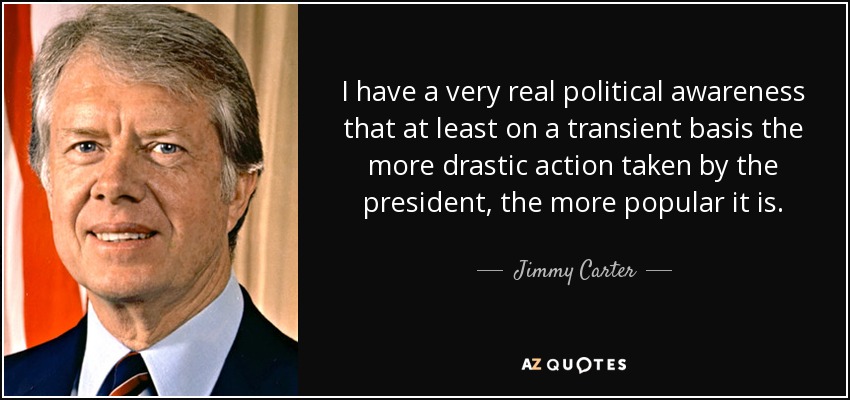
I have a very real political awareness that at least on a transient basis the more drastic action taken by the president, the more popular it is.
I start from the supposition that the world is topsyturvy, that things are all wrong, that the wrong people are in jail and the wrong people are out of jail, that the wrong people are in power and the wrong people are out of power, that the wealth is distributed in this country and the world in such a way as not simply to require small reform but to require a drastic reallocation of wealth. I start from the supposition that we don't have to say too much about this because all we have to do is think about the state of the world today and realize that things are all upside down.
We are not, of course, optimistic about our chances of success. Some form of ecocatastrophe, if not thermonuclear war, seems almost certain to overtake us before the end of the century. (The inability to forecast exactly which one - whether plague, famine, the poisoning of the oceans, drastic climatic change, or some disaster entirely unforeseen - is hardly grounds for complacency.)
The very metaphor Paul chooses for this decisive moment in his argument shows that what he has in mind is not the unmaking of creation or simply its steady development, but the drastic and dramatic birth of new creation from the womb of the old.
Nothing as drastic an innovation as abstract art could have come in to existence, save as the consequence of a most profound, relentless, unquenchable need. The need is for felt experience - intense, immediate, direct, subtle, unified, warm, vivid, rhythmic.
Obviously, where art has it over life is in the matter of editing. Life can be seen to suffer from a drastic lack of editing. It stops too quick, or else it goes on too long. Worse, its pacing is erratic. Some chapters are little more than a few sentences in length, while others stretch into volumes. Life, for all its raw talent, has little sense of structure. It creates amazing textures, but it can't be counted on for snappy beginnings or good endings either. Indeed, in many cases no ending is provided at all.
It is a paradox that in our time of drastic rapid change, when the future is in our midst devouring the present before our eyes, we have never been less certain about what is ahead of us.
The most drastic and usually the most effective remedy for fear is direct action.
You ride one in to the beach, and it's the most amazing thing you've ever felt. But at some point the water goes back out; it has to. And maybe you're lucky-maybe you're both too busy to do anything drastic. Maybe you're good as friends, so you stay. And then something happens-maybe it's something as big as a baby, or as small as him unloading the dishwasher-and the wave comes back in again. And it does that, over and over. I just think sometimes people forget to wait.
I realized that improvisers should probably always have time off. But musicians are always gigging and never have a chance to stop for a minute - unless something drastic occurs.
Peoples have come to experience that political structures and divisions of power are not immutable. Nor will they perceive the distribution of wealth and resources between nations to be unalterably ordained by heaven and incapable of drastic rearrangement by the less than gentle manipulation of man.
What he brought out was a wooden gag they put in someone's mouth before doing something drastic, like cutting off a leg.
I am a believer in change peu a` peu (little by little) since drastic changes, including lots of changes made all at once, are often the sort of modifications that don't stick.
In the instant before the door opened, I could almost sense my life expanding just like a river whose waters have begun to swell; for I had never before taken such a drastic step to change the course of my own future. I was like a child tiptoeing along a precipice overlooking the sea. And yet somehow I hadn't imagined a great wave might come and strike me there, and wash everything away.
During the next four years...unless drastic steps are taken by Congress, the U.S. will have nearly 8,000,000 unemployed and will stand on the brink of a deep depression.
It is one thing to impose drastic measures and harsh economic penalties when an environmental problem is clear-cut and severe....It is foolish to do so when the problem is largely hypothetical and not substantiated by observations....we do not currently have any convincing evidence or observations of significant climate change from other than natural causes.
I didn't realize what I was doing, but once I realized, I was like "this is a gift, let me do this the right way." I don't gotta rush nothing, I don't have to be impatient. Because when you have a gift with something, it's a blessing. You just use it. You don't have to do anything drastic, because it's in you. People told me what it was, and I just stuck with it.
Intimate or drastic elements in the work of others are untouchable and should not be commented upon even in their absence. Private conflicts, quarrels, sentiments, animosities are unavoidable in any human group. It is our duty towards creation to keep these in check in so far as they might deform and wreck the work process.
The well adjusted make poor prophets. A pleasant existence blinds us to the possibilities of drastic change. We cling to what we call our common sense, our practical point of view. Actually, these are names for an all-absorbing familiarity with things as they are. . . . Thus it happens that when the times become unhinged, it is the practical people who are caught unaware . . . still clinging to things that no longer exist.
It is one thing to impose drastic measures and harsh economic penalties when an environmental problem is clear-cut and severe...
We can never really be prepared for that which is wholly new. We have to adjust ourselves, and every radical adjustment is a crisis in self-esteem: we undergo a test, we have to prove ourselves. It needs subordinate self-confidence to face drastic change without inner trembling.
While no man in his right mind would advocate sending our ground forces into continental China, and such was never given a thought, the new situation did urgently demand a drastic revision of strategic planning if our political aim was to defeat this new enemy as we had defeated the old.
So when we call pain a problem, we claim we do not deserve it. We are even prepared to scuttle God to maintain our own innocence. We will say that God is not able to do what He would like, or He would never permit persons such as ourselves to suffer. That puffs up our egos and soothes our griefs at the same time. "How could God do this to me?" is at once an admission of pain and a soporific for it. It reduces our personal grief by eradicating the deity. Drastic medicine, indeed, that only a human ego, run wild, could possibly imagine.
Among the repulsions of atheism for me has been its drastic un-interestingness as an intellectual position. Where was the ingenuity, the ambiguity, the humanity of saying that the universe just happened to happen and that when we're dead we're dead?
Sometimes drastic change requires drastic measures.
Follow AzQuotes on Facebook, Twitter and Google+. Every day we present the best quotes! Improve yourself, find your inspiration, share with friends
or simply: