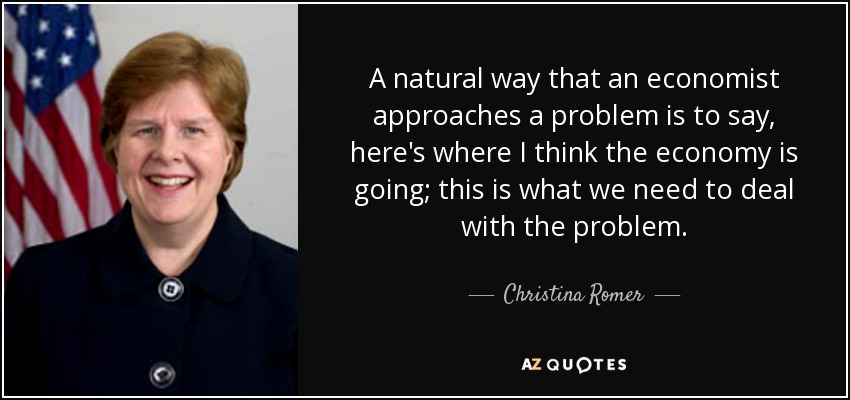
A natural way that an economist approaches a problem is to say, here's where I think the economy is going; this is what we need to deal with the problem.
Raising the minimum wage, as President Obama proposed in his State of the Union address, tends to be more popular with the general public than with economists.
I've felt for some time that economics needs to be taught differently by economists who actually have had experience making a payroll or investing on Wall Street. When economics is taught by pure academics, watch out.
Lunches don't get free just because you don't see the prices on the menu. And economists don't get popular by reminding people of that.
With various people complaining about "price gouging?... economist Walter Williams has coined a new term: "Tax gouging." But government is never accused of either "greed" or "gouging" ? not even when they bulldoze people's homes in order to turn.
Politicians, bureaucrats, editors, new commentators, 'economists' teachers,' and other word artists who denounce private enterprise and praise socialism are their own worst enemies...these attackers are unwittingly destroying the sources of their own livelihood. They kill the geese that lay the golden eggs - and don't know it!
Only economists mistake physical opulence for riches.
I'm not an economist and we all know economists were created to make weather forecasters look good.
We're more familiar with what economists call an English auction - prices start low and rise as people bid. However, there is also the Dutch auction, where prices start high and go lower until somebody bites. Movies are sold to the audience via a very slow Dutch auction, where each phase between price drops can last weeks or months.
Being an economist is the least ethical profession, closer to charlatanism than any science.
The track record of economists in predicting events is monstrously bad. It is beyond simplification; it is like medieval medicine.
We want an economic team, Paul Krugman and Robert Kuttner, Joseph Steiglitz's people and others, who say, you know what? We're sophisticated economists but we're concerned about poor and working people.
Although most Americans apparently loathe inflation, Yale economists have argued that a little inflation may be necessary to grease the wheels of the labor market and enable efficiency-enhancing changes in relative pay to occur without requiring nominal wage cuts by workers.
There is the expression of selfishness and there is the expression of selflessness - but economists or theoreticians never touched that part. They said: 'Go and become a philanthropist.' I said, 'No, I can do that in the business world, create a different kind of business - a business based on selflessness.'
For far too long economists have sought to define themselves in terms of their supposedly scientific methods. In fact, those methods rely on an immoderate use of mathematical models, which are frequently no more than an excuse for occupying the terrain and masking the vacuity of the content.
Any man who is only an economist is unlikely to be a good one.
When an economist says the evidence is "mixed," he or she means that theory says one thing and data says the opposite.
The unpopularity of economics is the result of its analysis of the effects of privileges. It is impossible to invalidate the economists demonstration that all privileges hurt the interests of the rest of the nation or at least a great part of it.
Probably the only people left who think that economics deserves a Nobel Prize are economists. It confirms their conceit that they're doing 'science' rather than the less tidy task of observing the world and trying to make sense of it. This, after all, is done by mere historians, political scientists, anthropologists, sociologists, and (heaven forbid) even journalists. Economists are loath to admit that they belong in such raffish company.
Everything we get, outside of the free gifts of nature, must in some way be paid for. The world is full of so- called economists who in turn are full of schemes for getting something for nothing. They tell us that the government can spend and spend without taxing at all; that it can continue to pile up debt without ever paying it off, because "we owe it to ourselves."
It is often sadly remarked that the bad economists present their errors to the public better than the good economists present their truths. It is often complained that demagogues can be more plausible in putting forward economic nonsense from the platform than the honest men who try to show what is wrong with it.
The aim of the popularization of economic studies is not to make every man an economist. The idea is to equip the citizen for his civic functions in community life.
Why, when the economist gives advice to his society, is he so often cooly ignored? He never ceases to preach free trade, and protectionism is growing in the United States. He deplores the perverse effects of minimum wage laws, and the legal minimum is regularly raised each 3 or 5 years. He brands usury laws as a medieval superstition, but no state hurries to repeal its law.
It is particularly odd that economists who profess to be champions of a free-market economy, should go to such twists and turns to avoid facing the plain fact: that gold, that scarce and valuable market-produced metal, has always been, and will continue to be, by far the best money for human society.
For complex reasons, our culture allows "economy" to mean only "money economy." It equates success and even goodness with monetary profit because it lacks any other standard of measurement. I am no economist, but I venture to suggest that one of the laws of such an economy is that a farmer is worth more dead than alive. A second law is that anything diseased is more profitable than anything that is healthy. What is wrong with us contributes more to the "gross national product" than what is right with us.
Follow AzQuotes on Facebook, Twitter and Google+. Every day we present the best quotes! Improve yourself, find your inspiration, share with friends
or simply: