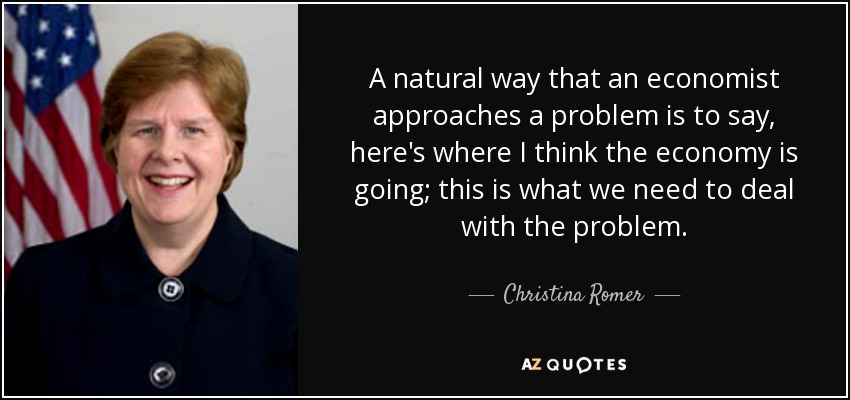
A natural way that an economist approaches a problem is to say, here's where I think the economy is going; this is what we need to deal with the problem.
Raising the minimum wage, as President Obama proposed in his State of the Union address, tends to be more popular with the general public than with economists.
I've felt for some time that economics needs to be taught differently by economists who actually have had experience making a payroll or investing on Wall Street. When economics is taught by pure academics, watch out.
Lunches don't get free just because you don't see the prices on the menu. And economists don't get popular by reminding people of that.
Economists are very good at saying that something cannot go on forever, but not so good at saying when it will stop.
Until the 19th century, the term 'to consume' was used mainly in its negative connotations of 'destruction' and 'waste'. Tuberculosis was known as 'consumption', that is, a wasting disease. Then economists came up with a bizarre theory, which has become widely accepted, according to which the basis of a sound economy is a continual increase in the consumption (that is, waste) of goods
All men have an equal right to the free development of their faculties ; they have an equal right to the impartial protection of that sovereign justice which is called the State ; but it is not true, it is against all tho laws of reason and equity, it is against the eternal nature of things, that the indolent man and the laborious man, the spendthrift and the economist, the imprudent and the wise, should obtain and enjoy an equal amount of goods.
Economists have provided capitalists with a comforting concept called the "free market." It does not describe any part of reality, at any place or time. It's a mantra conveniently invoked when it is proposed that government do something the faithful don't like, and just as conveniently ignored whenever they want government to do something for them.
Economist Frederick Thayer has studied the history of our balanced-budget crusades and has come up with some depressing statistics. We have had six major depressions in our history (1819, 1837, 1857, 1873, 1893 and 1929); all six of them followed sustained periods of reducing the national debt. We have had almost chronic deficits since the 1930s, and there has been no depression since then - the longest crash-free period in our history.
The evolution of government from its medieval, Mafia-like character to that embodying modern legal institutions and instruments is a major part of the history of freedom. It is a part that tends to be obscured or ignored because of the myopic vision of many economists, who persist in modeling government as nothing more than a gigantic form of theft and income redistribution.
Our popular economics writers, however, are not in the business of giving their readers a ringside seat on the research action; with no exception I can think of, they use their books to do an end run around the normal structure of scholarship, to preach ideas that few serious economists share. Often, these ideas are not just at odds with the professional consensus; they are demonstrably wrong, and sometimes terminally silly. But they sound good to the unwary reader.
I can't resist telling you that when the Vienna Economics Institute celebrated its centennial, many years ago, they invited, as their keynote speaker, my father [John Kenneth Galbraith]. The leading economists of the Austrian school- including von Hayek and von Haberler - returned for the occasion. And so my father took a moment to reflect on the economic triumphs of the Austrian Republic since the war, which, he said, "would not have been possible without the contribution of these men." They nodded - briefly - until it dawned on them what he meant. They'd all left the country in the 1930s.
The reality is that we are all economists. We all deal with scarcity as we make choices and calculate how to ration various items and resources that we consume, produce and utilize.
Discovering various economists, economic works, reading financial periodicals and keeping up on current events in geopolitics and economics around the world opened my eyes to many facets of how the extended order works.
Economists and workplace consultants regard it as almost unquestioned dogma that people are motivated by rewards, so they don't feel the need to test this. It has the status more of religious truth than scientific hypothesis. The facts are absolutely clear. There is no question that in virtually all circumstances in which people are doing things in order to get rewards, extrinsic tangible rewards undermine intrinsic motivation.The bonus myth: How paying for results can backfire The world is a dangerous place, not because of those who do evil, but because of those who look on and do nothing.
The policy of letting things alone, in the practical sense that the Government should never interfere with business or go into business itself, is called Laisser-faire by economists and politicians. It has broken down so completely in practice that it is now discredited; but it was all the fashion in politics a hundred years ago, and is still influentially advocated by men of business and their backers who naturally would like to be allowed to make money as they please without regard to the interest of the public.
There is a beauty in discovery. There is mathematics in music, a kinship of science and poetry in the description of nature, and exquisite form in a molecule. Attempts to place different disciplines in different camps are revealed as artificial in the face of the unity of knowledge. All literate men are sustained by the philosopher, the historian, the political analyst, the economist, the scientist, the poet, the artisan and the musician.
It is a misfortune of the times that all of us must needs be amateur economists-including, and perhaps especially, the professionals.
Until the Great Depression, most economists clung to a vision of capitalism as a perfect or nearly perfect system. That vision wasn’t sustainable in the face of mass unemployment, but as memories of the Depression faded, economists fell back in love with the old, idealized vision of an economy in which rational individuals interact in perfect markets.
Congress has always had a soft spot for "experts" who tell members what they want to hear, whether it's supply-side economists declaring that tax cuts increase revenue or climate-change skeptics insisting that global warming is a myth.
Despite the high salaries involved, employing economists is a cost-effective way for banks, and stockbrokers to secure exposure in the media.
At best the principles that economists have supposed the choices of rational individuals to satisfy can be presented as guidelines for us to consider when we make our decisions.
I am not a conservative but I have spoken out for years against the staggering amount blind hatred directed at black conservatives by liberals. Liberals are shockingly quick to demean and dismiss brilliant black people like Rice, Carson, Supreme Court Justice Clarence Thomas, U.S. Senator Tim Scott (R-SC), Professor Walter E. Williams and economist Thomas Sowell because they don't fit into the role they have carved out for a black person in America. Black Americans must be obedient liberals on all things or risk being called a race traitor or an Uncle Tom.
Despite the array of groups and organizations working on global warming, we are still missing a key element: the movement. Along with the hard work of not-for-profit lobbyists, environmental lawyers, green economists, sustainability-minded engineers, and forward-thinking entrepreneurs, it's going to take the inspired political involvement of millions of Americans to get our country on track to solving this problem.
The fundamental differences between Marxian and traditional orthodox economics are, first, that the orthodox economists accept the capitalist system as part of the eternal order of Nature, while Marx regards it as a passing phase in the transition from the feudal economy of the past to the socialist economy of the future.
Follow AzQuotes on Facebook, Twitter and Google+. Every day we present the best quotes! Improve yourself, find your inspiration, share with friends
or simply: