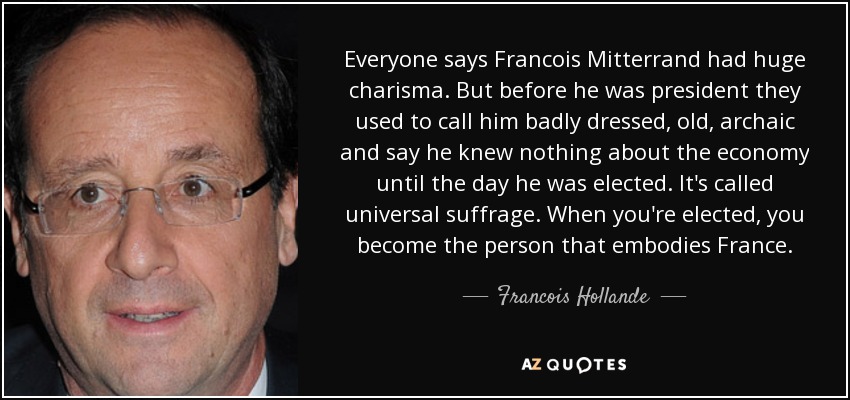
Everyone says Francois Mitterrand had huge charisma. But before he was president they used to call him badly dressed, old, archaic and say he knew nothing about the economy until the day he was elected. It's called universal suffrage. When you're elected, you become the person that embodies France.
Banks should contribute to the real economy, make a positive contribution to economic growth.
The people of the United States don't recognize it, but the oil industry has given the greatest gift to the people of the nation, and that gift is the low cost of energy. Bottom line is this enables the country to be very competitive manufacturing-wise and in the world economy.
You would have thought that our first priority would be to ask what the ecologists are finding out, because we have to live within the conditions and principles they define. Instead, we've elevated the economy above ecology.
The only way to continue to have a robust economy is to out-innovate other nations.
But I think the global economy will understand that the United States has the ability to meet its obligations. But it's not going to be able to do it over the long term if we can't control the growth of government.
We’ve never had a decline in house prices on a nationwide basis. So, what I think what is more likely is that house prices will slow, maybe stabilize, might slow consumption spending a bit. I don’t think it’s going to drive the economy too far from its full employment path, though.
Roughly two billion people participate in the money economy, with less than half of those living in the wealthy countries of the developed world. These affluent 800 million, however, account for more than 75 percent of the world's energy and resource consumption, and also create the bulk of its industrial, toxic, and consumer waste.
The money economy thus leaves a large ecological footprint, defined as the amount of land and resources required to meet a typical consumer's needs. For example, with only about 4% of the world's population, the United States, the largest money economy, consumes in excess of one-quarter of the world's energy and materials and generates in excess of 25 percent of the world's greenhouse gas emissions.
We must surely appear to the world as exactly what we are: a nation that organizes its economy around consuming twice as much oil as it produces, and around the profligate wastefulness of the wars and campaigns required to defend such consumption. In recent years we have defined our national interest largely in terms of the oil fields and pipelines we need to procure fuel.
I think of the old slavery, and of the way The Economy has now improved upon it. The new slavery has improved upon the old by giving the new slaves the illusion that they are free. The Economy does not take people's freedom by force, which would be against its principles, for it is very humane. It buys their freedom, pays for it, and then persuades its money back again with shoddy goods and the promise of freedom. "Buy a car," it says, "and be free. Buy a boat and be free." Is this not the raw material of bad dreams? Or is it maybe the very nightmare itself?
The answers to the human problems of ecology are to be found in economy. And the answers to the problems of economy are to be found in culture and character. To fail to see this is to go on dividing the world falsely between guilty producers and innocent consumers.
The economy is still substantially that of the fur trade, still based on the same general kinds of commercial items: technology, weapons, ornaments, novelties, and drugs. The one great difference is that by now the revolution has deprived the mass of consumers of any independent access to the staples of life: clothing, shelter, food, even water. Air access remains the only necessity that the average user can still get for himself, and the revolution has imposed a heavy tax on that by way of pollution. Commercial conquest is far more thorough and final than military defeat.
The foundation is being laid for the emergence of both wind and solar cells as cornerstones of the new energy economy. World wind generating capacity grew from 7,600 megawatts in 1997 to 9,600 in 1998, an expansion of 26 percent. At a national level, Germany led the way, adding 790 megawatts of capacity, followed by Spain with 380 megawatts, and the United States with 226 megawatts. In the past, U.S. wind generating capacity was concentrated in California, but in 1998, wind farms began generating electricity in Minnesota, Oregon, and Wyoming, broadening the new industry's geographical base.
No matter how advanced our economy might be, no matter how sophisticated our equipment becomes, for the foreseeable future we will still depend on fossil fuels.
I trace the inequality to a particular set of decisions that we took when we lowered the tax rate from 91% down to very low levels at the top, where we stripped away regulations. So the result of that was not a more dynamic economy, but a more unequal society. We tried the experiment of trickle-down. A third of a century later, we can say fairly definitively that it was a failure.
The American economy is driven by small business. And there's nothing basically to create incentives for small businesses. We've done no tax reform. They're the highest-taxed group in the country. And corporations can go anywhere they want and do whatever they want. Small businesses have to stay.
We're the richest economy in the history of the world. For the majority of Americans not to get the benefits of this extraordinarily prosperous economy, there's something fundamentally wrong.
No economy can continue to function when the vast middle class and everybody else don't have enough purchasing power to buy what the economy is capable of producing without going deeper and deeper into debt.
We have to change the whole job structure of America. We have got to basically reorient our economy toward the future.
I think it would be nearly impossible to find someone who has contributed more to South Carolina than Carroll Campbell. His efforts to transform South Carolina's economy and raise our state's income levels are still paying dividends today.
It is a little surprising given the strength of the economy that there is a perception - at least among some of the public - that the economy is not very good.
If we're talking about buying exchanges abroad, we have to have global securities standards, as we have global banking regulations. I'm talking about margins. Now, the United States has certain margin requirements that are not the same in London. Investors and hedge funds that want to borrow more money against securities ? if they can't in the U.S., they go abroad. That could add additional risks to the global economy.
The conditions conducive to deep thought have become increasingly rare in our highly mediated lives... Now we live in an attention economy, where the most in-demand commodity is 'eyeballs.
I cite a good example, say, of agriculture, .. In agriculture we need to move with speed to bring to full utilization the land that is now in our possession. We need to curb aspects of corruption that are endemic in the economy. We need to be transparent in everything that we do. We need to be consistent in implementing the policies we would have agreed. And not implement policies one day and reverse them the other day.
Follow AzQuotes on Facebook, Twitter and Google+. Every day we present the best quotes! Improve yourself, find your inspiration, share with friends
or simply: