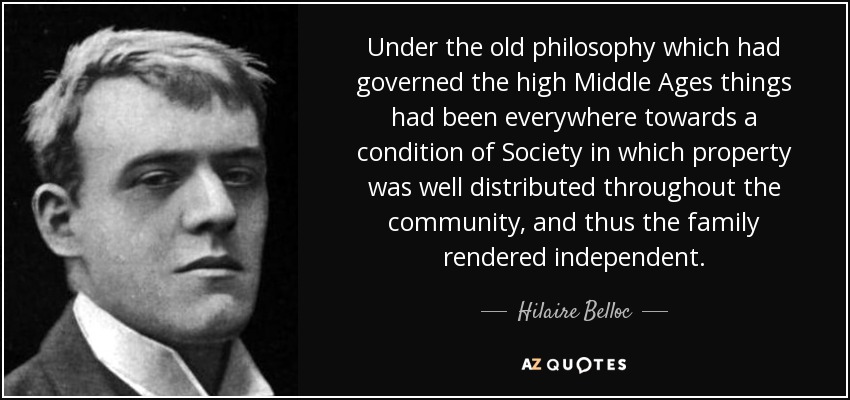
Under the old philosophy which had governed the high Middle Ages things had been everywhere towards a condition of Society in which property was well distributed throughout the community, and thus the family rendered independent.
When the mass of families in a State are without property, then those who were once citizens become virtually slaves. The more the State steps in to enforce conditions of security and sufficiency; the more it regulates wages, provides compulsory insurance, doctoring, education, and in general takes over the lives of the wage-earners, for the benefit of the companies and men employing the wage-earners, the more is this condition of semi-slavery accentuated.
We may not say to the poor: "You have a right to fight the rich merely because they are rich and in order to make yourselves less poor." We may say: "You have a right to fight to prevent the conditions of your life becoming inhuman," but we may not say, "You have a right to fight merely because you desire to have more and your opponent to have less."
Protest against Industrial Capitalism from one aspect or another is universal: so was the protest against the condition of European religion at the beginning of the sixteenth century.
In the midst of all these innumerable forms of a common protest and universal ill-ease there has grown up one definite body of doctrine whose adherents are called Communists and who desired the total subversion of what had been, hitherto unquestioned among civilized European men, the general doctrines of property and individual freedom.
And these great natural rights may be reduced to three principal or primary articles: the right of personal security; the right of personal liberty; and the right of private property; because as there is no other known method of compulsion, or of abridging man's natural free will, but by an infringement or diminution of one or other of these important rights, the preservation of these, inviolate, may justly be said to include the preservation of our civil immunities in their largest and most extensive sense.
When I was Governor, Louis Kelso went out of his way to brief me. I was very impressed, but I was never able to get any of the economists in state government to give him the help his plan deserves.
The whole Jeffersonian ideal was that people are temporarily in government. Government is not the basic reality. People are. The private sector. And government is just a limited power to make things go better.
Wages is a cunning device of the devil, for the benefit of tender consciences, who would retain all the advantages of the slave system, without the expense, trouble, and odium of being slave-holders.
But certainly I didn't know he was doing anything that was criminal.
Our economy is built upon convergent thinkers, people that execute things, get them done. But artists and designers are divergent thinkers: they expand the horizon of possibilities.
When a woman earns a dollar, the payback is higher. She'll invest in her children, in their education, health care, and basic needs. The impact of a woman's role in the economy benefits society at large.
Heads know that failing to invest in good, nutritious food is a false economy and parents won't tolerate reconstituted turkey being put back on the menu.
If all you think we need to do to get this economy going and get this country on the right track is to cut government and reduce taxes, you don't understand America. America is a moral enterprise, not an economic enterprise.
To be a leader in this new economy, you have to love risk-which means patterning your life on the heroic, not on the strategic. Acting boldly is better than acting knowingly.
In an information economy, entrepreneurs master the science of information in order to overcome the laws of the purely physical sciences. They can succeed because of the surprising power of the laws of information, which are conducive to human creativity. The central concept of information theory is a measure of freedom of choice. The principle of matter, on the other hand, is not liberty but limitation- it has weight and occupies space.
The first bill that President Obama signed into law was the Lilly Ledbetter Fair Pay Act. I think it says something about his priorities that the first bill he put his name on has my name on it too. As he said that day with me by his side, "Making our economy work means making sure it works for everyone."
In the 1980s, we were advised, why don't you follow Reaganomics or Thatcherite economics. We said, yes, there are good points, let's see how we can fit them in the Indian economy. Every country has its own way of moving forward.
I do not know that any writer has supposed that on this earth man will ultimately be able to live without food.
The histories of mankind are histories only of the higher classes.
We also know that China and India, as their economies ramp up, are using more and more energy.
Governments of all stripes want to deliver growth and rebalance their economies now that they have learned the hard way that, left to their own devices, markets pick expensive banking losers.
Employ every economy consistent with thoroughness, accuracy and reliability.
Everyone says Francois Mitterrand had huge charisma. But before he was president they used to call him badly dressed, old, archaic and say he knew nothing about the economy until the day he was elected. It's called universal suffrage. When you're elected, you become the person that embodies France.
You know, in a business, you have to operate on the basis of voluntary investment by individuals in a cause. With government, there is no voluntary effort to invest capital. It's just taken and invested. And the same accountability is not at play. The same natural forces in the economy are not at play.
Follow AzQuotes on Facebook, Twitter and Google+. Every day we present the best quotes! Improve yourself, find your inspiration, share with friends
or simply: