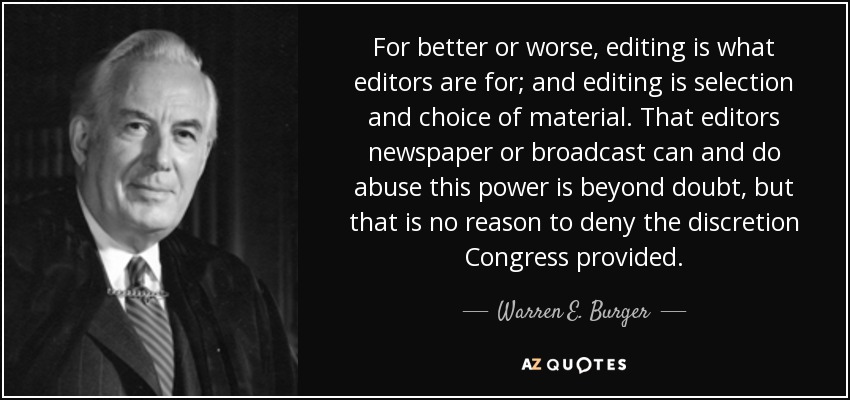
For better or worse, editing is what editors are for; and editing is selection and choice of material. That editors newspaper or broadcast can and do abuse this power is beyond doubt, but that is no reason to deny the discretion Congress provided.
I do believe that the collapse of the traditional media is catastrophic for our democracy, but I wasn't about to mythologize it. I understand its structural flaws, and the lies it tells, which are primarily, but not always, the lies of omission, and I wasn't going to leave that out. Knopf offered to publish the book but they said that an editor was going to "take out all the negativity," which, of course, I wasn't going to accept. I had been paid half my advance, and I had Nation Books buy the manuscript for that half.
I think you either have chemistry or you don't. If you could create chemistry in the editing room then there would be no films without chemistry, obviously, because there are a lot of good editors out there who'd be able to take care of that then if that's how it really worked.
Whenever I visit Korea she [Kang] buys me lunch and takes me to a gallery. As if all this wasn't enough, she has incredible respect for translation as a creative, artistic practice - she insists that each English version is 'our book', offered to share her fees with me when she found out I wasn't getting paid for translating her publicity stuff, always asks the editor to credit me, and does so herself whenever she's interviewed. Too good to be true.
Hours is an understatement. I honestly don't know how the director and editor decide each week what actually makes it on the air. There's of course director and cast commentary on each episode on the DVD. We had a blast recording that.
I read The Vegetarian and fell in love with it. A year later, I was invited to go and speak at the London Book Fair (which I'd never even heard of before), as they were gearing up for Korea being the market focus country in 2014. I met Max Porter there, Kang's editor at Portobello, sent him my sample, and the rest is history.
Be persistent. Editors change; tastes change; editorial markets change. Too many beginning writers give up too easily.
An editor is the uncrowned king of an educated democracy.
I'm thoroughly convinced that editors don't help authors.
The editors are committed to nothing save this: to keep common sense as fast as they can, to belabor sham as agreeably as possible, to give civilized entertainment.
A magazine editor recently asked me to sit down on my 40th birthday and write an article on the most important things I had learned in my first 40 years. I told him that the chief thing I had learned was that the copybook maxims are true, but that too many people forget this once they go out into the heat and hustle and bustle of the battle of life and only realize their truth once one foot is beginning to slip into the grave. The man who has won millions at the cost of his conscience is a failure.
As editor of the largest newspaper in West Virginia, I scan hundreds of reports daily . . . and I am amazed by the frequency with which religion causes people to kill each other. It is a nearly universal pattern, undercutting the common assumption that religion makes people kind and tolerant.
I grew up around fashion - my mom was an editor for Vogue. Compared to the music industry, though, I'd say [fashion] is a little bit more disorganized. But it's exciting for me because, when you're a performer, there is a fashion element.
The lovely thing is, if Marvel had a Spider-Man movie over at Sony or something, they own the rights to the character, and the editors and producers make suggestions and get notes and things. But you're talking about Matthew Vaughn and Jane Goldman. They're two of the best people in the world. The notes are just things like, "This is absolutely brilliant."
Well I've made no secret of my life long love of MAD Magazine, it's probably my first and greatest influence in terms of my comic sensibilities. I've known John [Ficarra] for many years, and we've been friends. About four or five months ago, at a dinner in New York, John made the very nice offer of my being guest editor for an issue of MAD and I thought about it for about half a nanosecond and decided that was a pretty good idea.
Jason Rezaian is finally headed home. He's the correspondent for The Washington Post who was held in Iran for a year and half while U.S. diplomats, his family and his editors worked to win his release. Rezaian was one of the four Americans released from prison in Tehran in a swap for seven Iranians held in U.S. prisons.
Every day is still exciting. I have like a very good system worked out with my editor. Some directors are in there every day, sitting there in the room with the editor. I lose perspective incredibly quickly, and so what I do is I watch...I come in the room and give very specific notes and then I go back to my house or in my office and I watch the dailies.
Sadly, too much has changed about publishing ... not only does attractiveness matter to agents and editors, but there's no room anymore for a reclusive writer.
My role as the chair of the fashion department at Parsons put me face to face with all the big designers, retailers, and editors. Since I was moving in these new circles regularly, I realized I needed to do something about my own personal style. It was really Diane von Furstenberg who gave me the nudge.
The image isn't just created with the camera. That's just part one. The editor gets an imprint. The colorist does something to it. Visual effects does something to it. It's not just what you capture that people are going to see. The image gets made in many ways. In production and then in post.
Having been an editor for more than a decade, I thought I had a good idea of how much work was involved in writing a novel. I was wrong! Writing is a lot harder than I ever imagined - but worth it.
I have wanted to write from a young age, but working with so many gifted authors and editors over the years has taught me so much. I doubt I would be where I am today without that amazing experience.
For my second novel, The Apothecary's Daughter, my editor encouraged me to think of another unusual profession for a woman to have. That led to the main character, Lilly Haswell, who finds herself doing the work of an apothecary at a time when it was illegal for women to do so.
If you ever go to talk to an editor you don't want to be able to turn down a job because you can't do what is necessary.
Comics have a caste system - an editor has to act in a certain way, an artist has to be humble.
Follow AzQuotes on Facebook, Twitter and Google+. Every day we present the best quotes! Improve yourself, find your inspiration, share with friends
or simply: