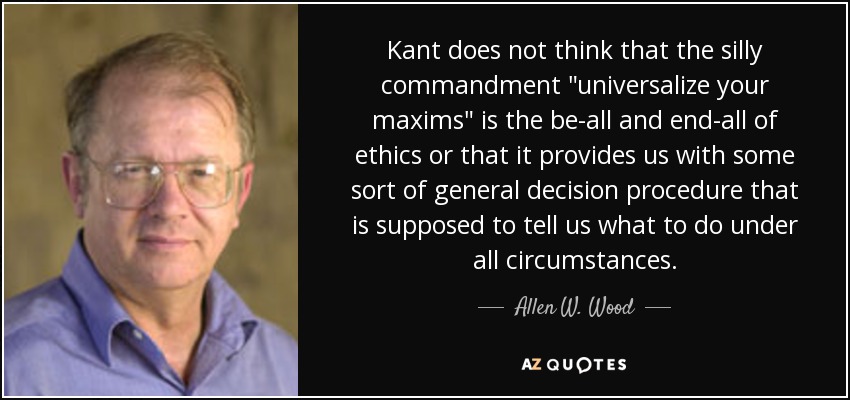
Kant does not think that the silly commandment "universalize your maxims" is the be-all and end-all of ethics or that it provides us with some sort of general decision procedure that is supposed to tell us what to do under all circumstances.
Kant does represents a distinctively modern view of the human condition in contrast to that of ancient high culture, found in ancient Greek ethics and also in ancient Chinese ethics.
Epicureanism did inspire libertine culture in isolated sects, but Epicurus himself rejected an ethics of sensory indulgence, and he would have disowned latter-day 'Epicureanism' as a fussy, expensive, unphilosophical approach to eating and drinking.
We are now returning to the 18th century empirical approach with the new interest in the evolutionary basis of ethics, with 'experimental' moral philosophy and moral psychology. As a result, we understand better why moral formulas are experienced as ineluctable commands, even if there is no commander and even if the notion of an inescapable obligation is just superstition. So moral philosophy has made huge progress.
Being a moral realist I see normative ethics as a search of the truth about our obligations and a search of explanation; the idea is that moral principles can help us to a moral explanation of our particular obligations.
Normative ethics, pursued as a free, systematic, and critical attempt to find moral truth, regardless of religious and other authorities, is a rather new adventure. Let's wait and see what will happen!
I had no kind of work ethic and I always felt that music - especially rock 'n' roll - was a more for boys.
We had a Judeo-Christian ethic hanging around a couple thousand years that didn't help erase racism at all. So the notion of the little half-hour comedy changing things is something I think is silly.
I played with English and Sociology in college but dropped out to work in the anti-war movement. I was going around denouncing the Viet Nam war as immoral but one day it dawned on me that I didn't know what that meant. I signed up for an ethics class at San Francisco State to find out the answer.
Ethics is prescriptive and can change behavior, but usually only at the margins.
I begin with human psychology and then see what we can say about ethics.
In trying to develop an impartial, expansive ethic we are trying to get ethical systems to do something which they did not evolve in order to do. This doesn't mean that it can't be done or that we shouldn't try to expand the reach of our ethical frameworks, only that there are reasons to be skeptical about its success.
From the economy to national security to government ethics, the Republican nominee promised once-in-a-lifetime change if he is elected Nov. 8.
Most people don't have any association in their minds with what they do and with ethics. They think they somehow moved past the questions of morality or values or ethics, and that's something that I've never imagined to be true.
Under a neoliberal regime, the language of authority, power and command is divorced from ethics, social responsibility, critical analysis and social costs.
The prevailing move in American society to a permanent war status does more than promote a set of unifying symbols that embrace a survival of the fittest ethic, promoting conformity over dissent, the strong over the weak, and fear over responsibility, it also gives rise to what David Graeber has called a "language of command" in which violence becomes the most important element of power and mediating force in shaping social relationships.
There is a peak and valley to careers and that includes fame. If you are lucky to ride this wave of fame to a plateau - it won't last there. I guess it is just a blue-collar work ethic that I was raised with.
We saw his [Donald Trump] children appointed this week to formal roles in the transition. A lot of ethics experts looking at that and saying that there is not a blind trust.
Who you really are, is an immaterial soul and the body is an external thing that's sort of an encrustation your soul. So this has important implications for Plotinus' ethics, because his ethics are basically all about encouraging us to turn away from the body and turn towards these higher principles, so universal soul, universal intellect and ultimately the One.
He that has energy enough to root out a vice should go further, and try to plant a virtue in its place.
It is futile to judge a kind deed by its motives. Kindness can become its own motive. We are made kind by being kind.
Honesty pays, but it doesn't seem to pay enough to suit some people.
If it be a sin to covet honor, I am the most offending soul.
We are made wise not by the recollection of our past, but by the responsibility for our future.
In terms of instilling the values of mental toughness and work ethic, discipline is the gift that keeps on giving.
Follow AzQuotes on Facebook, Twitter and Google+. Every day we present the best quotes! Improve yourself, find your inspiration, share with friends
or simply: