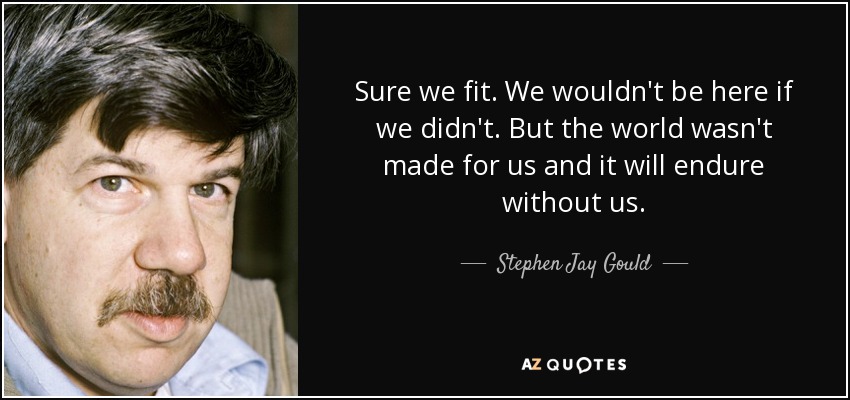
Sure we fit. We wouldn't be here if we didn't. But the world wasn't made for us and it will endure without us.
For Dawkins, evolution is a battle among genes, each seeking to make more copies of itself. Bodies are merely the places where genes aggregate for a time.
Some evolutionists will protest that we are caricaturing their view of adaptation. After all, do they not admit genetic drift, allometry, and a variety of reasons for nonadaptive evolution?
Charles Darwin viewed the fossil record more as an embarrassment than as an aid to his theory.
Einstein's theory of gravitation replaced Newton's, but apples did not suspend themselves in mid-air, pending the outcome. And humans evolved from apelike ancestors whether they did so by Darwin's proposed mechanism or by some other yet to be discovered.
Speciation does not necessarily promote evolutionary change; rather, speciation 'gathers in' and guards evolutionary change by locking and stabilization for sufficient geological time within a Darwinian individual of the appropriate scale. If a change in a local population does not gain such protection, it becomes-to borrow Dawkins's metaphor at a macroevolutionary scale-a transient duststorm in the desert of time, a passing cloud without borders, integrity, or even the capacity to act as a unit of selection, in the panorama of life's phylogeny.
Since we proposed punctuated equilibria to explain trends, it is infuriating to be quoted again and again by creationists-whether through design or stupidity, I do not know-as admitting that the fossil record includes no transitional forms. Transitional forms are generally lacking at the species level, but they are abundant between larger groups.
The literal record was not a hopelessly and imperfect fraction of truly insensible gradation within large populations but an accurate reflection of the actual process identified by evolutionists as the chief motor of biological change. The theory of punctuated equilibrium was, in its initial formulation, little more than this insight adumbrated.
I emphatically do not assert the general 'truth' of this philosophy of punctuational change. Any attempt to support the exclusive validity of such a grandiose notion would border on the nonsensical.
... many folks take them seriously because they just 'know' that evolution can never be seen in the immediate here and now. In fact, a precisely opposite situation prevails: biologists have documented a veritable glut of cases for rapid and eminently measurable evolution on timescales of years and decades.
If evolution almost always occurs by rapid speciation in small, peripheral isolates, then what should the fossil record look like? We are not likely to detect the event of speciation itself. It happens too fast, in too small a group, isolated too far from the ancestral range.
Sigmund Freud often remarked that great revolutions in the history of science have but one common, and ironic, feature: they knock human arrogance off one pedestal after another of our previous conviction about our own self-importance.
Life shows no trend to complexity in the usual sense-only an asymmetrical expansion of diversity around a starting point constrained to be simple.
The modern theory of evolution does not require gradual change. It in fact, the operation of Darwinian processes should yield exactly what we see in the fossil record. It is gradualism that we must reject, not Darwinism.
We have always been involved in spiritual evolution. We are spiritual beings, we have always been spiritual beings and we will always be spiritual beings.
'Time's noblest offspring is the last.' This line of Bishop Berkeley's expresses the real cause of the belief in progress in the animal creation.
Zweck sein selbst ist jegliches Tier. Each animal is an end in itself.
There is not enough evidence, consistent evidence to make it as fact, and I say that because for theory to become a fact, it needs to consistently have the same results after it goes through a series of tests. The tests that they put- that they use to support evolution do not have consistent results. Now too many people are blindly accepting evolution as fact. But when you get down to the hard evidence, it's merely a theory.
You know what, evolution is a myth. ... Why aren't monkeys still evolving into humans?
A new species develops if a population which has become geographically isolated from its parental species acquires during this period of isolation characters which promote or guarantee reproductive isolation when the external barriers break down.
A species consists of a group of populations which replace each other geographically or ecologically and of which the neighboring ones integrate or hybridise wherever they are in contact or which are potentially capable of doing so (with one or more of the populations) in those cases where contact is prevented by geographical or ecological barriers.
All geologic history is full of the beginning and the ends of species-of their first and last days; but it exhibits no genealogies of development.
All Modern Men are descended from a Wormlike creature but it shows more on some people.
An attempt to study the evolution of living organisms without reference to cytology would be as futile as an account of stellar evolution which ignored spectroscopy.
And no one has the right to say that no water-babies exist, till they have seen no water-babies existing; which is quite a different thing, mind, from not seeing water-babies; and a thing which nobody ever did, or perhaps will ever do. But surely ... they would have put it into spirits, or into the Illustrated News, or perhaps cut it into two halves, poor dear little thing, and sent one to Professor Owen, and one to Professor Huxley, to see what they would each say about it.
Follow AzQuotes on Facebook, Twitter and Google+. Every day we present the best quotes! Improve yourself, find your inspiration, share with friends
or simply: