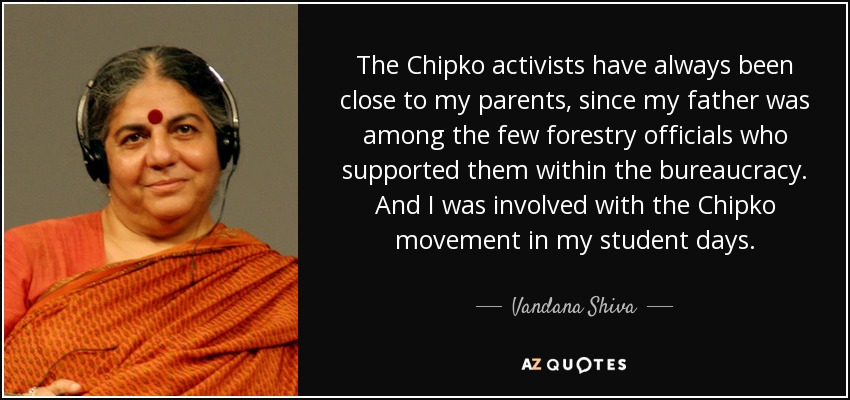
The Chipko activists have always been close to my parents, since my father was among the few forestry officials who supported them within the bureaucracy. And I was involved with the Chipko movement in my student days.
I mean, her father was an alcoholic, and her mother was the suffering wife of a man who she could never predict what he would do, where he would be, who he would be. And it's sort of interesting because Eleanor Roosevelt never writes about her mother's agony. She only writes about her father's agony. But her whole life is dedicated to making it better for people in the kind of need and pain and anguish that her mother was in.
Her [Eleanor Roosevelt] father was the love of her life. Her father always made her feel wanted, made her feel loved, where her mother made her feel, you know, unloved, judged harshly, never up to par. And she was her father's favorite, and her mother's unfavorite. So her father was the man that she went to for comfort in her imaginings.
Well, the reality of her father was that he was a very diseased alcoholic, who died at the age of 34. And one always has to pause to wonder how much you have to drink to die at 34. And he was a really tragic father. I mean, he was absolutely unreliable. He was absolutely involved with various people. He had outside families, outside children, outside wives. He made his wife's life miserable. And she [Eleanor Roosevelt]ignored all of his faults and retained this sense of him as the perfect father.
It's interesting to me that really one of the first things she [Eleanor Roosevelt]did as First Lady was to collect her father's letters and publish a book called The Letters of My Father, essentially, hunting big game, The Letters of Elliott Roosevelt. And it really was an act of redemption, really one of her first acts of redemption as she entered the White House. She was going to redeem her father's honor. And publishing his letters, reconnecting with her childhood really fortified her to go on into the difficult White House years.
I think FDR was very dashing and charming and debonair, and probably reminded her of her father. A great bon-vivant. He loved to party. He loved to sing. He loved to have fun. And he wrote beautiful letters, just as her father did, which - alas and alack - Eleanor Roosevelt destroyed. But she refers to his beautiful letters. And she was charmed by him.
And in the same way, FDR's not much of a father. Although the children in all their memoirs really talk about what a fun-loving guy Dad was, and how brooding and unhappy Mom was. The children sort of blame it all on the mother. Well, this is kind of standard and typical, and aggrieved Eleanor Roosevelt that she was not a happier mother. She wanted to be a happier mother. And I must say, she was a happier grandmother.
It's an awesome feeling being a father, because you never think you can fall in love with something so quickly. It was almost immediate.
I think previously, when fathers and sons argued with each other, they would still face each other and face each other's feelings, but now, the relationships between people has become much more abstracted. I think, actually, in China, the gulf that exists between the pre- and post-internet generations is more vast.
I read Stephen King as a junior high schooler. My father introduced me to Stephen King far too young, which I'm very grateful for now.
It's a whole nother aspect of this life that most people have no idea about. There's the loved ones, the wives, the girlfriends, the children. Some of the people out here are fathers and mothers. Whether you mean to or not, you end up neglecting your family in a lot of ways. Even if you do your best to keep in touch, the fact of the matter is that you're physically absent.
My mom, my father, my little sisters, and my brother - I don't got that much family. I'm not really a family person. I just do my own thing. But I've just been spending time with my mom, especially since the [September motorcycle] accident happened. I drive all the way down there to Georgia just to check up on her. You just get tired of being that person that you thought you were. I don't feel no different. I see the music, because I made it. I don't really see the fame.
I was introduced to skateboarding through my father. He was a surfer back in the 50's & 60's in Hawaii, where my parents grew up. They later moved to California and I was born. Skateboarding was the thing for surfers here in California in the 60's and my Dad immediately made me a homemade board.
Because I know that the early Greeks and Romans and the early Europeans at that age did not see racism as we see it now - because racism was created to justify slavery to build the capital for capitalism - and back in the day they respected talent over race. We had an African Pope in the late 5th century, we had an African Emperor of Rome, and early church Fathers were black.
My father actually lived next door to Hobie Alter [creator of the Hobie catamarans]. So growing up, we had prototypes and experimental things that we could play with; it was just fabulous. I actually bought my first surfboard in junior high. I saved my money.
My father was swallowed alive by his own anus. It was a terrible way to go.
I think my father was sick of being on the sidelines watching a bunch of incompetents in his mind. And in our world, in our business world, these people wouldn't last five minutes in real companies, and he's sick of them making decisions that are costing our children, their children behind them, trillions of dollars and really giving up the great power that we've built up over the last 200 years.
I think a lot of people see, obviously, the business side of my father. But, I mean, he's just a great guy. We enjoyed the holidays so much. To be able to spend time with him when he's not necessarily working or not doing the political thing, I mean, he's much more of a blue collar American.
We always speak very bluntly with father [Donald Trump]. But in the end I think the things that he's saying are things that need to be said. They're conversations that need to be had. There conversations that haven't been had.
I think the fact that father is running now as opposed to in 2012 where he didn't that he's had enough faith in myself and my siblings to be able to run the company.We've got tens of thousands of people that are under his direct employ. Those people, he wouldn't leave a company and leave those people and their lives and everything they've put into it at risk if he didn't think there was competent leadership to take over after him.
In a personal way, to do with family and the father-son relationship, in a kind of artistic way with regard to him being an art student. I also studied the visual arts at Lancaster University. I then decided to become an actor as he was becoming a musician. And then as an actor/performer, we have similar sort of interests - music hall and that whole world. So, there's a lot that I felt connected with.
Assad's mother was a terror. He was terrified of her and she kept saying to him, you're not like your father. That's interesting, but it's useless information. It doesn't tell me anything about how the first and second armored brigades are going to operate.
At one point I took a copy of Berkeley's Principles from my father's library. That was the first philosophy book I read. I found it fascinating and wanted to read more philosophy.
My father was a deeply committed humanitarian. He was a fighter for social justice. He was spirited in the deepest sense.
My father and grandfather were stockbrokers, and they would actually take stock certificates from a vault, give it to a runner, and send it to another vault. Then somebody said, "Let's digitize it and have one vault." Now the DTCC clears and settles almost everything, and the cost of doing a trade is a tenth of what it was before.
Follow AzQuotes on Facebook, Twitter and Google+. Every day we present the best quotes! Improve yourself, find your inspiration, share with friends
or simply: