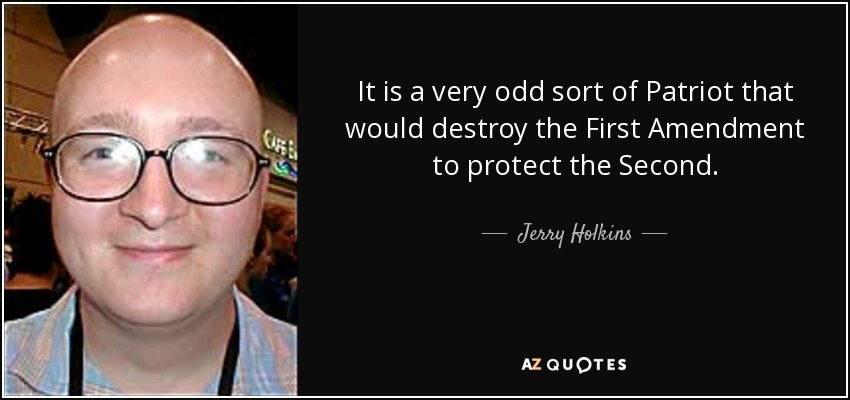
It is a very odd sort of Patriot that would destroy the First Amendment to protect the Second.
There's no way you are going to get rid of the Second Amendment, there's no way you're going to get rid of the First Amendment, and people have to understand how important this is. But I think when they see more and more killings, we have to figure out, of course what we are going to do about it. And I don't think the criminal justice system has an answer.
I begin to feel like I was in the last generation of Americans who took a civics class. I begin to feel like most Americans don't understand the First Amendment, don't understand the idea of freedom of speech, and don't understand that it's the responsibility of the citizen to speak out.
This is what democracy is all about. People have every right to protest whoever's in the White House, without fear of persecution. If this happened in Iran, people would be shot on the streets. This is the United States of America, and we have a First Amendment that protects this kind of speech.
Trump was so different - in a bad way - that I thought the best thing I could do was to resist him. And that's because he was attacking the institutions of our democracy, from the First Amendment and the free press to the judiciary. He was stifling internal dissent, and then he was making false and misleading statements routinely. And to me, that's what takes us down the road to authoritarianism and that's why I decided to start resisting him.
If you have an internet service provider that's capable of slowing down other sites, or putting other sites out of business, or favoring their own friends and affiliates and customers who can pay for fast lanes, that's a horrible infringement on free speech. It's censorship by media monopolies. It's tragic: here we have a technology, the internet, that's capable really of being the town square of democracy, paved with broadband bricks, and we are letting it be taken over by a few gatekeepers. This is a first amendment issue; it's free speech versus corporate censorship.
The First Amendment does not extend to corporations. It's a U.S. government thing. Companies can shut speech down all they want. But the thing is this is destructive. This is discriminatory. And what they're telling themselves is they're making a much more peaceful environment. "We are creating a much more conducive and productive and peaceful environment," when they're not. They're suppressing opinion. They are inflicting their own world view and demanding that it be agreed with and acceded to. And if it's not, you get fired.
False religions like Islam who teach that you must worship this way, are completely opposite with what our First Amendment stands for.
Because of the free speech clause in the First Amendment, which is very clear, "The government shall make no law abridging freedom of speech," and it literally is about political speech. You can say anything you want about politics, a candidate, and the government cannot stop you. And the Democrats hate that.
I think the president, very simply, has never read a copy of the Constitution. I think that that's true. He's just never bothered to read the Constitution, and he just has no understanding and appreciation of the First Amendment's protections for freedom of speech.
Our 1 million members across the country will be watching closely to see if the video game industry hides behind a First Amendment veil in order to exploit children for the sake of corporate profit.
The Constitution, in addition to delegating certain enumerated powers to Congress, places whole areas outside the reach of Congress' regulatory authority. The First Amendment, for example, is fittingly celebrated for preventing Congress from "prohibiting the free exercise" of religion or "abridging the freedom of speech." The Second Amendment similarly appears to contain an express limitation on the government's authority.
A school prayer amendment would confer upon public school boards a power the First Amendment now denies to Congress and the states, that is, the power to establish religion.
I call myself a radical conservative. What's that? Well, let's analyze it. Go to the dictionary. Radical: One who gets to the roots of things. And I'm a conservative because I want to conserve the green of the grass, the potability of drinking water, the first amendment of the Constitution and whatever sanity we have left.
The First Amendment, however, does not say that in every and all respects there shall be a separation of Church and State. Rathe, it studiously defines the manner, the specific ways, in which there shall be no concert or union or dependency one on the other. That is the common sense of the matter. Otherwise the state and religion would be aliens to each other.
The first phrase of the First Amendment spoke to the freedom uppermost in Jefferson's mind when it provided that, 'Congress shall make no law respecting an establishment of religion, or prohibiting the free exercise thereof.' Here a double guarantee could be found: first, that government would do nothing to give official endorsement to a religion or to set one faith above another; second, that government would do nothing to inhibit the freedom of religion.
The men who wrote the First Amendment religion clause did not view paid legislative chaplains and opening prayers as a violation of that amendment... the practice of opening sessions with prayer has continued without interruption ever since that early session of Congress. It can hardly be thought that in the same week the members of the first Congress voted to appoint and pay a chaplain for each House and also voted to approve the draft of the First Amendment... (that) they intended to forbid what they had just declared acceptable.
Every public elementary school ought to welcome Good News Clubs. Parents appreciate them; children love them; and the First Amendment protects them. The First Amendment requires that similar groups be provided with equal treatment. Religious speech is not a disability. It is our preeminent freedom.
The First Amendment...does not say that in every respect there shall be a separation of Church and State....Otherwise the state and religion would be aliens to each other - hostile, suspicious, and even unfriendly....The state may not establish a 'religion of secularism' in the sense of affirmatively opposing or showing hostility to religion, thus preferring those who believe in no religion over those who do believe.
The word 'free' is used three times in the Declaration of Independence and once in the First Amendment to the Constitution, along with 'freedom.' The word 'fair' is not used in either of our founding documents.
But the United States is neither a Christian nation nor the exclusive home of any particular religious group. Non-Christians are not guests. We are as much hosts as any Mayflower-descendant Protestant. It is our home as well as theirs. And in a home with so many owners, there can be no official sectarian prayer. That is what the First Amendment is all about, and the first act by the new administration was in defiance of our Constitution.
Concerning First Amendment fetishism - A federal subsidy for a photo of a crucifix suspended in a jar of urine is fine, but religious figures on stamps are offensive.
No one understands that the First Amendment is only important if you are going to offend somebody. If you're not going to offend somebody, you don't need protection of the First Amendment.
I'm a big supporter of the Second Amendment. But I think I have a First Amendment right not to be shot.
The First Amendment of the US Constitution ... is an eloquent repudiation of the First Commandment's prohibition of religious freedom. It is also a repudiation of the Third Commandment's prohibition of freedom of speech. The Thirteenth Amendment repudiates the institution of slavery which is so cozily assumed by the Fourth and Tenth Protestant Commandments.
Follow AzQuotes on Facebook, Twitter and Google+. Every day we present the best quotes! Improve yourself, find your inspiration, share with friends
or simply: