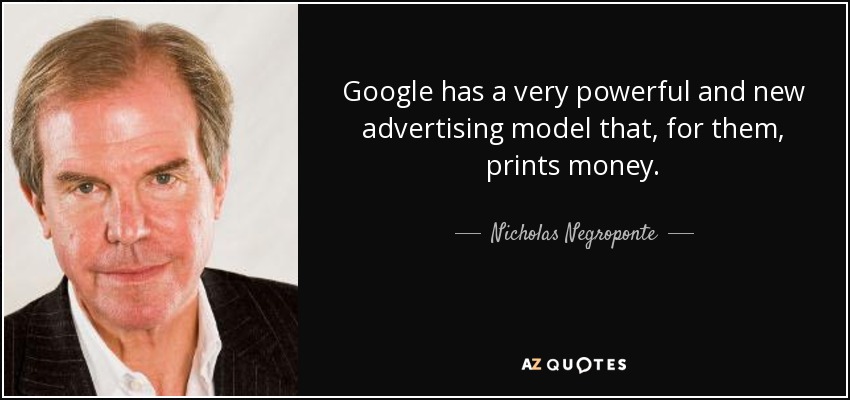
Google has a very powerful and new advertising model that, for them, prints money.
If you're worried about messaging, people will just move to something else. You know if you legislate against Facebook and Apple and Google and whatever else in the US, they'll just use something else. So are we really safer then? I would say no. I would say we're less safe, because now we've opened up all of the infrastructure for people to go wacko at.
I think people need to understand that deep learning is making a lot of things, behind-the-scenes, much better. Deep learning is already working in Google search, and in image search; it allows you to image search a term like "hug."
Actually, we did a fun April Fools' thing with Google a couple of years ago, which we called Virgle. And we looked for volunteers to go on a one-way trip to Mars.
The last thing I need is for daughter to move back into my basement and become another unemployed millennial statistic. Would love for her to get a job at Facebook. Become the president of Google.
My prediction is that in the same way that Google is an intent revealing service that can be monetized that way, I would think that if I were at Twitter, I would focus on the search aspect of Twitter, because people are revealing intents when they do a search.
In fact, when I come up with an idea for a parody I try to resist the urge to Google the idea to see if someone has done it already because the answer is almost always, "Yes, of course they have, they've thought of it!"
The great thing about Google is that you type in neuro-surgery and somehow you end up with Peter Sellers or watching Frank Sinatra. Google is a great resource.
It's unreal. I mean, the dog backflips. It's amazing. Google Jumpy on YouTube - I had seen the dog first and I was like, "Y'all don't even know."
Computers allow us to squeeze the most out of everything, whether it's Google looking up things, so I guess that tends to make us a little lazy about reading books and doing things the hard way to understand how those things work.
Don't forget that SlideShare is indexed by Google. Great opportunity to appear in search results.
You can make something big when young that will carry you through life. Look at all the big startups like Microsoft, Apple, Google, Facebook, Twitter, etc. They were all started by very young people who stumbled on something of unseen value. You'll know it when you hit a home run.
There is more interest in what is occurring in technology companies that impact news. Such companies don't have the same sense of transparency about what they do. They have a tradition of secrecy about products, mores and decision-making that goes along with Silicon Valley and intellectual property and technology. You cannot step onto the grounds of Google without signing a Non-Disclosure Agreement. That industrial secrecy mentality exists along with a theoretical sensibility about transparency on the Web, which is different than transparency inside companies that profit from the Web.
The Internet, and Google, and everything that goes along with that is awesome for some things, but not so awesome for other things. Because everything gets leaked nowadays.
Artificial intelligence would be the ultimate version of Google. The ultimate search engine that would understand everything on the Web. It would understand exactly what you wanted, and it would give you the right thing. We're nowhere near doing that now. However, we can get incrementally closer to that, and that is basically what we work on.
Google will fulfill its mission only when its search engine is AI-complete. You guys know what that means? That's artificial intelligence.
Google’s objective is to organize the world’s information and to make it accessible. Unicode plays a central role in this effort because it is the principal means by which content in every language can be represented in a form that can be processed by software. As Unicode extends its coverage of the world’s languages, it helps Google accomplish its mission.
We are a consumer company and our success is directly linked to our users trusting us. Therefore we have the same incentive as the user: they want to see relevant advertising so their experience of Google is positive and we want to deliver it.
Let's face it: Engineering companies in general have more men than women. Google has tried really hard to recruit women. On the other hand, we have a standard. Google tries to recruit the best engineers.
But to value every company as if they are the next Google, rather than valuing them all as if one of them might be, is pretty much the definition of a bubble.
There have been women who stumbled across Feministing randomly, through a bizarre Google search or something, and had no idea what feminism was. They thought it was something older women do, or bought into the hairy bra-burning man-hating stereotype 100 percent. Anything that deviates from that is very exciting for them.
I would much rather have 1,000 visitors click over to my website via a podcast interview that I’ve done on someone else’s website than have 1,000 search result visitors from Google. Anyday.
I am about as pro-Google a person as you're going to find in the media. I've had friends at all levels of the company since its founding, and still do now.
Click-throughs on a video are often much higher than a standard website listing on the front page of Google. If you see a video in the Google results... it stands out a lot more than a regular website listing does, so [it] tends to attract more clicks.
History shows fans want consolidation; you see it across the web every place. The big players are people like Google, Amazon, eBay, Facebook.
Follow AzQuotes on Facebook, Twitter and Google+. Every day we present the best quotes! Improve yourself, find your inspiration, share with friends
or simply: