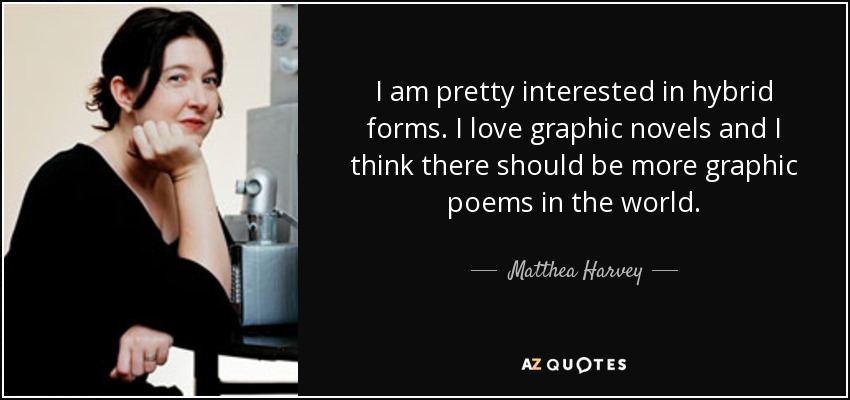
I am pretty interested in hybrid forms. I love graphic novels and I think there should be more graphic poems in the world.
The graphic novel? I love comics and so, yes. I don't think we talked about that. We weren't influenced necessarily by graphic novels but we certainly, once the screenplay was done, we talked about the idea that you could continue, you could tell back story, you could do things in sort of a graphic novel world just because we kind of like that world.
I'm hoping to develop a lot of graphic novels and television shows and films and animation. I've got my hands in a lot of different things!
I felt there was a certain amount of violence in the graphic and that it could still be cheated on screen so you could still have a hard PG-13 and open up your audience. Anybody can read the graphic novel. If you're 14, you can go out and buy it, and I felt that if you're 14 you should be able to see this movie [The Loosers].
I've always been really impressed with some of the longer graphic novels and thought it would be really amazing if one day I could try something like that.
I've no objection to the term 'graphic novel,' as long as what it is talking about is actually some sort of graphic work that could conceivably be described as a novel. My main objection to the term is that usually it means a collection of six issues of Spider-Man, or something that does not have the structure or any of the qualities of a novel, but is perhaps roughly the same size.
Considering my specialization in architecture, I'm not surprised that the first graphic novel to thoroughly engage, not to say captivate, me is Chip Kidd and Dave Taylor's 'Batman: Death by Design.'
I think with something like Watchmen you can genuinely call that a graphic novel because it has the weight and the intent of a proper novel and it also is the complete story.
Playing Destroyo, who was sort of a 'Silence Of The Lambs' type character, I'd say I was wearing about 50 pounds of rubber and foam rubber and makeup. But I had no idea who The Tick was. I'm not a big graphic-novel guy. I don't even know if 'The Tick' was a graphic novel!
I would love to collaborate on a graphic novel with an artist - I'm terrible at drawing but I really love that genre.
That pompous phrase (graphic novel) was thought up by some idiot in the marketing department of DC. I prefer to call them Big Expensive Comics.
There were [in Wilson] a lot of clues in it that you don't normally get, you know, normally you use your imagination or whatever, you get some clues in the script, of course, but yeah, it was really helpful, and I really like the graphic novel. There's stuff in there, there's a couple things in there I really wanted to use that they couldn't get in the movie, but it's definitely, he's a unique guy, you know, I never read a character like this before.
Comics are actually dubbed by euphemistic label of graphic novel, which became a big deal.
You can make your superhero a psychopath, you can draw gut-splattering violence, and you can call it a "graphic novel," but comic books are still incredibly stupid.
Most - and I mean maybe 99% or more - graphic novels are simply fat comicbooks. The term is a bogus, cocked-up concept some marketing whizkid conceived to get comics on the shelves of bookstores.
I often notice how students can gain the capacity to use certain critical methodologies through engaging with very different texts - how a graphic novel about gentrification and an anthology about Hurricane Katrina and a journalistic account of war profiteering might all lead to very similar classroom conversations and critical engagement. I'm particularly interested in this when teaching law students who often resist reading interdisciplinary materials or materials they interpret as too theoretical.
Whenever summer rolls around I begin to realize that I'm a complete and utter book snob. In relation to reading, I have absolutely no guilty pleasures at all. No graphic novels. No murder mysteries. My summer read is really no different from my winter read. I know many bookshops and magazines would have me believe that our summer forays are different, but literature is literature, and unfortunately snobbery is snobbery.
I think reading has got so many more enemies now that graphic novels have kind of flipped over to that side.
If you look at the whole world now it's just computer games, graphic novels, film, TV spinoffs, spinoffs of spinoffs like Deadpool spinning off of Wolverine. So I think that any kind of smart producer looks at all of those bases. Once it comes down to the integrity of it audiences are very smart, they smell that they're just kind of being played.
The language in a comic book or a graphic novel and the cinematographic language are really not the same language. They are false brother and sister. It's not at all the same.
We [Rodriguez and Frank Miller] wanted to take the movies and turn them into a graphic novel, so that people wouldn't even know what they were looking at. It's still visual storytelling, but it's approached completely different. The two mediums don't have to be separate mediums. They can be one and the same.
Just look at the cinema itself: It's comprised of lots of movies about graphic novels, and if you're not 20 years old and wearing a cape and a mask and white, you're out of business. Today's cinema is a proliferation of comedies, which are in some ways creating caricature images. They're one-dimensional.
I wrote a graphic novel called 'Soul Stealer' with big, beautiful, epic artwork by Chris Shy. It grew into a trilogy.
Julio's Day is a story of one man's life, but it's a great more than that as well. It's the story of the life of a century, also told as if a day. Beginning with Julio's birth in 1900 and ending with his death in 2000, the graphic novel touches on most of the major events that shaped the 20th century.
Today, although as a whole, the industry is still male-dominated, more women are drawing comics than ever before, and there are more venues for them to see their work in print. In the 1950s, when the comic industry hit an all-time low, there was no place for women to go. Today, because of graphic novels, there's no place for aspiring women cartoonists to go but forward.
Follow AzQuotes on Facebook, Twitter and Google+. Every day we present the best quotes! Improve yourself, find your inspiration, share with friends
or simply: