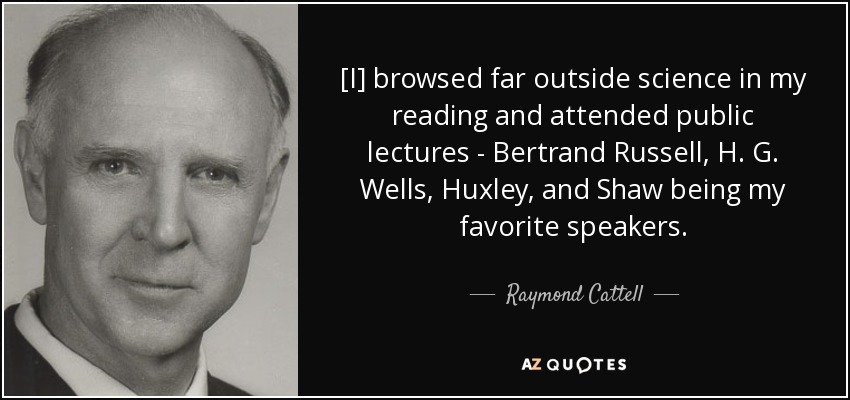
[I] browsed far outside science in my reading and attended public lectures - Bertrand Russell, H. G. Wells, Huxley, and Shaw being my favorite speakers.
And I will add this point of merely personal experience of humanity: when men have a real explanation they explain it, eagerly and copiously and in common speech, as Huxley freely gave it when he thought he had it. When they have no explanation to offer, they give short dignified replies, disdainful of the ignorance of the multitude.
Aldous Huxley took the drug mescaline and then chronicled his experience in the book The Doors of Perception. Now, I don't actually think that's the first thing he wrote: he probably wrote 'my brain is melting' ten thousand times, but it was the book that the critics latched on to.
Science is being daily more and more personified and anthromorphized into a god. By and by they will say that science took our nature upon him, and sent down his only begotten son, Charles Darwin, or Huxley, into the world so that those who believe in him, &c.; and they will burn people for saying that science, after all, is only an expression for our ignorance of our own ignorance.
You have to realize the truth of biologist Julian Huxley's idea that 'Life is just one damn relatedness after another' "So you must have the models, and you must see the relatedness and the effects from the relatedness.
I brought something back from those experiences [with drugs] which made me softer, open to other ideas. And I've learned from listening to other people talk about their experiences, from listening to Bill Hicks or reading Terrence McKenna or Aldous Huxley and Timothy Leary. But there's always some dumb cop out there who says "We don't need another legal drug and there's psychological addiction and blah blah blah."
[Thomas Henry] Huxley, I believe, was the greatest Englishman of the Nineteenth Century—perhaps the greatest Englishman of all time. When one thinks of him, one thinks inevitably of such men as Goethe and Aristotle. For in him there was that rich, incomparable blend of intelligence and character, of colossal knowledge and high adventurousness, of instinctive honesty and indomitable courage which appears in mankind only once in a blue moon. There have been far greater scientists, even in England, but there has never been a scientist who was a greater man.
I know these are going to sound like school reading-list suggestions, but if you like dystopian fiction, you should check out some of the originals: Anthem, by Ayn Rand; 1984, by George Orwell; or Brave New World, by Aldous Huxley.
It's really hard to write a screenplay, it's nauseating. All those great writers that tried to write screenplays, they couldn't do it, most of them - John Faulkner, whoever, Aldous Huxley.
"Agnostic" is a much more recent word than "atheist", coined by Thomas Huxley in 1869 to mean "without knowledge of God" and acquiring the usage of "being doubtful about the existence of God."
[One of my kids ]is not named after Aldous Huxley. I haven't even read Brave New World!
I think the fact that Aldous Huxley wrote Brave New World and talked about anthrax bombs probably helped because at least we... people had the understanding before the war began that's something we didn't want to get into.
I used to wonder: Is Huxley right or is Orwell right? It turns out they're both right. First you get the new world state and endless diversions as you are disempowered. And then, as we are watching, credit dries up, and the cheap manufactured goods of the consumer society are no longer cheap. Then you get the iron fist of Oceania, of Orwell's 1984.
Writers like Aldous Huxley and George Orwell have imagined the sort of scientific utopia which is coming to pass, but already their nightmare fancies are hopelessly out of date. A vast, air-conditioned, neon-lighted, glass-and-chromium broiler-house begins to take shape, in which geneticists select the best stocks to fertilise, and watch over the developing embryo to ensure that all possibilities of error and distortion are eliminated.
There's a joke in everything, the trick is finding it. The best compliment a joke can get is what Huxley said about Darwin's theory of evolution - 'Why didn't I think of that?'
One of the most intensely unlikeable figures of the twentieth century, fanatical anti-Semite, enemy of labour unions and proud recipient of medals from Nazi Germany, where Hitler held him in veneration, Henry Ford was also an employer who paid his workers more than his competitors, an innovator who pioneered the assembly line and a visionary whose part in the creation of the twentieth century was so great that Aldous Huxley, in his Brave New World, prefigured a society whose calendar was divided into BF and AF-Before Ford and After Ford.
Even time is a concept. In reality we are always in the eternal present. The past is just a memory, the future just an image or thought. All our stories about past and future are only ideas, arising in the moment. Our modern culture is so tyrannized by goals, plans, and improvement schemes that we constantly live for the future. But as Aldous Huxley reminded us in his writings, "An idolatrous religion is one in which time is substituted for eternity...the idea of endless progress is the devil's work, even today demanding human sacrifice on an enormous scale.
The greatest artists, saints, philosophers, and, until quite recent times, scientists... have all assumed that the New Testament promise of eternal life is valid.... I'd rather be wrong with Dante and Shakespeare and Milton, with Augustine of Hippo and Francis of Assisi, with Dr. Johnson, Blake, and Dostoevsky than right with Voltaire, Rousseau, the Huxleys, Herbert Spencer, H. G. Wells, and Bernard Shaw.
Perhaps the greatest lesson [Huxley] learned from reading Carlyle was that real religion, that emotive feeling for Truth and Beauty, could flourish in the absence of an idolatrous theology.
A man got up [after one of Huxley's 'sermons'] and said 'they had never heard anything like that in Norwich before'. Never 'did Science seem so vast and mere creeds so little'.
People complain of the unequal distribution of wealth [but it is a far greater] injustice that any one man should have the power to write so many brilliant essays... There is no one who writes like [Thomas Huxley].
I would trade all the advantages of humanity to be a fly on the wall when Franklin and Jefferson discussed liberty, Lenin and Trotsky revolution, Newton and Halley the shape of the universe, or when Darwin entertained Huxley and Lyell at Down.
Too often critics seem more intent on seeking new ways to alter Congress than to truly learn how it functions. They might well profit from the advice of Thomas Huxley, who said a century ago: Sit down before facts as a little child, be prepared to give up every preconceived notionor you shall learn nothing.
'The scientific method,' Thomas Henry Huxley once wrote, 'is nothing but the normal working of the human mind.' That is to say, when the mind is working; that is to say further, when it is engaged in correcting its mistakes.
Mr. [Aldous] Huxley has been the alarming young man for a long time, a sort of perpetual clever nephew who can be relied on to flutter the lunch party. Whatever will he say next? How does he think of those things? He has been deplored once or twice, but feeling is in his favor: he is steadily read. He is at once the truly clever person and the stupid person's idea of the clever person; he is expected to be relentless, to administer intellectual shocks.
Follow AzQuotes on Facebook, Twitter and Google+. Every day we present the best quotes! Improve yourself, find your inspiration, share with friends
or simply: