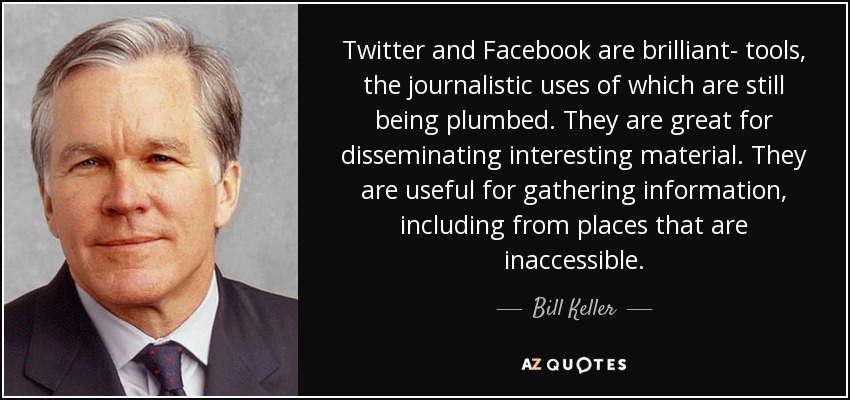
Twitter and Facebook are brilliant- tools, the journalistic uses of which are still being plumbed. They are great for disseminating interesting material. They are useful for gathering information, including from places that are inaccessible.
Other people have all kinds of information about you that is invisible to you. How do you get feedback?
I don't mind close-ups, I like them, but they're kind of forceful - you see a lot, you get a lot of information in a close-up. There's less mystery.
Macroeconomics, even with all of our computers and with all of our information - is not an exact science and is incapable of being an exact science.
Our fellow-citizens think they have a right to full information, in a case of such great concernment to them. It is their sweat which is to earn all the expenses of the war, and their blood which is to flow in expiation of the causes of it.
For me, with any character, there are different ways that you approach understanding him, and in this film in particular, because I had the novel to refer to. It's always really helpful to have all of that information and all of those hundreds more words which give you an idea into the background and your character and all.
Innovation comes only from readily and seamlessly sharing information rather than hoarding it.
Comedy makes everything accessible. Watching the news is kind of like being fed your evening pill. What's fun about it? Nothing. And so if you can get news and information about things going on in the world through a comic platform, everything's going to connect.
This impressed me when I was the editor of the Sunday Times [of London] - we had the "Bloody Sunday" killings of 13 unarmed civilians by British paratroopers. We interviewed 500 people for our report, and not one of them could give us a total picture of what was happening. It was like the Rashomon effect multiplied a million times. For a website or even a newspaper to be a collector of information flow is not the highest form of journalism.
If I want to spend the rest of my life reading one day's output of information, which is about what it would take, OK fine. But I personally prefer calibration from an aggregator or newspaper, where the No. 1 story is one they consider important, [and] they're usually right.
It's a fascinating time, I think. I do believe that with all the qualifications I've said - [such as] the uncertain accuracy of the web - nonetheless the access to speeches, documents is unparalleled with the ease of gathering information. If I had had that access when I was an editor or coming up, it would have made my life so much easier. As it was, everything took so much longer.
I find it more credible, since it is anterior information, that one man should know heaven, as the Chinese say, than that so many men should know the world.
The main importance of Francis Bacon's influence does not lie in any peculiar theory of inductive reasoning which he happened to express, but in the revolt against second-hand information of which he was a leader.
We have reached the point where we are now possessed of sufficient information for each individual human to dare to exercise the option to "make it" rather than having to depend on the decisions of an educated elite.
I was certain that some people, whether by accident of birth or some pecularity of training, could tune in to another source of information and could know things about people we didn't think were possible to know.
The role of a librarian is to make sense of the world of information. If that's not a qualification for superhero-dom, what is?
It is in the nature of human beings to bend information in the direction of desired conclusions.
Too much information is rather deadening.
Information overload will lead to 'future shock syndrome' as an individual will suffer severe physical and mental disturbances.
You don't get to cut that chain of evidence and start over. You're always going to be pursued by your data shadow, which is forming from thousands and thousands of little leaks and tributaries of information.
Knowledge resides in the user and not in the collection. It is how the user reacts to a collection of information that matters.
Some of you may think that you are not of interest because you don't have access to classified information. You are mistaken.
The information I most want is in books not yet written by people not yet born.
Lying is a deliberate choice to mislead a target without giving any notification of the intent to do so. There are two major forms of lying: concealment, leaving out true information; and falsification, or presenting false information as if it were true.
The greatest challenge Internet users face is information overload.
Follow AzQuotes on Facebook, Twitter and Google+. Every day we present the best quotes! Improve yourself, find your inspiration, share with friends
or simply: