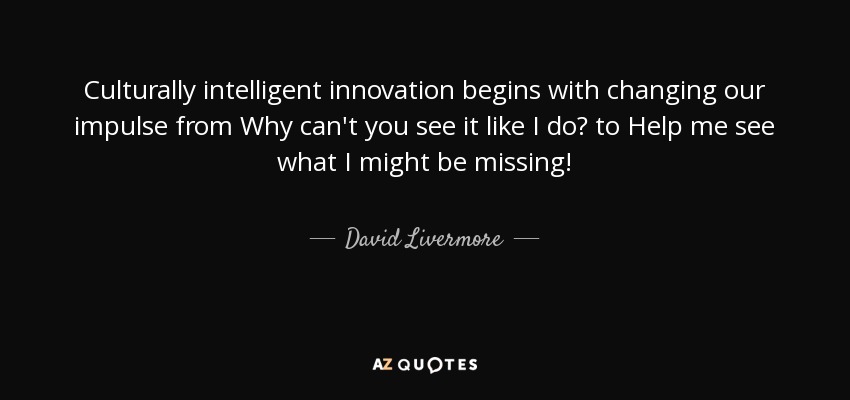
Culturally intelligent innovation begins with changing our impulse from Why can't you see it like I do? to Help me see what I might be missing!
Whitney proved to be a competent manufacturer, but wasn't an original inventor to any important degree. Thomas Blanchard was a true genius: his stock making machine was the daddy of all the industrial profiling machinery, like the 1870s universal milling machine, that was the especial American contribution to machining technology. By that time, the British conceded that machinery innovation had shifted to America.
I have called this phenomenon of stealing common knowledge and indigenous science "biopiracy" and "intellectual piracy." According to patent systems we shouldn't be able to patent what exists as "prior art." But the United States patent system is somewhat perverted. First of all, it does not treat the prior art of other societies as "prior art." Therefore anyone from the United States can travel to another country, find out about the use of a medicinal plant, or find a seed that farmers use, come back here, claim it as an invention or an innovation.
We have to build movements in the face of trade retaliation on the basis of people's democratic rights, on the basis of an ancient heritage of collective innovation. We work from the grassroots all the way to the national government and the World Trade Organization. It basically means being very multidimensional in our campaigns. And that is where part of the fun is. It involves both resistance and creativity. It involves constructive action, while at the same time saying "no."
Creativity and Innovation produces better comics.
I would agree with you that there's 90% imitation and 10% innovation. That's true of any genre.
Wherever I am in the world I want to be creating new projects and innovations, which are exciting and make a difference to communities.
We need innovation. We need great ideas that can be simply and effectively produced all over the place.
We wanted to see how access to care can be expanded and service quality can be improved when one uses a participatory approach to program development. We showed that major changes become possible if you work in a participatory manner, listen to local people, diagnose what the problems are, provide training and identify where there are opportunities for mobilizing local resources to take action. In time leaders from other municipalities expressed interest in replication and the project succeeded in expanding innovations to three other areas.
In the late 60s, 70s and possibly early 80s, social scientists were interested in researching the diffusion of innovation and studying the link between applied research and policy and program development. Recently there has been less interest in these issues and we feel that this interest must be rekindled.
I would like to see policy makers and international donor agencies realize that it is not enough to give money for demonstration projects. From the very beginning plans should be made for the scaling-up of successful innovations.
We should all seek to innovate, or be curious about innovation. Innovation truly is one of our greatest gifts.
The combination of moral intentionality and human innovation is a powerful force. And that's the force behind the humane economy. By embracing its tenets, we help animals, but we also advance commerce in a more sustainable, and profitable, way. I think we have every reason to believe it is the way of the future.
Innovation grows out of membership and a sure sense of responsibility people feel for their work and the organizations that employ them.
More broadly, Prime Minister Lee [Hsien Loong] and I will work to advance the US-Singapore partnership across the board. We're committed to sustaining the dynamism of our economies with the Trans-Pacific Partnership - the highest-standard trade agreement ever - which will support trade and innovation in both our countries.
Over the past eight years, the United States has worked hard to deepen partnerships across the region and across South-east Asia in particular. We're now a part of the East Asia Summit and we have a strategic partnership with Asean. At the US-Asean Leaders Summit I hosted earlier this year in Sunnylands, California, we agreed to a set of principles that will shape the future peace and prosperity of the region, from promoting innovation and furthering economic integration to addressing transnational challenges like global health security and climate change.
Silicon Valley, after all, feeds off the existence of computers, the internet, the IT systems, satellites, the whole of micro electronics and so on, but a lot of that comes straight out of the state sector of the economy. Silicon Valley developed, but they expanded and turned it into commercial products and so on, but the innovation is on the basis of fundamental technological development that took places in places like this [MIT] on government funding, and that continues.
I think people make innovation much more complicated than it needs to be.
I've come to the conclusion that the core characteristic that separates companies that get innovation from those that don't is a simple word: curiosity.
Anytime you see a constrained market, where consumption is limited to those who have special skills or are wealthy, that signals an opportunity for innovation.
One of the biggest mistakes large companies make is creating innovation teams that mirror all the functions of the core business. Those teams make no progress because they spent forever updating each other on what they are doing versus really crushing the most critical problems they need to address.
Nearly all of the advances in structural and aesthetic innovation is coming from abroad.
By nature, men are nearly alike; by practice, they get to be wide apart.
The more you think, the more time you have.
We know that the nature of genius is to provide idiots with ideas twenty years later.
Follow AzQuotes on Facebook, Twitter and Google+. Every day we present the best quotes! Improve yourself, find your inspiration, share with friends
or simply: