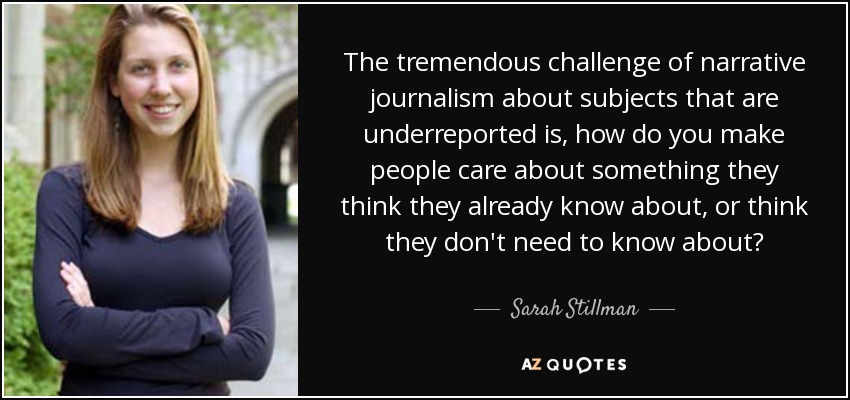
The tremendous challenge of narrative journalism about subjects that are underreported is, how do you make people care about something they think they already know about, or think they don't need to know about?
You can't be wrong in journalism. Take a wrong turn in journalism, and you are writing fiction. You can take a wrong turn in poetry, and something wonderful can happen.
Which is one of the dangers of immersion journalism: you can find yourself getting sucked into battles you have nothing to do with, in this case an ongoing battle between Muslims.
The fun thing about journalism is if you go do a story about something, you can now ask three intelligent questions about it. Or say three intelligent things. And that gets people talking.
As journalism dies, I kind of feel like I want some skills besides writing. I'd like to be able to write movies or host TV shows or whatever. Things that I might actually not inherently like quite as much, but are interesting and fun things to do. A good backup plan.
I write about how I was attracted to stripping because I didn't feel comfortable with my body, for instance, but there could be plenty of not-so-good reasons why I chose to go into journalism, too. Maybe someone had a trauma in childhood and it led them to become a nurse, or a lawyer, but because people stigmatize sex work they try to find a traumatic moment in your past and say, "There!"
In my second year of Harvard Divinity School, where I was studying to be a minister like my father, I met a guy named Robert Cox, who had been the editor of the Buenos Aires Herald during the Dirty War in Argentina. Bob used to print the names of those who had been disappeared the day before, above the fold in his newspaper. It was a kind of an awakening to me to see what great journalism can and should do.
WikiLeaks combines several of my prior interests in technology, policy questions, and journalism.
I hated the culture [working in the bank], I hated the work. I very quickly realized that this wasn't what I wanted to do. So, after two years, I took some writing courses - I always loved to write - and I figured the only way I was going to get paid to write was in journalism.
Also, and this may sound naïve, but since my early days in journalism, I've felt that getting as close as possible to truth, revealing the reality of a situation in detail, has its own persuasive power. This allows readers to look at the facts and the perspectives presented and draw informed conclusions.
Generally I try to read anything but indie rock journalism or anything about music at all, especially in the summer.
There is a very big difference between American and British travel journalism, and that's this whole business of the assisted or freebie trip. In Britain we are unashamed about any travel company paying for you to go and then writing about it. That's the only way we can do it. But I have tried the same in the States, and I can't write for any sizeable American newspaper because they tell you to do it on this basis.
It's important to remember that the future of quality journalism is not dependent on the future of newspapers. The discussion needs to move from "How do we save newspapers?" to "How do we save and strengthen journalism?" - however it is delivered.
I've talked about how the future of journalism will be a hybrid future where traditional media players embrace the ways of new media (including transparency, interactivity, and immediacy) and new media companies adopt the best practices of old media (including fairness, accuracy, and high-impact investigative journalism).
As the newspaper industry continues to contract, one of the most commonly voiced fears is that serious investigative journalism will be among the victims of the scaleback. And, indeed, many newspapers are drastically reducing their investigative teams.
The Huffington Post Investigative Fund's goal is to produce a broad range of investigative journalism created by both staff reporters and freelance writers, with a focus on working with the many experienced reporters and writers impacted by the economic contraction. The pieces will range from long-form investigations to short breaking news stories and will be presented in a variety of media - including text, audio, and video.
Moving forward, investigative journalists need to train themselves to be media amphibians - just as comfortable with the classic verities of great journalism as they are with video, Twitter, Facebook, and, most importantly, citizen journalism.
I'm a girl from South Carolina. I was raised in a middle class family and decided to major in broadcast journalism and now I'm at the national level and that doesn't happen to most people and I realize that. I know that I'm very fortunate but this great country allowed that to work in my favor.
It's very hard in our adversarial society to find a third view. Take journalism, where everything is always presented as one person against another: "Now we're going to hear the opposing view." There is never a third view.
I strongly believe that journalism is one of the most noble professions, because without an informed world, and without an informed society, we are weak, we are weak.
I work in comedy, journalism, media, and technology, many of which don't have a lot of black faces in visible positions. I walk through Brooklyn with a surfboard. It's fun to challenge and expand people's expectations.
Those of us with a microphone who are blessed with the gift of being in the public eye have a special opportunity to give voice to all those groups whose activism is sometimes ignored or put on the back pages with the the dumbing down of television and the tabloidization of journalism. As Ralph Nader called it, "sound barks," not even sound bites.
For me, the best journalism is usually the best storytelling, and the best stories are those of real people. Sometimes those real people are people in positions of great prominence or power or adverse situations, and sometimes it's just normal folks who help illuminate a situation, a place, a culture. And for me, that's always been the best way of telling a story.
For me, the best journalism is usually the best storytelling, and the best stories are those of real people.
'Fact checking' is opinion journalism pretending to be some sort of heightened objectivity.
Follow AzQuotes on Facebook, Twitter and Google+. Every day we present the best quotes! Improve yourself, find your inspiration, share with friends
or simply: