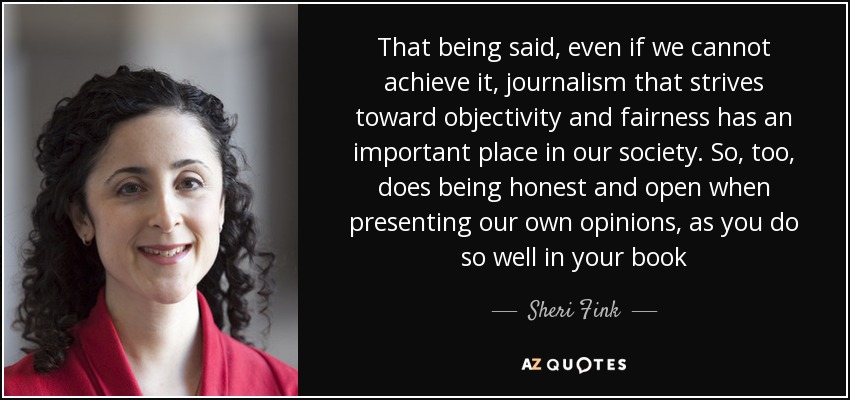
That being said, even if we cannot achieve it, journalism that strives toward objectivity and fairness has an important place in our society. So, too, does being honest and open when presenting our own opinions, as you do so well in your book
I think the deepest thing is that many fiction writers tell stories but are not elegant writers. But, we're not writing journalism when we're making literature.
It's important to remember that the future of quality journalism is not dependent on the future of newspapers. The discussion needs to move from "How do we save newspapers?" to "How do we save and strengthen journalism?" - however it is delivered.
As the newspaper industry continues to contract, one of the most commonly voiced fears is that serious investigative journalism will be among the victims of the scaleback. And, indeed, many newspapers are drastically reducing their investigative teams.
Given the multiple crises we are living through, investigative journalism is all the more important.
Moving forward, investigative journalists need to train themselves to be media amphibians - just as comfortable with the classic verities of great journalism as they are with video, Twitter, Facebook, and, most importantly, citizen journalism.
Citizen journalism is rapidly emerging as an invaluable part of delivering the news. With the expansion of the Web and the ever-decreasing size and cost of camera phones and video cameras, the ability to commit acts of journalism is spreading to everyone.
It's very hard in our adversarial society to find a third view. Take journalism, where everything is always presented as one person against another: "Now we're going to hear the opposing view." There is never a third view.
You had journalist saying during the campaign that Donald Trump compels them to suspend all objective standards of journalism.
One of the principles of journalism is you don't lie. You never lie.
My father always wanted me to be president of the United States, and his fallback position was that I not become a ward of the county. I think my father was okay about my going into journalism, though.
It's not the day in which I grew up, long time ago, where we had three news networks. No cable, no social media, no internet. Where what you see is what you got. We had basically straight journalism. We don't have that anymore.
Letting journalism be from the perspective of the journalist. It's usually a no-no, and journalists are encouraged to be completely objective.
Prediction is a low form of journalism.
There have been so many individuals who have really put a lot on the line. That they've sacrificed so much to try to protect the principle of source protection in the journalism world. And I think Julian Assange, and WikiLeaks, and Sarah Harrison have really been extraordinary in standing up for that.
Investigative journalism and reporting has become much more dangerous. This is especially true for journalists and sources in National Security - but it has been getting pretty bad for beat reporters and small outlets doing local reporting, too.
One of the things that always drives any practitioner of journalism crazy is you'll run it people who say why doesn't the media cover this or that? Well of course the media covered it. Why didn't you read about it? And, you know, it's, you know, there you are, it's not the journalist's job to knock down your door, you know, punch the URL into your computer and force you to stop watching the Kardashians and to read, you know, a report on integrity in government instead, it's your job.
Journalism's been a continuing course in adult education for me.
I'm happy to have interns at The Weekly Standard and happy to have readers of The Weekly Standard, but if you all tell me that you were busy reading Plato and [Lev] Tolstoy and playing violin in the orchestra, I'd say that was great. I wouldn't tell you to take time out from that to get involved in political journalism.
The media is fully fine and hunky-dory with the idea that they may destroy somebody, and they think that's part of the job description. But you turn around and criticize them, and that's not permitted in the vacuum in which they live. They have free rein over you, because I guess this is how they define their constitutional responsibility. And since they have constitutional recognition, somehow they've all been taught at journalism school that nobody may assail them, that nobody may criticize them.
My English teacher, Dr. John Lindstrom, taught me an appreciation for the written word. Until his class, I'd dabbled in journalism and essay writing. But when he selected one of my essays as the best in the class, it gave me the confidence to see myself as a writer.
I think there was a moment in the middle part of the century into the 60s, 70s when at least elite journalism claimed to be non-partisan. You can go back and look at it and wonder about how non-partisan it was.
I certainly don't mean to suggest that all investigative journalism prior to 9/11 in the US was praiseworthy. But there were more examples to which one could point, and there were at last some activist photographers who understood that getting information into the public sphere in spite of military censorship was a right and obligation within democracy. That strain in war journalism did nearly vanish during that time.
You can't just reprise the news. You have to have journalism that makes a point and you have to be in sync with your audience.
The lessons learned in journalism also apply. Writing for NPR has taught me to cut a piece in half and then in half again - without losing the essence. Apply that to the swollen prose of a bulky novel and you might reveal a beautiful work.
Follow AzQuotes on Facebook, Twitter and Google+. Every day we present the best quotes! Improve yourself, find your inspiration, share with friends
or simply: