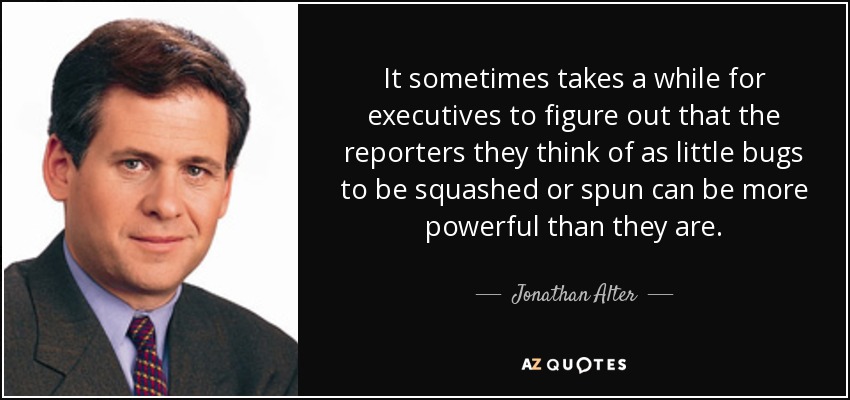
It sometimes takes a while for executives to figure out that the reporters they think of as little bugs to be squashed or spun can be more powerful than they are.
the heaviest restriction upon the freedom of public opinion is not the official censorship of the Press, but the unofficial censorship by a Press which exists not so much to express opinion as to manufacture it.
Folks, Brian Williams isn't the exception. He's exactly what they've taught us to expect from them all. It's not journalism any more - it's entertainment, it's celebrity, it's agendas and it's money. All too often, a lie is now an acceptable way of communicating. To the media, a lie has as much value as the truth.
I think if you look at the failure of journalism in the modern age, then I don't want to be called a journalist.
The Congressional leaders set the agenda for journalism; it's not the other way around.
I think the style Plimpton popularized - the dive-in, try-it-yourself journalism - is appealing and useful for a number of reasons, not the least of which is the value of an outsider's view into a little-known or misunderstood subculture. I tried to do the same thing with my book - tap into a pocket of American life that few people have any idea about, and tell the real, unvarnished truth about it in a way that was open-minded and authentic.
I've never written a hard journalism piece in my life. I've never wanted to do that.
The best I can hope for is that I might provoke a water cooler argument between you and somebody else. But it is not journalism. It doesn't have the rigor of journalism. It doesn't have the proof positive that facts provide. So it can be readily dismissed as mere propaganda. But I can certainly reach more people.
Tailoring the facts to fit one's theory constitutes neither good science nor good journalism. Rather, it is intellectually dishonest and, when published for consumption by a mass audience, adds up to propaganda.
The difference between fiction and journalism is that you can disguise the characters, so you won't get your legs broken, and there's no interview tapes to transcribe.
We don't consider ourselves equal opportunity anythings, because that's not - you know, that's the beauty of fake journalism. We don't have to - we travel in fake ethics.
The first word I would remove from the folklore of journalism is the word objective.
As an old creative industry full of cruelty and moral sense, British journalism once flourished on the imperative that people required the truth in order to survive. But people don't require that now. They want sensation and they want it for nothing.
Chris Matthews can't start any sentence without 'Let me ask you this... ' And I love Chris Matthews! But almost everybody in journalism does it. Who's stopping you? Just say it!
I chose Journalism by default. I always loved TV, and I had no idea what else to do, so I studied what interested me.
I eventually got a job with a television company, started to see how exciting journalism could be as a career, and decided that was what I wanted to do.
I've always taken risks and bought property well. As journalism wasn't particularly well paid, buying homes and selling them for profit improved my income.
More people pay attention to fiction and to narrative than pay attention to journalism. That's quite sad. More people pay attention to television than to prose. That's equally sad, if not more so.
A TV show can't hold people and institutions to account like good journalism can.
Political correctness is the fascism of the 90's, it is this rigid feeling that you have to keep your ideas and your way of looking at things within very narrow boundaries or else you'll offend someone. Certainly one of the purposes of journalism is to challenge just that way of thinking, and certainly one of the purposes of criticism is to break boundaries, that's also one of the purposes of art.
To have no ideas and being able to express them is the essence of journalism.
Journalism makes you think fast. You have to speak to people in all walks of life. Especially local journalism.
Truthfully, without over-egging it, as I often do, the library and journalism, those things made me who I am.
I don't think there's any connection between my journalism career and my film career. They are two totally different mediums and very different skills.
I'm coming from journalism, but at the same time I'm tempted by poetry, politics, and maybe the idea of being a witness, a belief that you can still change things with the image.
Follow AzQuotes on Facebook, Twitter and Google+. Every day we present the best quotes! Improve yourself, find your inspiration, share with friends
or simply: