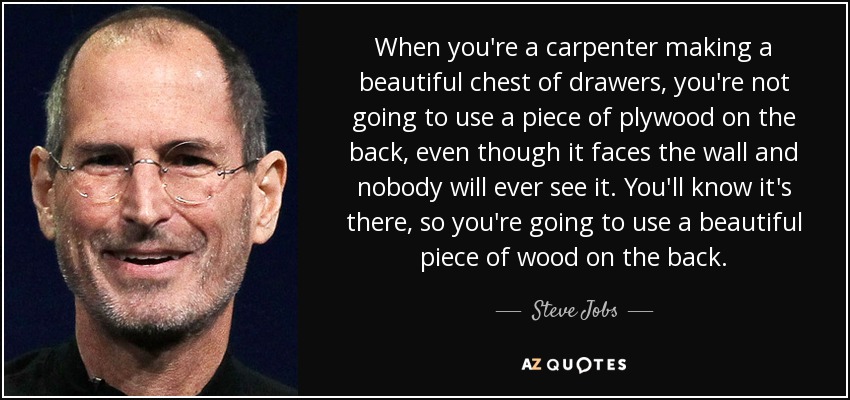
When you're a carpenter making a beautiful chest of drawers, you're not going to use a piece of plywood on the back, even though it faces the wall and nobody will ever see it. You'll know it's there, so you're going to use a beautiful piece of wood on the back.
To create a new standard it takes something that's not just a little bit different. It takes something that's really new and really captures people's imagination. And the Macintosh, of all the machines I've ever seen, is the only one that meets that standard.
The Macintosh may only have 10% of the market, but it is clearly the top 10%.
I think the Macintosh was created by a group of people who felt that ah there wasn't a strict vision between sort of science and art.
Look back to the old days: people bought an MS DOS machine and struggled with it for weeks to bring it up to speed. Then Apple created Macintosh, struggled a bit with it, but eventually succeeded. Then it went into other businesses. If your company truly wants to change the world, it would make these problems go away for customers.
It was 4 or 5 years into my first design job before the idea of doing graphic design on computers started taking hold. I started working in 1980, the Macintosh was introduced in 1984, then the real desktop publishing only started coming around in 85-86, but it wasn't really until the end of the decade that the transition became irresistible.
Andy [Hertzfeld], just by nature, is one of these straight shooters. A very moral guy, kind of an open book. Along with being brilliant and one of the original members of the Macintosh team, he has a really generous spirit.
I found that I loved producing that kind of propaganda and I loved the power that a few students with a Macintosh computer could wield. I was hooked on communications at that point.
Reed College at that time offered perhaps the best calligraphy instruction in the country.... I decided to take a calligraphy class to learn how to do this.... It was beautiful, historical, artistically subtle in a way that science can't capture, and I found it fascinating. None of this had even a hope of any practical application in my life. But ten years later, when we were designing the first Macintosh computer, it all came back to me.
If Macintosh hadn't been successful, then I should have just thrown in the towel, because my vision of the whole industry would have been totally wrong.
I just had a romance that I really care about, a lot-I mean, a lot-go up in smoke. Because of the stress, and the sort of other woman that Macintosh is.
Like Semmering Academy, the Grove School was a Gothic pile of bricks run by 1950s-era chalk drones, which maintained its cultural viability by perpetuating a weirdly seductive anxiety throughout its community. Mary herself was a victim of the seduction; despite the trying and repetitive emotional requirements of her job, she remained eternally fascinated by the wicker-thin girls and their wicker-thin mothers, all of them favoring dark wool skirts and macintoshes and unreadably far-away expressions; if she squinted, they could have emerged intact from any of the last seven decades.
Everything that I've learned about computers at MIT I have boiled down into three principles: Unix: You think it won't work, but if you find the right wizard, they can make it work. Macintosh: You think it will work, but it won't. PC/Windows: You think it won't work, and it won't.
And, of course, you have the commercials where savvy businesspeople get ahead by using their MacIntosh computers to create the ultimate American business product: a really sharp-looking report.
I write with a Uni-Ball Onyx Micropoint on nine-by-seven bound notebooks made by a Canadian company called Blueline. After I do a few drafts, I type up the poem on a Macintosh G3 and then send it out the door.
Ultimately, it comes down to taste. It comes down to trying to expose yourself to the best things that humans have done and then try to bring those things into what you're doing. Picasso had a saying: good artists copy, great artists steal. And we have always been shameless about stealing great ideas, and I think part of what made the Macintosh great was that the people working on it were musicians and poets and artists and zoologists and historians who also happened to be the best computer scientists in the world.
The world is a big place. There are lots of smart people in it. Entrepreneurs are kidding themselves if they think they have any kind of monopoly on knowledge. And, sure as I'm a Macintosh user, on the same day that an entrepreneur tells this lie, the venture capitalist will have met with another company that's doing the same thing.
I am firmly of the opinion that the Macintosh is Catholic and that DOS is Protestant. Indeed, the Macintosh is counterreformist and has been influenced by the methodical path of the Jesuits.... It is catechistic: the essence of revelation is dealt with via simple formulae and sumptuous icons. Everyone has a right to salvation. DOS is Protestant, or even Calvinistic. It allows free interpretation of scripture, demands difficult personal decisions, imposes a subtle hermeneutics upon the user, and takes for granted the idea that all can reach salvation.
The grandiose plans of what Macintosh was gonna be was just so far out of whack with the truth of what the product was doing. And the truth of what the product was doing was not horrible, it was salvageable. But the gap between the two was just so unthinkable that somebody had to do something, and that somebody was John Sculley.
The Macintosh was supposed to be the computer for people that just wanted to use a computer without having to learn how to use one.
I hate mice. The mouse involves you in arm motions that slow you down. I didn't want it on the Macintosh, but Jobs insisted. In those days, what he said went, good idea or not.
October arrives in a swirl of fragrant blue leaf smoke, the sweetness of slightly frosted MacIntosh apples, and little hard acorns falling. We are in the midst of cool crisp days, purple mists, and Nature recklessly tossing her whole palette of dazzling tones through fields and woodlands.
I think Apple's revenge is just the fact that Windows, you know, PCs all became Macintoshes in a way.
Here I am, ninety years old and ready for the cooling board, using a brand new Macintosh computer, and there you sit, twenty-two and gorgeous, fresh as a new peach, yet scrawling on a yellow legal pad like an old maid in a Victorian romance.
It feels as if ever since the iPhone was released, the Macintosh computer has become just another leverage point in this other operating system's marketing plan.
Follow AzQuotes on Facebook, Twitter and Google+. Every day we present the best quotes! Improve yourself, find your inspiration, share with friends
or simply: