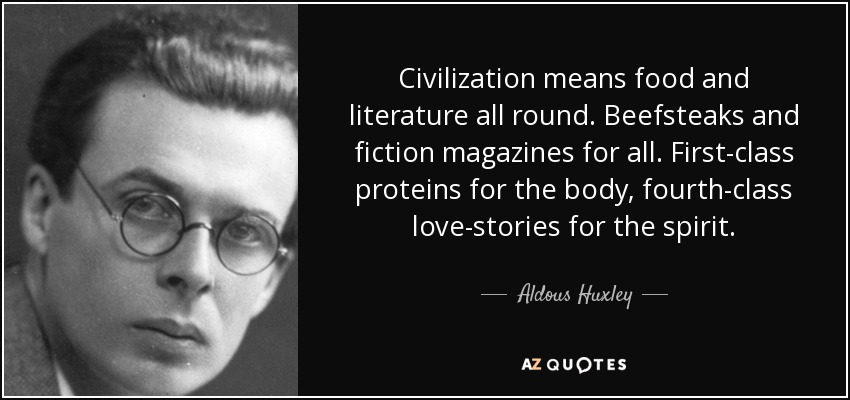
Civilization means food and literature all round. Beefsteaks and fiction magazines for all. First-class proteins for the body, fourth-class love-stories for the spirit.
The want of an international Copy-Right Law, by rendering it nearly impossible to obtain anything from the booksellers in the wayof remuneration for literary labor, has had the effect of forcing many of our very best writers into the service of the Magazines and Reviews.
The history of all Magazines shows plainly that those which have attained celebrity were indebted for it to articles similar in natureto Berenice--although, I grant you, far superior in style and execution. I say similar in nature. You ask me in what does this nature consist? In the ludicrous heightened into the grotesque: the fearful coloured into the horrible: the witty exaggerated into the burlesque: the singular wrought out into the strange and mystical.
I heard that Commentary and Dissent had merged and formed Dysenery.
Most magazines have that look of being predestined to be left which one sees on the faces of the women whose troubles bring them to the Law Courts.
Predictions that unit cohesion could not survive honesty about sexual orientation were simply wrong. What does threaten morale arethe prolonged investigations, the questioning of friends and co-workers, the searches of barracks for magazines and letters, the witch hunts.
Newspapers, television networks, and magazines have sometimes been outrageously abusive, untruthful, arrogant, and hypocritical. But it hardly follows that elimination of a strong and independent press is the way to eliminate abusiveness . . .
The American woman's concept of marriage is a clearly etched picture of something uninflated on the floor. A sleeping-bag withoutair, a beanbag without beans, a padded bra without pads. To work on it, you start pumping--what the magazines call "breathing life into your marriage." Do enough of this and the marriage becomes a kind of Banquo's ghost, a quasi-living entity.
Religion embarrasses the commentators. It is offbounds. An editor of the old Life magazine once assigned me a book on religion with remark that I was the only 'religious nut' - his term for a believer - in his stable of regular reviewers.
And one has eaten and one walks, past the magazines with nudes and the posters for bullfight and the Manhattan Storage Warehouse, which they'll soon tear down.
I don't have a publicist, I don't go to events, I don't do magazines, and it's just not my life.
Whenever summer rolls around I begin to realize that I'm a complete and utter book snob. In relation to reading, I have absolutely no guilty pleasures at all. No graphic novels. No murder mysteries. My summer read is really no different from my winter read. I know many bookshops and magazines would have me believe that our summer forays are different, but literature is literature, and unfortunately snobbery is snobbery.
A well-known magazine asks a man how they should refer to him, as Psychologist X, as Author X? He suggests man of letters, for that is what he is, in the eighteenth-century meaning. But they can't buy that because the word doesn't exist in Time-style; he cannot be that, and presumably the old function of letters cannot exist.
I remember that even my first impression of Italian cinema was pictures by paparazzi because my mom was reading all of these trash magazines with paparazzo pictures.
I don't think that this movie is the kind of movie that a magazine like In Touch even cares about, if you know what I mean. It's a Lars von Trier film. They care about Moneyball, not Melancholia. They care about what I wear to Melancholia premieres; they don't really care about a Lars von Trier film.
I used to be a huge fan of Heavy Metal magazine growing up, and I was exposed to Cobalt there and fell in love with the character and the world. I've tried to track it down and pursue it myself to make a movie out of it. Also I felt like the thing that's cool about Cobalt is it does have a culty kind of underground quality to it that I really like.
I think the thing about relationships is that you're always thinking "Oh, it's going to go bad." [...] But then, it's the same thing that all the silly magazines say, "Take time for yourselves. Go away."
Writing has to do with truth-telling. When you're writing, let's say, an essay for a magazine, you try to tell the truth at every moment. You do your best to quote people accurately and get everything right. Writing a novel is a break from that: freedom. When you're writing a novel, you are in charge; you can beef things up.
One of the biggest challenges in the past for me in working on the networks was that audiences have grown accustomed to television being something that keeps you company-background music, something that you have on while you're flipping through a magazine, cooking dinner, talking on the phone, putting the kids to bed.
I think it's very important what young people see in pictures or on TV or in magazines. Drugs, violence, anorexia. All of the things that I absolutely do not reference in my photos.
I have a CS degree and a history that includes working as a software developer and being a computer magazine columnist back during the 1990s. I guess I simply paid attention to the social effects of the IT revolution as I lived through it.
Well, I'm very much a literary person. And my fashion always tells a story somehow. I never look at fashion magazines. I find them incredibly boring. To me, reading a fashion magazine is the last thing I need to do. I've got books I need to read.
You can see with the proliferation of magazines, you know, that just focus entirely on that. So it just - it seems like there (was) a lot of fodder and a lot of stories and fun things to poke fun at and highlight.
I think a young poet, or an old poet, for that matter, should try to produce something that pleases himself personally, not only when he's written it but a couple of weeks later. Then he should see if it pleases anyone else, by sending it to the kind of magazine he likes reading.
Images in the 20th century had a unique power where image became divorced from reality, and often more important than reality. Buildings were judged more by the way they looked in magazines than by the satisfaction people felt when using them.
Follow AzQuotes on Facebook, Twitter and Google+. Every day we present the best quotes! Improve yourself, find your inspiration, share with friends
or simply: