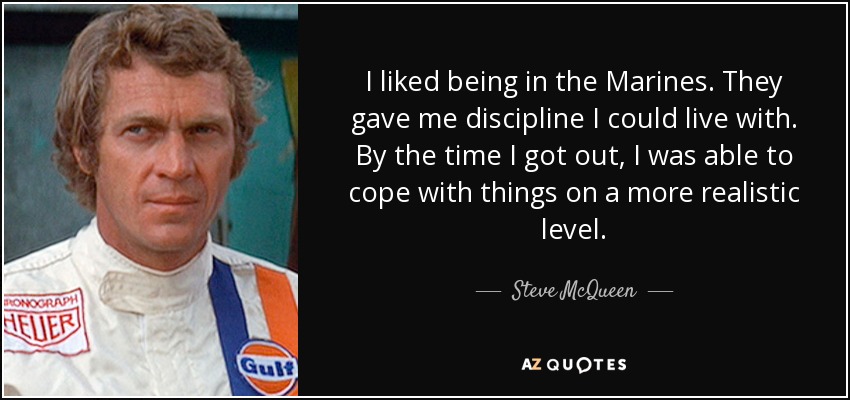
I liked being in the Marines. They gave me discipline I could live with. By the time I got out, I was able to cope with things on a more realistic level.
I entirely approve the measures proposed by you in relation to the Marines who are lately captives in Tripoli. Therefore execute them.
The amphibious landing of U.S. Marines on September 1950 at Inchon, on the west coast of Korea, was one of the most audacious and spectacularly successful amphibious landings in all naval history.
If you ask me why I've succeeded it's because I was in the Royal Marines. You have this unbelievable sense of achievement and of overcoming adversity. That's the confidence it breeds.
In the Navy, there is no wrong hole. In the Marines, there is always a hole.
The marines gave me an eternal discipline.
Our judgement is that the presence of the Royal Marines garrison is sufficient deterrent against any possible aggression.
Just rejoice at the news and congratulate our armed forces and the Marines. Rejoice!
I got interested in Zen when I was a teenage beatnik on the streets of San Francisco. And it was my interest in Zen, in part, that got me into the Marine Corps, because that was a ticket to Asia. So I spent a couple of years on Okinawa and began reading and thinking about how I wanted to go about conducting my life.
Dad mistook - for some reason unbeknownst to me - he mistook his family for a platoon of Marines. I mean, he - the exact same thing he brought to the disciplining of a squadron, a battalion, a platoon, he brought to the disciplining of his children. He ran the house - he had Saturday morning inspections for us, he had white-glove inspections for us as kids.
I got a little bit of the Marine mentality from my dad, I guess. You can't but help absorb the culture you're around.
It's kind of funny to read the work of ex-Marines and soldiers because what they said to me as a reporter was only a fraction of what they were thinking and feeling and saying to one another.
The number one issue that Ocean Mysteries has opened my eyes to is, no matter where you are, whether you're on a beach in Hawaii, you're diving in the Pacific, you're in a remote archipelago, or you're in the middle of nowhere - I am blown away and sobered and crushed, emotionally crushed, by the amount of marine debris, of garbage, that is now in our ocean.
I am passionate about making sure that we collectively and proactively preserve all of the world's most iconic coastal and oceanic wild places - those keystone ecosystems that are irreplaceable, breathtakingly beautiful refuges for fish and other marine wildlife.
The most important thing we can do to save our oceans is to dramatically expand our efforts to establish new marine protected areas and make sure that critical fish spawning sites and ecosystems remain undisturbed.
The oceans are a way of life. We fish; we sail; we have a robust marine economy.
There is another domain that we consider relevant and having good prospects - marine biology. For many years this region [Russian Far East] has been home for one of the leading institutes of the Russian Academy of Sciences, the Institute of Marine Biology.
We will build a Marine Corps based on 36 battalions, which the Heritage Foundation notes is the minimum needed to deal with major contingencies. Right now we only have 23.
Cheech [Marine] on the other hand, met [Barack] Obama and he knew right away who Cheech was. So that should tell you something.
Living in a bubble as I said in a featherbed of privilege. That's why leaving home, leaving the prep school and going to the University of Michigan in the early '60s was a moment of awakening and to go to a place like Michigan and to see suddenly a world in flames and the injustices all around was quite a wake up call. I lasted a year and a half at Michigan before I dropped out and joined the merchant marines and I was a merchant marine for my sophomore year then I came back to Michigan.
I was arrested 1965. I had come back from the merchant marines, got into conversations about the war. I had never heard of Vietnam until I was in the merchant marines in constitution square in Athens, and I picked up the New York Herald or the International Herald Tribune and there was my first introduction of the word Vietnam.
[ General James Mattis] is a Marine's Marine who has served in combat in both Afghanistan and Iraq.
I met Mel [Brooks] backstage in Anne's [Bancroft] dressing room. He was wearing one of those pea coats, pea jackets that were made famous by the Merchant Marines, and I admired it and he said, "You know, they used to call this a urine jacket, but it didn't sell."
If you look at the Associated Press wires, there's a constant flow of information coming in. At that time I happened to have direct access to AP wires. The day the marines landed in Haiti and restored [ Jan Bètran] Aristide there was a lot of excitement about the dedication to democracy and so on. But the day before the marines landed, when every journalist was looking at Haiti because it was assumed that something big was happening, the AP wires reported that then [Bill] Clinton administration had authorized Texaco to ship oil illegally to the military junta.
I wrote an article about the marine landing [in Haiti] right away, but barely mentioned the oil, because my article would come out two months later and I assumed by then, "of course, everybody knows." Nobody knew. There was a news report in the Wall Street Journal, in the petroleum journals, and in some small newspapers, but not in the mainstream press.
Follow AzQuotes on Facebook, Twitter and Google+. Every day we present the best quotes! Improve yourself, find your inspiration, share with friends
or simply: