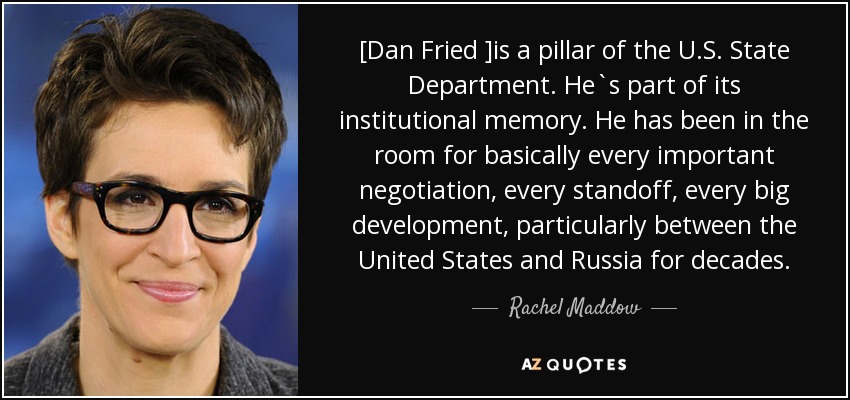
[Dan Fried ]is a pillar of the U.S. State Department. He`s part of its institutional memory. He has been in the room for basically every important negotiation, every standoff, every big development, particularly between the United States and Russia for decades.
[White House] feels even more like home now because you have all these memories that were formed watching your kids grow up.
One of the first memories I have was watching Whoopi Goldberg perform her one-woman show on Broadway on HBO. She moved seamlessly through an array of spirited and soul-stirring characters, each one holding a mirror up to me and allowing me in many ways to see a reflection of myself on screen.
Certainly for me prose has a dilatory capacity, insofar as I don't trust my abilities in prose. I imagine I could have done the same thing in poetry, but sometimes I feel more fluent in poetry than in prose, and as a consequence perhaps I might pass too quickly by a thing that I might, in prose, have struggled merely to articulate. That struggle creates space, and it seems to me a particular kind of space into which memory flows easily. I suspect I think better in poetry, however.
Remembered memory is much more powerful than actually having your own memory.
All memory is fiction.
To conjure a particular knowledge you visualize an architectural structure and then you walk around and see the details that then bring back the words or the poetry or the lines of thought. Memory's going extinct because we rely on machines and copies and so on. The idea of working with structures that conjure dreams, personages, history, time, that can be contained in this way as you walk through your mind, is a challenge.
Writing fiction lets you be a little more emotional and unguarded, a little freer. Writing fictional characters is also really different from writing about real people. In nonfiction, you can only say so much about the people you interact with. After all, they're actual people, their version of their story trumps yours. In a novel, you can build a character, using certain parts or impressions of someone you know, and guessing or inventing others, without having to worry that your guesses or memories or inventions are wrong.
You cannot build a cultural identity without the images and sounds of your culture. Most countries in the third world - poor countries - they've lost their memories. Because everyday, films and cultural artifacts disappear. Film is also a memory - of the character and imagination of a culture.
Some memories are best absorbed through your eyes in real time, even if you have no record of it later. Because then you can access that memory and how you felt in that moment. If you're looking at your cellphone screen, taking a video of something that is otherwise unforgettable, watching it later will not recover the emotion you would have had, had you witnessed it directly.
Everything is in our cellular level. My mom's is definitely in my cellular memory.
There's a genetic memory that stays on your bones. What you experience when you're young, I think it stays with you.
The Nova Scotian black community always remembered Viola Desmond - they didn't lose track of her, ever. Her memory was very much alive there, but the rest of us didn't know anything about her. It's just so typical of Canadians that we know Rosa Parks, in that "bad country to the south of us" - they needed this lovely, courageous woman to sit down in the front of the bus - but we wouldn't know ours, because of course we "don't have racism in Canada."
Wilkie Collins was a rival and competitor of Dickens. His novel Moonstone sold more copies at the time than Dickens' last two books. But that meant nothing in the long run. Right now, to be honest, Wilkie Collins is what he deserved to be back then: a footnote, an almost lost memory. And he knew he would become that.
There's a great temptation to throw things in, as you put it, that you think are neat, or that you have a very clear, specific memory of and think you could do a good job writing about. What I find is that it's like a seed you plant. You can try it, and if it will grow and connect with other ideas in the book, and you can see connections that you can actually realize on the page, then you're allowed to leave it in. But if it just kind of lies there and doesn't really add up to anything or there's no chemistry with everything else going on in the book, then you have to take it out.
While I read almost all my newspapers online, I'm not a big fan of e-books because I like to see what I've read and remember it. Books are a way of making memory physical.
I guess travelling that kind of long distance and travelling at such a slow pace, it wasn't something that I was thinking about when I was inside of the cistern, but when I started hearing the music played back to me for the first time by an ensemble, it totally brought me back, immediately, to memories of sailing. And it really became apparent that this was some sort of a through line in my life that I was excited to explore more.
I'm aware of everything - it's my job - I keep up to speed, and I have a blessed memory. The brain chemistry I have is such that my memory is wonderful. And sometimes it's helpful, and other times it ends up being frustrating.
I think it's good to leave people with the memory of that being a great character. And if we have a reason to bring him back, we'll bring him back.
I'd like to be remembered for music that moves people, that takes them some place else, that means something to them, reminds them of a good time or place, some memory, some positive moment.
Hillary Clinton never had this kind of success with her invention of the vast right-wing conspiracy. She tried, but that bombed out compared to this. Back then, it was her husband that ended up being impeached despite her conspiracy theory. But, sadly, now the chants of "lock her up" are just a distant, bitter memory, and the Donald Trump administration is in the crosshairs.
Each time a Palestinian or an Israeli dies, it is terrible. But they have the right to have a funeral, to be buried, to have a place in the memory of the survivors. And then you have these other places - Darfur, Rwanda, even Colombia - where the dead have no faces and literally cannot be counted. Theirs are minuscule lives moving toward imperceptible deaths. For me, it is the essence of tragedy.
Feelings are only your history being occasioned by the present moment. If that's your enemy, then your history is your enemy. If sensations are your enemy, your body is your enemy. And if memory is your enemy, you'd better have a way of controlling your mind in such a way that you never are reminded of things that are painful from the past. If you avoid people, avoid having your buttons pushed, avoid going to places that might occasion anxiety; if you're hammering down drugs and alcohol; these are all methods of trying to mount that unhealthy agenda.
I just don't think that being unable to forgive someone is the most healing move. It can be, and I've had times in my life when I thought I would be better off without the drama that another person was bringing to me, but cutting someone out isn't always the answer. I know someone who cut her mother out and it didn't magically heal her. She's still haunted. It's not as if you can wipe clean all of your memories of having a mother, or wanting or needing one.
Summer's the same, autumn is even more extreme. Then winter is when you sort of condense all of your ideas. You process all these things and you try to look for new concepts. In that sense, your intuition is in hibernation. What you fill up is your imagination; you fill up your memories there.
Follow AzQuotes on Facebook, Twitter and Google+. Every day we present the best quotes! Improve yourself, find your inspiration, share with friends
or simply: