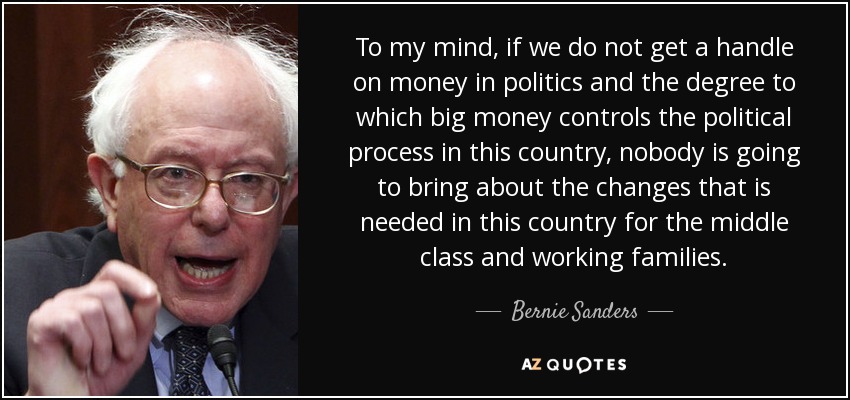
To my mind, if we do not get a handle on money in politics and the degree to which big money controls the political process in this country, nobody is going to bring about the changes that is needed in this country for the middle class and working families.
It is a campaign to break down every barrier that holds you back. We need more than a plan for the big banks. The middle class needs a raise. And we need more jobs.
Mexico City is very different now than when I grew up, but I was in the streets all the time - though I was born to a middle-class neighborhood where there weren't a lot of gangs and things. I was always comfortable.
The people who perpetrated the terror of the World Trade Center and Pentagon bombings are something different because these people were obviously not desperate and poor refugee dwellers. They were middle class, educated enough to speak English, to be able to go to flight school, to come to America, to live in Florida.
I did my BA in English lit, and hated the restriction - I'd always read more in translation than not; coming from a working-class background, what I knew of as British literature - the writers who made big prize lists and/or were stocked in WH Smith, Doncaster's only bookshop until I was 17 - seemed incredibly, alienatingly middle-class. Then in 2009, just after the financial crash, I graduated with no more specific skill than 'can analyse a bit of poetry'.
Not only are unpaid internships exploitative, they're one of the main forces keeping publishing in this country a primary white middle-class industry, which has a direct knock-on effect on what gets published and how.
I'm from a middle class family but my father squandered all the money, so I didn't really run around with rich people. I was very judgmental towards a lot of them.
I understood that these trade agreements were going to destroy the middle class of this country. I led the fight against us. That is one of the major differences that we have.
It may not be replicable: One of the hardest transition that a developing country can make is the transition to middle-class status. Governments have to let go, people start insisting on following their own lights, etc.
merica was middle-class for the very start - the people who came first were hyper-strivers from England. There were no vested interests, no ranks, no classes, it was very lightly populated, there were unlimited natural resources - for free essentially - if you failed, you could always start over.
I would speculate that a critical mass of the population has to internalize a middle class outlook first. International aid experience has demonstrated many times that just building railroads doesn't get you there. You need people ready to sue them.
Well the thinking is we have the highest tax rate in the world. In the entire world, we have the highest tax rate. There's gridlock in Washington because there's no leadership. So what I'm doing is a large tax cut especially for the middle class and they're gonna- we're going to have a dynamic country. We're going to have dynamic economics. And it's going to be something really special. And people are going back to work.
I came from a white middle class neighborhood. Was I expected to go back there and teach the woman next door about Renaissance sonnets? The embarrassing truth of the matter was that I was being chosen because Yale University had some peculiar idea about what my skin color or ethnicity signified.
I had an Indian face, but I never saw it as Indian, in part because in America the Indian was dead. The Indian had been killed in cowboy movies, or was playing bingo in Oklahoma. Also, in my middle-class Mexican family indio was a bad word, one my parents shy away from to this day. That's one of the reasons, of course, why I always insist, in my bratty way, on saying, Soy indio! - "I am an Indian!"
I was a lower middle-class kid. My family had no money. There was no room in our small house where there were already four kids, including myself, living.
Most writers are middle-class and are the children of doctors or lawyers.
Gallup defines a good job as 30+ hours per week for an organization that provides a regular paycheck. Right now, the U.S. is delivering at a staggeringly low rate of 44%, which is the number of full-time jobs as a percent of the adult population, 18 years and older. We need that to be 50% and a bare minimum of 10 million new, good jobs to replenish America's middle class.
I hear all the time that 'unemployment is greatly reduced, but the people aren't feeling it.' When the media, talking heads, the White House and Wall Street start reporting the truth - the percent of Americans in good jobs; jobs that are full time and real - then we will quit wondering why Americans aren't 'feeling' something that doesn't remotely reflect the reality in their lives. And we will also quit wondering what hollowed out the middle class.
The middle class is not doing well, and trade policy might have something to do with that, and so someone who is going to be fixated on those things, who has a business background, has some appeal.
I'm a girl from South Carolina. I was raised in a middle class family and decided to major in broadcast journalism and now I'm at the national level and that doesn't happen to most people and I realize that. I know that I'm very fortunate but this great country allowed that to work in my favor.
I started to understand what the song could be about. The ache of nostalgia even for things we don't like, the commitment to keep moving despite that ache. It made me think of how I relate to my privilege - as a white person, as someone who grew up upper middle class.
Our traditional stories are based on an aristocratic model without a middle class, whereas The Arabian Nights reflect people living in cities, traders, merchants, travelers, with a wide range of personalities.
One of the things about me is that I actually had marginally middle-class living from writing. For years and years, I actually wrote so much through the '70s and '80s that I made a living. And very rarely have I had to take another job. And now it's impossible for anybody coming up to make such a living. They've pissed in the temple, you know?
I guess I'm also obligated to note that the experience of sex workers who are not upper/middle class/white probably have much worse conditions than anything that's portrayed commonly in media/what I experienced.
Drugs and drinking affect every family I know, country and city, middle-class and poor.
Follow AzQuotes on Facebook, Twitter and Google+. Every day we present the best quotes! Improve yourself, find your inspiration, share with friends
or simply: