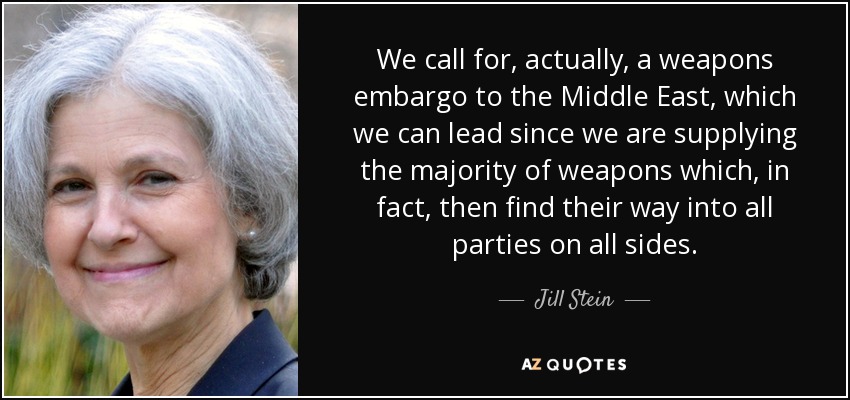
We call for, actually, a weapons embargo to the Middle East, which we can lead since we are supplying the majority of weapons which, in fact, then find their way into all parties on all sides.
What we need to do with respect to the Middle East is strong, steady leadership, not wrong and reckless leadership that is all over the map.
There seems to be a passive alliance between Vladimir Putin and Donald Trump and that's unprecedented in its form and dangerous in its content, because Russia is our most dangerous geopolitical opponent because of the desires that they have in the Middle East and because of their desire to break up Europe. And in the United States, we spent a lot of blood and a lot of treasure trying to keep Europe intact and democratic, and trying to keep the Middle East from being only influenced by people who are massive fans of [Syrian President] Assad and massive fans of the Iranians.
In the American Jewish community, there is little willingness to face the fact that the Palestinian Arabs have suffered a monstrous historical injustice . . . Until this is recognized, discussion of the Middle East crisis cannot even begin.
The incubator for terrorism, after the Middle East, is Europe, partly because of proximity, partly because of the existence of large Muslim communities there.
America has spent as of one month ago $6 trillion in the Middle East. And in our country we can't afford to build a school in Brooklyn or we can't afford to build a school in Los Angeles. And we can't afford to fix up our inner cities. We can't afford to do anything.
Terrorism has essentially become a franchise in the Middle East and North Africa and increasingly in other parts of the world.
If you look at social movements in Latin America, there are spaces where alternative politics are thought about on the ground, at the grassroots level, but they are always under threat. The problem in North Africa and the Middle East is the politics of oil. It means that the spaces for truly grassroots politics, involving those masses of people excluded from high politics, are very quickly closed down. They are not really allowed any kind of autonomy to develop, and that seems to be the real problem, which gets us back to the neo-colonial relationship.
Donald Trump basically said: One state, two states, do whatever you like. I do not think this was a serious statement of American policy. This was him shrugging his shoulders and saying: Who cares about it. I think he doesn't even have the faintest idea of what he wants to do in the Middle East.
What is likely to happen? Either an escalation of violence or an entire change in the whole Middle East theater. It may well happen, and I say this to my Palestinian friends, that the Palestinians have in a certain way missed their hour. They had their moment when the world's public opinion was behind them, and a considerable part of the Israeli public was willing to compromise with them.
The Palestinians don't have oil. If they were the Saudis, they wouldn't be in the position they are now. But they have the power of being able to upset the imperial order in the Middle East.
Certainly, until there is justice for the Palestinians, there will never be any kind of stability in the Middle East.
Israel is the representative of the United States in the Middle East. Its policies are so integrated with American policies that they use the same language. If you read Sharon's statements and George W. Bush's statements, they're virtually identical.
In the Middle East, America has spent as of four weeks ago $6 trillion. Think of it. And, by the way, the Middle East is in what - I mean, it's not even close - it's in much worse shape than it was 15 years ago. If our Presidents would have gone to the beach for 15 years, we would be in much better shape than we are right now, that I can tell you.
I hope that that the people in the Occupy movement are politically aware enough to know that their being excluded from the obscene amassing of wealth of US corporations is part of the same system of the exclusion and war that is being waged by these corporations in places like India, Africa and the Middle East.
In the States, you have the First Amendment. People feel the freedom to speak and the right to be heard. And they kind of push the message: "It's a free country." Everybody has the right to say whatever they want to say. But in the Middle East, culture is your guide. You have to ask, is it culturally okay to say something like that? Is it culturally okay, for example, to show a woman giving birth? As Arabs watching such a scene in an American film it's okay, but when it comes to the Arabic context, we're like, "How dare you?" So it's how you present it.
Politicians don't want democracy here in America, why would they want it in the Middle East?
The Iranian issue I don't think has much to do with nuclear weapons frankly. Nobody is saying Iran should have nuclear weapons nor should anybody else. But the point in the Middle East, as distinct from North Korea, is that this is center of the world's energy resources. Originally the British and secondarily the French had dominated it, but after the Second World War, it's been a U.S. preserve. That's been an axiom of U.S. foreign policy, that it must control Middle East energy resources.
China is the center of the Asian energy security grid, which includes the Central Asian states and Russia. India is also hovering around the edge, South Korea is involved, and Iran is an associate member of some kind. If the Middle East oil resources around the Gulf, which are the main ones in the world, if they link up to the Asian grid, the United States is really a second-rate power. A lot is at stake in not withdrawing from Iraq.
I think it is less the limited amount of information than the filters that information about the Middle East must pass through before being fairly addressed in the mainstream media. In more intellectual and geopolitical terms, the perceptions of the region are distorted by a combination of Orientalism and the priorities of the state of Israel, including the refusal to discuss the relevance of Israel's nuclear weapons arsenal in the context of addressing Iran on its nuclear program.
Most of the time, teachers who talk about the Middle East do not know the history, culture or present context of the problems they are discussing. So they go to the media, which quote government or academic "experts" (who often are no such thing) or journalists who, by virtue of working for the media, are supposed to know what they are talking about. In the end they know little or nothing beyond a standard line that reflects the perceptions of the US government and its special-interest supporters. That is what the students get. Indeed, that is what we all get.
The continual linking of the notions of terrorist and terrorism with Muslims and the Middle East is, essentially, an act of propaganda that cannot help but promote "Islamophobia."
The worst crimes against humanity in the last half of the previous century and this century are carried out with conventional advanced weapons, upgraded daily by a greedy arms industry, super power's apathy and criminal ideologies. In the Middle East, Iran lags behind many other military powers in this respect.
While in the American academia the knowledge production on the Middle East in general and Syria in particular has been considerably transformed in recent years, the dissemination of these more updated views fails to reach the conventional educational system. For two main reasons: Politics can still subdue and censor views that are not endorsed ideologically, and academics have still not learned how to write openly, directly and, one should say, courageously about these issues.
Luckily for [Barack] Obama, the Russians came along and rescued him with this proposal [to confiscate Assad's chemical weapons] which he quickly accepted - it was a way out of the embarrassment of facing likely defeat. They still have the option of bombing if they want to. And incidentally, to add one comment about this, you'll notice that this would be a very good moment to institute a call for imposing the Chemical Weapons Convention on the Middle East.
Follow AzQuotes on Facebook, Twitter and Google+. Every day we present the best quotes! Improve yourself, find your inspiration, share with friends
or simply: