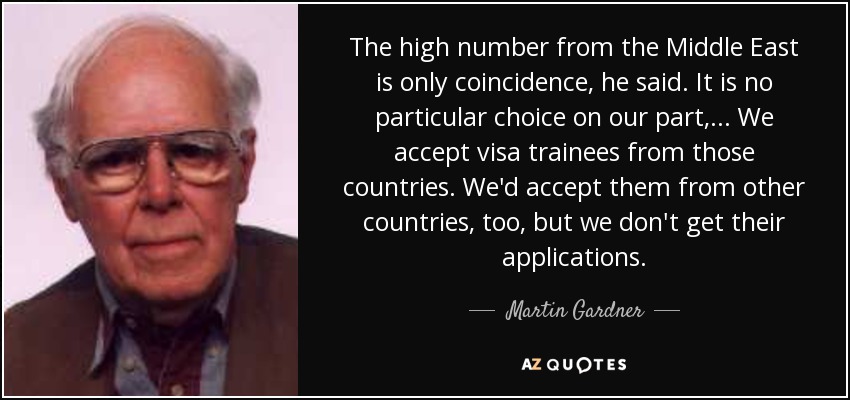
The high number from the Middle East is only coincidence, he said. It is no particular choice on our part, ... We accept visa trainees from those countries. We'd accept them from other countries, too, but we don't get their applications.
Public interest in most of the Middle East was slight at that time; the Arab-Israeli conflict was all that people were interested in and that was not my specialty.
We must remember our duty to Nature before it is too late. That duty is constant. It is never completed. It lives on as we breathe. It endures as we eat and sleep, work and rest, as we are born and as we pass away. The duty to Nature will remain long after our own endeavors have brought peace to the Middle East. It will weigh on our shoulders for as long as we wish to dwell on a living and thriving planet, and hand it on to our children and theirs.
Without action, we are going to continue to allow Iran to be a safe harbor for terrorists, see its economy further deteriorate, and see the Middle East further destabilize.
Obviously I have concerns, right, about national security in terms of Russia, and China, and North Korea, and obviously, the problems we have in the Middle East.
We've got to do everything we can to vacuum up intelligence from Europe, from the Middle East. That means we've got to work more closely with our allies, and that's something that Donald [Trump] has been very dismissive of.
I'm worried about the world because there's chaos in the Middle East, and I think the Iranian deal [to lift sanctions] is going to continue the Shia-Sunni battles, the Persian-Arab battles.
You look at the Middle East, it's a total mess.
I think we have to get NATO to go into the Middle East with us, in addition to surrounding nations, and we have to knock the hell out of ISIS, and we have to do it fast, when ISIS formed in this vacuum created by Barack Obama and Secretary [Hillary] Clinton.
We call for, actually, a weapons embargo to the Middle East, which we can lead since we are supplying the majority of weapons which, in fact, then find their way into all parties on all sides.
I'll do anything to try to prevent John Bolton from getting any position, because I think his world view is naive. He believes we're going to spread democracy. We're going to topple governments everywhere and they're going to elect Thomas Jefferson. That's not the way it works in the Middle East.
As a state, as a government, in 2001 we proposed to the United Nations to empty or to get rid of every WMD in the Middle East, and the United States stood against that proposal. This is our conviction and policy.
After I made my tour in the Middle, into the Middle-East and Africa and visited Mecca and other places, I think that the separation [ from the Black Muslim movement] became psychological as well as physical, so that I could look at it more objectively and - and separate that which was good from that which was bad.
I think that there is a particular mindset that was on display in the run-up to the Iraq war that continues to this day. Some of the folks who were involved in that decision either don't remember what they said or are entirely unapologetic about the results, but that views the Middle East as a place where force and intimidation will deliver on the security interests that we have, and that it is not possible for us to at least test the possibility of diplomacy.
Western culture is what is at risk from immigration from the Middle East.
President Murabak has been a U.S. ally for decades. He was a guarantor of some degree of peace in the Middle East and has kept a good relationship with the Western world.
[Roots of terrorism] come out of a long dialectic of U.S. involvement in the affairs of the Islamic world, the oil-producing world, the Arab world, the Middle East - those areas that are considered to be essential to U.S. interests and security.
In the story ["The Pyramid and the Ass"] there's this war against the so-called Buddhist Terrorists. As we find out, they're not really terrorists at all, just good folks trying to liberate people from technology and fight against an American government/corporation trying to coopt our souls. The inherent racism and Buddhist-phobia in the story plays into the present demonizing of Islam - and of our loss of knowledge about the great, spiritual history of the Sufis, for example, or the cultural heritage from the middle east.
There has been sort of, if you will, a moral interventionism on the part of the United States trying to reshape countries in our own image. Now, we had to go into Afghanistan. We didn't have to go into Iraq. But the idea that you could create a Vermont in the Middle East like that was naive from the beginning.
I very much believe in the Intentional Fallacy. If Donald Trump lies and dopes and bumbles and staggers his way into peace in the middle east, he gets credit for it. He owns it.
I said in 2004,in fact a group was sent to me from the White House to try talk to me, because I was getting a lot of publicity.I said it in 2004, you're going to destabilize the Middle East, Iran is going to take over Iraq... and somebody else is going to help and that turned out to be ISIS. It's an exact.
Chicago is like a warzone. Chicago is worse than some of the people that you report, in some of the places that you report about every night, in the Middle East.
When they're shooting, when they're chopping off the heads of our people and other people, when they are chopping off the heads of people because they happen to be a Christian in the Middle East, when ISIS is doing things that nobody has ever heard of since medieval times, would I feel strongly about waterboarding? As far as I'm concerned, we have to fight fire with fire.
I went to Jerusalem, the dead sea, it was just amazing. Because what we see in the TV, I'm sorry to say it, I don't want to insult nobody, but a lot of the image that we see from the middle east in Canada - It's sad to say but it's always bad stuff. I was thinking coming here it would be a lot of military, security, everybody would be a little more on the edge, but I see it's amazing. It feels a little bit similar to Miami.
40, 50 years ago, Americans - the majority of Americans did not want to accept these Vietnamese refugees who they saw as completely foreign. Now there are new foreigners - Syrians and other people from the Middle East, people of Muslim backgrounds. And the sense among many Americans is, well, these people are completely different from us, and they're not like the Vietnamese who are much more assimilable. And I think that's very, very doubtful. I think that the majority of these new foreigners, if given the opportunity, will be able to assimilate and deal with American culture.
Follow AzQuotes on Facebook, Twitter and Google+. Every day we present the best quotes! Improve yourself, find your inspiration, share with friends
or simply: