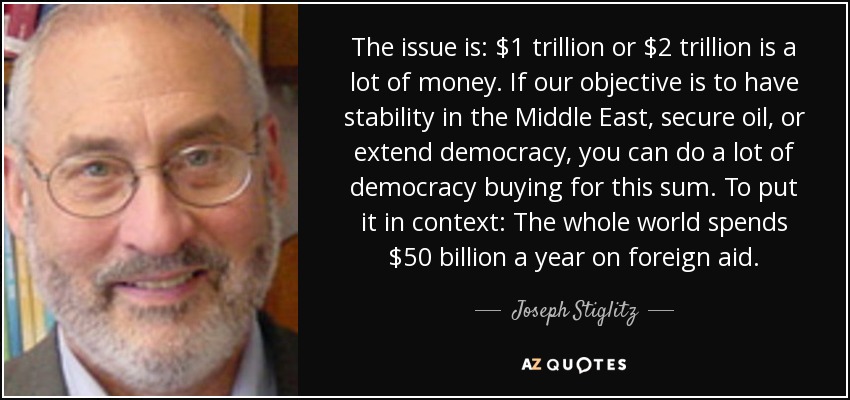
The issue is: $1 trillion or $2 trillion is a lot of money. If our objective is to have stability in the Middle East, secure oil, or extend democracy, you can do a lot of democracy buying for this sum. To put it in context: The whole world spends $50 billion a year on foreign aid.
At the same time, old confrontations have taken on frightening urgency, especially the India-Pakistan conflict over Kashmir and the violent stalemate in the Middle East. Progress on these and other global challenges requires us to develop a larger strategy for American foreign policy, rooted in a fundamental commitment to move the world from interdependence to an integrated global community committed to peace and prosperity, freedom and security.
This is one thing that's very interesting, how the people on the left always talk about separation of church and state. When you look at the theocracies all across the Middle East, where we look at constitutions that are based upon the Qur'an, I don't think you want to see that happening in the United States of America. So it is a theocratic political construct.
We have already provided a strong humanitarian response to the problems in the Middle East and that response will be stronger within coming days.
The big issue is whether the United States will succeed in its venture of reshaping the Middle East. It is not clear to me that using military force is the way to do it. We should not have gone into Iraq. But we have.
I'm not naive. I know perfectly well that there isn't a single Arab or Muslim in the world who would say: There has to be a Jewish state in the Middle East.
The United States does not have a very good record in the Middle East. I think they have the best of intentions but I think the problem is that it's very difficult from Washington, or from Iowa or Nebraska to understand what is happening in this crazy part of the world. In some cases US diplomacy has been somewhat naive.
Public interest in most of the Middle East was slight at that time; the Arab-Israeli conflict was all that people were interested in and that was not my specialty.
We must remember our duty to Nature before it is too late. That duty is constant. It is never completed. It lives on as we breathe. It endures as we eat and sleep, work and rest, as we are born and as we pass away. The duty to Nature will remain long after our own endeavors have brought peace to the Middle East. It will weigh on our shoulders for as long as we wish to dwell on a living and thriving planet, and hand it on to our children and theirs.
So much of what we see and hear about the Middle East focuses on what we call politics, which is essentially ideology. But when it comes to the Middle East, and especially the Arab world, simply depicting people as human beings is the most political thing you can do. And that's why I chose to write about food: food is inherently political, but it's also an essential part of people's real lives. It's where the public and private spheres connect.
Our armed forces will fight for peace in Iraq, a peace built on more secure foundations than are found today in the Middle East. Even more important, they will fight for two human conditions of even greater value than peace: liberty and justice.
The special relationship between the United States and Israel still stands. Our total committments to Israel's security and our hope for peace is still preeminent among all the other considerations that our Nation has in the Middle East ... But there need be no concern among the Israeli people nor among Jews in this country that our Nation has changed or turned away from Israel.
We must help the reformers of the Middle East as they work for freedom, and strive to build a community of peaceful, democratic nations.
Therefore, the question is not whether such democratization is possible, but instead how to meet the yearning of the masses in the Middle East for democracy; in other words, how to achieve democratization in the Middle East
Similarly, it is argued that the culture of Islam is incompatible with democracy. Basically, this conventional perspective of the Middle East thus contends that democracy in that region is neither possible nor even desirable
The Muslim world and its subset the countries of the Middle East have been left behind in the marathon of political, economic and human development. For that, there is a tendency to blame others as the primary cause
As you travel through the Middle East what keeps on striking home to me is how similar everyone is, and yet the degree to which we can find differences to fight wars over. It requires a great deal of empathy, I think, between various sides to overcome this history and live in peace.
On the McLaughlin Report, August 26, 1990: 'There are only two groups that are beating the drums for war in the middle East, the Israeli Defense Ministry and its amen corner in the United States.
I love the Middle East and have been lucky enough to visit a few of the countries like Egypt, Lebanon, Jordon and the U.A.E.
We know that this mad dog of the Middle East has a goal of a world revolution. (On Muammar Qaddafi of Libya)
I am pleased to see that many of the world's leaders have publicly recognized that the crisis in the Middle East was deliberately incited by terrorist organizations.
The Middle East is literally going up in flames, as is California, and Katrina's problems haven't been solved, and Congress' response is to criticize Federal judges.
In many parts of the world-including Polynesia, north Africa & the Middle East-public dancing that focused on a physically linked couple would have been unthinkable, a violation of communal propriety.
Wars between states and people seem to have existed under all historical systems for as long as we have some recorded evidence. War is quite clearly not a phenomenon particular to the modern world-system. On the other hand, once again the technological achievements of capitalist civilization serve as much ill as good. One bomb in Hiroshima killed more people than whole wars in pre-modern times. Alexander the Great in his whole sweep of the Middle East could not compare in destructiveness to the impact of the Gulf War on Iraq and Kuwait.
I think the government should be spying on all Arabs, engaging in torture as a televised spectator sport, dropping daisy cutters wantonly throughout the Middle East and sending liberals to Guantanamo.
Follow AzQuotes on Facebook, Twitter and Google+. Every day we present the best quotes! Improve yourself, find your inspiration, share with friends
or simply: