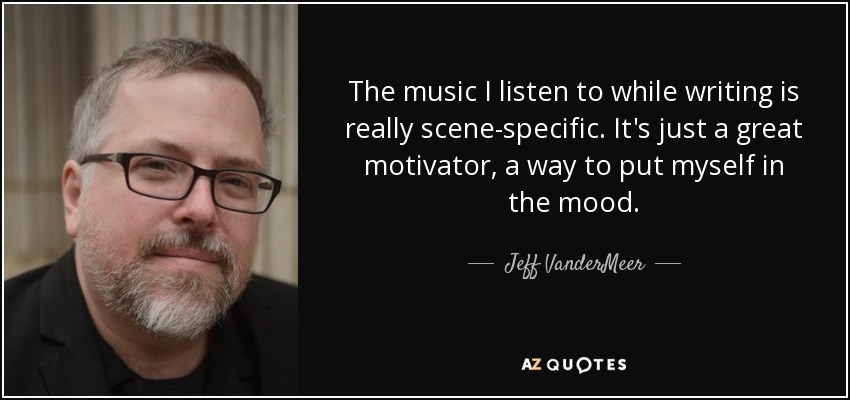
The music I listen to while writing is really scene-specific. It's just a great motivator, a way to put myself in the mood.
To me, lighting really sets the mood for a room. A 40 watt bulb in a cheap lamp is the same as a 40 watt bulb in an expensive one.
Even the pictures I was doing at college - a little narrative based on a butterfly catcher, or a chimney sweep - the images were always telling stories. They were all scenarios and moods which I storyboarded and worked through - it's exactly what I do now.
I used to write when I was in the mood or felt inspired. Anymore, I write whether I feel inspired or not. It's a discipline. So that's definitely different. It's part of maturing as a person and as a professional.
The storyboard artists job is to plan out shot for shot the whole show, write all the dialog, and decide the mood, action, jokes, pacing, etc of every scene.
Music is extremely important to have on photo shoots - it brings the mood.
Exercise is the single best thing you can do for your brain in terms of mood, memory, and learning.
Imagine you are walking in the woods and you see a small dog sitting by a tree. As you approach it, it suddenly lunges at you, teeth bared. You are frightened and angry. But then you notice that one of its legs is caught in a trap. Immediately your mood shifts from anger to concern: You see that the dog's aggression is coming from a place of vulnerability and pain. This applies to all of us. When we behave in hurtful ways, it is because we are caught in some kind of trap. The more we look through the eyes of wisdom at ourselves and one another, the more we cultivate a compassionate heart.
My idea of a perfect surrealist painting is one in which every detail is perfectly realistic, yet filled with a surrealistic, dreamlike mood. And the viewer himself can't understand why that mood exists, because there are no dripping watches or grotesque shapes as reference points. That is what I'm after: that mood which is apart from everyday life, the type of mood that one experiences at very special moments.
Wilderness is rapidly becoming one of those aspects of the American dream which is more of the past than of the present. Wilderness is not only a condition of nature, but a state of mind and mood and heart. It cannot be confined to the museum-case status—seen only as a passing diorama from superlative throughways.
Innumerable changes of moods are yours, and they are uncontrolled by you. If you knew their origin, you would be able to dominate them. If you cannot localize your own changes, how can you localize that which formed you?
Music can change lives. Whether you are having a good or bad day, the power of music can change one's mood.
Since you're going to die anyway, why not go do whatever it is you are in the mood to do. To postpone anything is ridiculous, if it's important to you.
A man likes to believe that he is the master of his soul. But as long as he is unable to control his moods and emotions, or to be conscious of the myriad secret ways in which unconscious factors insinuate themselves into his arrangements and decisions, he is certainly not his own master.
It’s almost just a difference of mood as to whether I would describe myself one way or the other. I think I share that experience with most people.
I think weather affects my mood a lot more than I thought, and I like to be in bad moods sometimes.
What I've always found interesting in gardens is looking at what people choose to plant there. What they put in. What they leave out. One small choice and then another, and soon there is a mood, an atmosphere, a series of limitations, a world.
We have discovered that exercise is strongly correlated with increased brain mass, better cognition, mood regulation, and new cell growth.
Luck in all its moods had to be loved and not feared. Bond saw luck as a woman, to be softly wooed or brutally ravaged, never pandered to or pursued.
Doth Nature draw me, 'tis because, Unto my seeming, there doth lurk A lawlessness about her laws, More mood than purpose in her work.
Our love of art is often quite temporary, dependent upon our moods, and our love of art is subservient to our demand for a positive self-image. How we look at art should account for those imperfections and work around them.
So how do people listen to music? How do the broad masses listen to it? Apparently they have to be able to cling to pictures and 'moods' of some kind. If they can't imagine a green field, a blue sky or something of the sort, then they are out of their depth.
Painting is an unspoken and largely unrecognized dialogue, where paint speaks silently in masses and colors and the artist responds in moods.
You begin by engaging the left hemisphere of the brain with the overall shape, the basic structure of the painting, and then eventually you engage with the colour, with the mood of the painting and then you are entering the activities of the right hemisphere - and it is in the right hemisphere that ideas of space are born, the realization that you are seeing space.
Exercise is really for the brain, not the body. It affects mood, vitality, alertness, and feelings of well-being.
Follow AzQuotes on Facebook, Twitter and Google+. Every day we present the best quotes! Improve yourself, find your inspiration, share with friends
or simply: