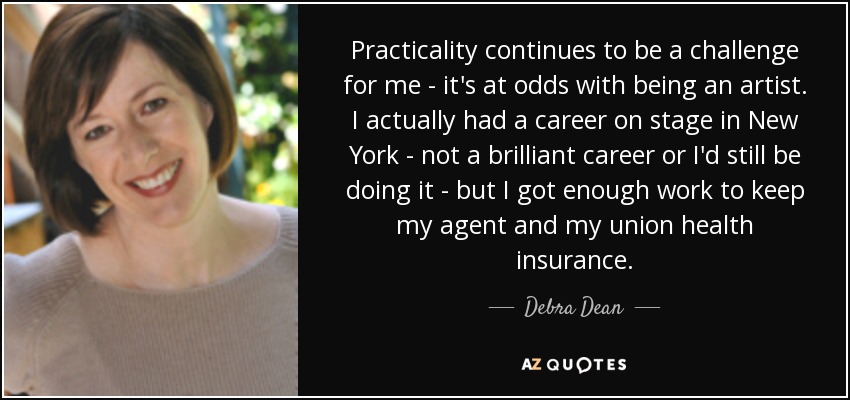
Practicality continues to be a challenge for me - it's at odds with being an artist. I actually had a career on stage in New York - not a brilliant career or I'd still be doing it - but I got enough work to keep my agent and my union health insurance.
Especially students. I love to turn them on to a story. Some of them have to go see me as an assignment, like kids from the schools in New York will go to the Y. I want them to know why I love this and why they should too.
A lot of writers choose to live in New York, partly because of the literary culture here, and partly because Brooklyn's a pretty nice place to live. And a lot of writers who might not geographically reside in New York still point their ambitions towards New York in some sense.
I was thinking about New York and realized how much I hate walking around in the winter and how much I dread getting on the train.
When you have the national narrative being "crack is awful and black people are using it," why go against that narrative when you want to get that publication in The New York Times or wherever? It encourages people to play right into it.
I want to play a show at Madison Square Garden in New York, which is where the New York Knicks play. That's what I want.
Some friends of mine in the class ahead of me in college were auditioning for graduate school in New York, and then a few of them got into Juilliard, and it sort of opened my eyes. I didn't really know anything about it, but it opened my eyes to a possible next step after school, where I could just deepen my knowledge and also not be responsible for life and stay in school.
I don't have many actors in my family, but I do have a Great Uncle that is a film-maker in Philadelphia, and my great-great-grandparents were Flamenco dancers in the 30's in New York, they were Spanish dancers.
The New York Times and Politico report , as Bush continues to flounder on the campaign trail, backers are placing some of the blame on Right To Rise and its inability to sell their candidate.
Being in New York and having worked at Time Out New York and then being at Time, living in New York for a long time has helped because I know everybody. And they're the people who call me and give me jobs. So that kind of real networking, which is just living in a place and having jobs where people around you are extremely successful, has helped me tremendously.
I never thought to look at the New York Times one, even though I knew people were pissed off. I've seen YouTube videos from people who are pissed off at me about that and that takes a lot of effort to go find.
Look, there's no denying that comics have moved dramatically into the mainstream in North American culture in the last 10 years, and for someone like me who's always tried to make a living at it, it's been great, I'm very grateful for it. But at the same time, it's not a subculture-y thing anymore; it's something that's in the New York Times and the New Yorker.
Odd things happen in New York, which is why it's such a great source of stories.
Being from New York, I wonder why am I inspired by bluegrass and Earl Scruggs? But when I look at the whole history of the banjo, I feel really good about it, including the Earl Scruggs part.
Whenever I go to New York I try to soak up as much live music as I can, including as many nights at the opera as I can manage.
People in New York, LA, San Francisco, they scratch their head at the concept of a gay Republican, but it really makes sense there.
I always think about Katharine Graham - she was the publisher of The Washington Post. In her autobiography she talks about the way her parents met. Her father was, I think, in New York just walking by on his way home and looked into a store and saw the lady that became his wife. It was just pure luck. And she said that it once again reminds her of the role that luck and chance play in our life. I really believe that, too.
It wasn't a direct route. I began as a freelance reporter. That's an important distinction, because people who rise through the ranks of The New York Times become vetted, conditioned, harassed, and shaped by the institution. That never happened to me.
The New York Times is an institution that attracts careerists, who are drawn to power and access. This gave me a kind of a free hand. The kind of work that I wanted to do, most of the other reporters didn't want to do. I was not doing lunch. I was not sucking up to officials. I was writing from the street.
I was doing a play in New York, which we had done in New Haven, Connecticut. It was an American premiere of a play called The Changing Room written by a wonderful man named David Story. It was about a rugby team in the North of England. It got just screaming rave reviews. At that time, virtually every major critic went up to the Long Wharf Theater to see a new play like that.
I walk into office, which is the casting office for CBS in New York. Mainly what they cast out of this office was the CBS daytime shows. I go in and walk into this room which every seat is filled with young African-American boys and girls and they were in their teens. I went, "I'm in the wrong place. Why am I here? What's going on?"So I go in and meet Norman [Lear].
We did a campaign here with New York Times. We had a great ad: "Today in America, someone will kill an elephant for a bracelet." We became sensitized in our society. Now there are four or five billion people in Asia who need to get this message. We need to use social media, print magazines, celebrities - anything we can to share this message. It's not cool, it's not okay. You are destroying beautiful animals. You are robbing a continent of its wealth. And you are hurting a lot of innocent people.
When we cut off access to certain parts of our cities to people on bikes or in wheelchairs, we're not only doing economic damage, we're also doing culture damage. New York is the culture capital of the world because people are running into each other on the street all the time. They are forced to engage in creativity and problem-solving.
I always loved watching and reading family-friendly mysteries growing up, like the shows Murder, She Wrote and Nancy Drew, and am thrilled to be bringing these New York Times best-selling books right into your living room on the small screen.
I've always liked New York even before I lived in New York. It represents something, I think, and it would be trite to say what it represents really because it's been said so many times.
Follow AzQuotes on Facebook, Twitter and Google+. Every day we present the best quotes! Improve yourself, find your inspiration, share with friends
or simply: