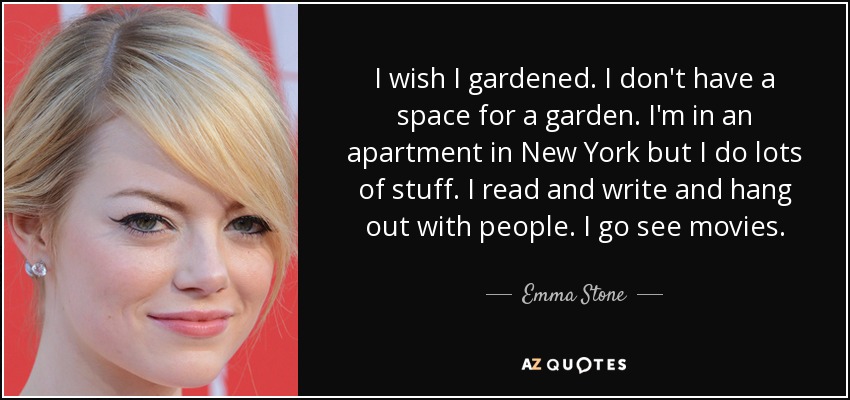
I wish I gardened. I don't have a space for a garden. I'm in an apartment in New York but I do lots of stuff. I read and write and hang out with people. I go see movies.
I didn't do well in high school, but I took photography, and I loved being able to capture moments. It led to more and more photography, and fashion was the angle into photography for me. It was incredible to see photographs by Irving Penn or Helmut Newton. I was really intrigued by that, and that's what led me to New York City.
The Dain Curse [Tom Fink] was a great job. I was in New York, and I was young - I think I'm 28 years old in that - and I got to work with James Coburn and Jean Simmons and Jason Miller. Plus, it was a Dashiell Hammett story, and I had a great character. It was fantastic to shoot.
John Logan is maybe the No. 1 screenwriter in the world today, not to mention that he won a Tony for Best Play for Red. So he may just be the best writer period right now. He wrote The Aviator, and I was in New York doing a play, and he asked if they would see me for the film, just meet with me. 'Cause that's what Martin Scorsese does.
Gian Luigi Polidoro and his girlfriend had written this script, it was an American comedy, and they decided I was the guy to play the part. I was young, they offered me the lead in the film, and I said, "Sure, I'll do it." And I'm telling you, there is a movie waiting to be made about the making of a movie like that, particularly at that time in New York. I mean, we shot all over the streets of New York without permits. We would literally grab a shot and run. But Rent Control... I think the total cost was $100,000, and to this director's credit, I think it looks like $200,000.
I wanted to look right. I remember a review - a very positive one - in The New York Times that said I was so good in the role [Earl Mills] that I "even managed to overcome a terrible red wig." I wanted to write her and tell her about the agony I'd gone through with the perm, but I thought better of it.
In the US you have New York, San Francisco, Los Angeles, Boston, Miami and dozens of other cities; a few of them have a really strong visual character. But even with those there is just too much space between them and too many people.
When people, especially from France, would ask me to talk about or so they could write about New York Jewish humor, I'd say I don't know anything about New York Jewish humor. I know who Zero Mostel was and I know Mel Brooks, but that's about all I could tell you about New York Jewish humor.
I certainly didn't have New York Jewish humor. But I was in three Mel Brooks films so people thought I was a connoisseur of New York Jewish humor.
I talked to my mother about it a lot. I asked her what it was like to grow up in New York and Harlem in the 1920s and 1930s, and I asked her about a woman leaving her husband. I asked her about how she would feel about that woman, and my mother grew up in the Church Of God In Christ, and she told me that the woman might be isolated because the other women thought she might go and come after their husbands. That's how they thought then.
[Juan Wauters] got the tips for Queens because he grew up there.So him and my roommate, Matt Volz, they hooked me up, New York Style.
The New York Times distorts and defrauds the news and then claims to be impartial. They never give an even-handed version of the news - that's the last thing they'd ever do.
The New York Times claims that they publish all the news that's fit to print but what they really do is print all the news that supports their agenda. What they are is the power base of the left.
America has borders. You have quite strict borders, actually. Even getting a work permit in New York actually is quite a difficult thing to do. I've got to prove I've got an address. I've got to prove I have private health care. And when my work permit runs out, if I haven't left, there'll be a knock at the door, they'll put me in handcuffs and take me to JFK Airport. That's how you guys do it.
I came first to America in 1977 at the invitation of a man who wanted to make my life story into a musical. But my agent said it was not to be and it was never done. So I went back, but I'd seen New York, and I wanted to live there. Because everybody talks to you in the street. See, nobody talks to you in England.
I was at the New York Film Critics Circle Awards one year - they called me up when somebody canceled two days before the thing, and asked me to present some awards. So I went, and one of the funniest film moments I've ever had was when they introduced the New York film critics. They all stood up - motley isn't the word for that group. Everybody had some sort of vision problem, some sort of damage - I had to bury myself in my napkin.
The New York School poets are my godfathers creatively.
I had a lot of fans in New York. The press would write about me, but I couldn't get a paying job.
I ran into Stephen King once in New York a few years ago and outside the Carlyle and he said, "You're in the pink." Which sounded so Stephen King. He's doing well I think after his accident and all of that, years and years ago.
I rang my friend Jim Wolfensohn, who was then running a private commercial bank in New York. I said, "Come up to Vancouver", and he did. I put my proposition to him. He said, "I think it could work." I said, "Will you help us?" He said, "Yes." So, I set aside senior people in our treasury and they worked with Wolfensohn and the investment sanctions were applied. And that's what brought the regime down. The last South African Finance Minister, Barend du Plessis, went on record as saying that it was the investment sanctions that put the final nail in the coffin of apartheid.
Following World War II, the U.S. was the architect of the UN system, and the world financial system, and the Human Rights Declaration, and of course the United Nations is based here in New York City. But, unfortunately, especially in the last decade, the U.S. really has been turning its back on international agreements and the set of agencies and procedures that they create as a means for governing the world.
I was new to acting on a stage in a narrative as opposed to acting on a stage as a stand-up. And like everything else it's just like comfort level. The first time I did stand-up I was at a place called the B3 in New York on Third and Avenue B and I not only didn't take the mic out of the stand, but I clutched the stand of the entire time.
I had written a book called "Boston Boy" some years ago, and that took me from the time I could speak, I guess, in Boston through the time when I finally left to come to New York. One was understanding and coping with anti-Semitism. Boston, at the time, was the most anti-Semitic city in the country. And I found out when I was an adolescent that you have to be crazy to go out after dark all by yourself; you'd get your head bashed in.
I live in the Village right near NYU, which is taking over most of the Village. I've lived there for most of my time in New York. One of the things I like about the Village is, it's considered the kind of area where you can't have skyscrapers or, actually, many tall buildings. So you can see the sky which, I think, is a benefit.
Margot [Hentoff] used to write regularly for The Voice, for The New York Review of Books, for Harper's Bazaar, and she really had the most distinctive writing style, even more than mine, than I've ever seen in this business.
Follow AzQuotes on Facebook, Twitter and Google+. Every day we present the best quotes! Improve yourself, find your inspiration, share with friends
or simply: