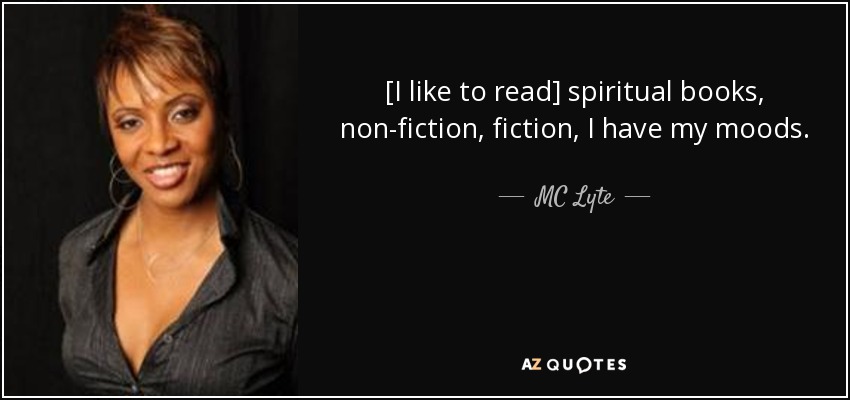
[I like to read] spiritual books, non-fiction, fiction, I have my moods.
I like writing non-fiction - and when you pick a [non-fiction] subject, it saves you the hassle of coming up with a plot.
The best way to tell people about climate change is through non-fiction. There's a vast literature of outstanding writing on the subject.
There is, in my mind, no higher compliment to pay a non-fiction book than to say it reads like a novel.
Autobiographical writings, essays, interviews, various other things... All the non-fiction prose I wanted to keep, that was the idea behind this collected volume, which came out about few years ago. I didn't think of Winter Journal, for example, as an autobiography, or a memoir. What it is is a literary work, composed of autobiographical fragments, but trying to attain, I hope, the effect of music.
With non-fiction writing I feel like I'm confined and driven by what actually happened. That makes the "plot". So it's a process of getting all of my notes typed up, then scanning through the notes, trying to extract or find certain vignettes that seem like they might write well - that might have a potential for good energy, shape, etc. And then at some point I start stringing these together, keeping an eye on the word count.
To my mind, the prose in a non-fiction work that's going to endure has to be of the same quality as the prose in a work of fiction that endures.
Any documentary; any capturing of a non-fiction event, is a hyper-realistic condensation of reality that hopefully reveals an emotional truth. It's never the actual literal truth of an event.
The effect of reading literary non-fiction that matters most to me is when the coin drops, and this happens in the company of the great, mercuric, encyclopedic minds: Empson, Kenneth Burke, Northrop Frye.
In high school, I was very active in extracurricular activities such as art, theatre, and choir. I also wrote for the school newspaper, but not regularly, because I never liked writing non-fiction very much.
I honestly believe that everything I know about the writing of non-fiction (or writing) could be engraved on the head of a pin with a garden hoe.
I spend most of my time reading non-fiction of all sorts. Then poetry. Then fiction to blurb. Then fiction I want to read.
My house is filled with books, most of which I have read, some of which I intend to eventually get to. I'm always reading at least one work of fiction and one work of non-fiction simultaneously. Whatever mood I'm in, there's always a book nearby to suit it.
I tend to read non-fiction.
I teach a non-fiction writing class at New York University, and one of my great pleasures is deciding on the syllabus.
I'm always looking for context in which people tell stories. In "Fight Club" it's these support groups for dying people, and then in "Choke" it's 12-step recovery groups. In one novel it's artists' colonies, in another novel it's a diary form that submariners' wives typically keep so that when their husband comes back from serving on a submarine they have an accounting of their spouse's time. So I'm always looking for, number one, a non-fiction context - because you can tell a more outrageous story if you use a non-fiction form.
I have two pairs of reading glasses. One pair is for reading fiction, the other for non-fiction. I've read the Bible twice wearing each pair, and it's the same.
Amy Rapp, my producing partner, and I are drawn to character-driven material. We're developing and producing movies and TV, fiction and non-fiction, studio and independent, broadcast and cable, theatre, and web so our slate is really diverse.
I do read a lot, and I think in recent years the ratio between the amount of non-fiction and fiction has tipped quite considerably. I did read fiction as a teenager as well, mostly because I was forced to read fiction, of course, to go through high school.
The idea of copyright did not exist in ancient times, when authors frequently copied other authors at length in works of non-fiction. This practice was useful, and is the only way many authors' works have survived even in part.
Expand the definition of 'reading' to include non-fiction, humor, graphic novels, magazines, action adventure, and, yes, even websites. It's the pleasure of reading that counts; the focus will naturally broaden. A boy won't read shark books forever.
I'd probably be a super wealthy guy if I had sat around writing songs and getting them placed like everyone else I know. But I write songs about people or after I meet them and they're somewhat biographical - they're fiction but also non-fiction.
A non-fiction writer pretty much has the shape of the figure in front of him or her and goes about refining it. A work of non-fiction is not as difficult to write as a work of fiction, but it's not as satisfying in the end.
The subject for a lot of non-fiction is very emotional, but if you read it, it's the most boring, dry stuff. I wanted 'Torn Apart' to be extremely accessible and readable.
The most deeply personal of my works are the non-fiction works, the autobiographical works, because there, I'm talking about myself very directly.
Follow AzQuotes on Facebook, Twitter and Google+. Every day we present the best quotes! Improve yourself, find your inspiration, share with friends
or simply: