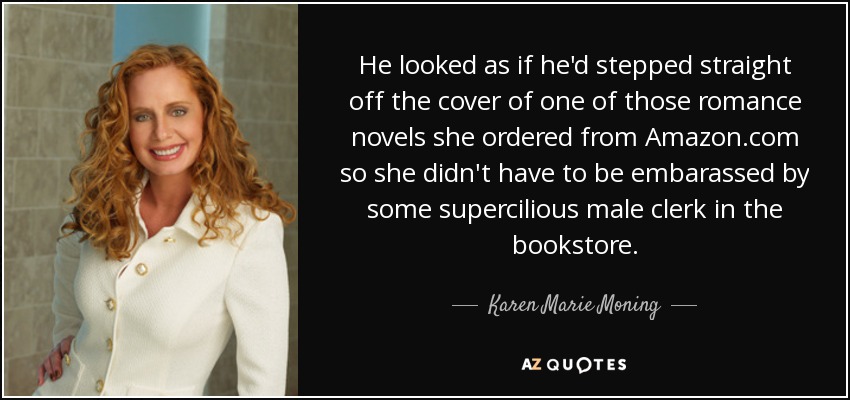
He looked as if he'd stepped straight off the cover of one of those romance novels she ordered from Amazon.com so she didn't have to be embarassed by some supercilious male clerk in the bookstore.
Now I'm in nonfiction. To me any given story has its appropriate form. There might be some story I get involved with that's begging to be a graphic novel, so that will have to be that way. There's always that matching of the content and the form, and that means everything to me. I spend years thinking about what that match is going to be before I can really make it work.
A Good Soldier is one of my favorite novels, for various reasons. But the class question is a good one, because it's not always easy to empathize with privileged people.
It seems to me that the basic plot of all historical novels is a romance swept aside by history.
I often say to my students in workshops that if they are trying to find literary inspiration, they should not go and read novels, because novels are more appropriate for series. Where as they should read short stories - that's the right format for you to be able to actually display the narrative in a film.
I'm more interested in moving toward writing stories - thinking about the graphic novel form, and just something more long-form. I did a lot of literary translation in college. Translation is an art. But for sure writing has always been a part of how I think through my ideas.
Raymond Carver had the quote that I loved about how he felt that a short story was the moment right before someone's life was about to fall apart. You can't really do that with a novel, but with a story you're just left hanging.
I'm writing a novel about the Syrian war. It will be completely different from my short stories. I have to address my feelings directly because I cannot avoid the war. It's something in my soul, in my blood.
There's the fact that American fiction is basically the most apolitical fiction on the globe. A South American writer wouldn't dare think of writing a novel if it didn't allude to the system into which these people are orchestrated - or an Eastern European writer, or a Russian writer, or a Chinese writer. Only American writers are able to imagine that the government and the corporations - all of it - seem to have no effect whatsoever.
I don't ever think about the utility of fiction. I don't believe in it or certainly don't require anybody to consider it. A novel or short story might be useful to a reader in all kinds of ways, many of which no writer would ever foresee, which is a good thing.
I've had enormous luck and enormous pleasure in working in such forms as movies and plays that I loved when I was a kid and I just - because I could always write dialogue, because I always had a sense of how people spoke. And because I had a strong narrative sense; growing up and loving stories, loving novels, I just seem to know how to tell a story and I read a lot, I went to a lot of movies, I went to a lot of plays, and it rubbed off on me. And that's all. It just rubbed off on me.
The key thing in my becoming a writer was going on a Arvon Foundation residential writing course. I took with me a really messy twenty thousand words of something that later became After You'd Gone, my first novel. My tutors were Barbara Trapido and Elspeth Barker.
Always, at the end of every book, there are things you will be unsatisfied with, and still more things that later on you will realize were not right. But mistakes are part of what a book is. That itchy, dissatisfied feeling at the end of a novel is useful. It's what keeps you writing and gets you writing the next one. It's what keeps you learning.
In the course of writing a book I'll produce loads of pieces of paper to help the novel itself. Diagrams, charts, family trees. And at the end of each book I'll pack it all away. It takes me a while to do it - it's like a relationship that way; there's a period of letting - go, of grief, in a way - but then I box it up, label it, and put it in the attic.
When I admire a writer, it's for the recognizable palette - Hemingway's minimalism, the dialogue, those isolated bar scenes. But with each story or novel, he shows me something different within the framework he's built - like noticing that there's a chair in the corner I didn't see in another story.
What I strive to do is make my characters seem like real people so that the reader experiences them as people - that's something I've been working on all of my life. I couldn't have written this novel at twenty or thirty, for technical reasons - I didn't have the technique then - but above all because I didn't have the life experiences I have now at sixty-seven.
I began as a poet, moved to short fiction, then to novel writing, and, for the past twelve years, back to stories. I sometimes wonder if the pendulum will swing all the way back to where I began. As T.S. Eliot says, "In my end is my beginning," but for now I'm staying put, sitting tight, and loving the short story form way too much to leave it quite yet.
Narco fiction novels have a reputation, at least here in Mexico among some of the writers I know, of being somewhat rushed productions, usually written in one way or another like crime thrillers, with something cheesily exploitative about them. It feels exploitive - taking this horrible and ongoing tragedy and trying to turn it into something entertaining. Or trying to turn it into something that might earn the writer a reputation of the sort that many writers believe they aspire to. Or earn them money.
There are many people who get beat up, who suffer, who are victimized, and then they sit down to write and they write crap. How many of these graphic novels over the years are from really talented people? Most of them actually, if you look at them, are self-pitying confessionals about "poor me".
Inspiration is everywhere - film, television, newspapers, novels, overheard conversations, whatever you can tap into. It's out there, and I've been at this long enough to know that it won't always just come to me; sometimes I have to go get it.
I think about material that could work in the novel or story as I'm writing. I see if I can get there through what's happening with the character. But it's by inclination. It's not "At this moment this will happen." Usually with my characters you can't tell what has induced them to do anything. That's because, from my understanding of reality - which is always subjective - everything is overdetermined.
Writing novels preserves you in a state of innocence - a lot passes you by - simply because your attention is otherwise diverted.
I've written 16 children's books and five unpublished novels. Some of the latter were breathtakingly bad.
As to the number of novels I've abandoned... I shudder to think. I have thrown away five completed novels, and that's a gruesome enough figure. But not necessarily a waste of effort.
Perhaps I am too tame, too domestic a magician. But how does one work up a little madness? I meet with mad people every day in the street, but I never thought before to wonder how they got mad. Perhaps I should go wandering on lonely moors and barren shores. That is always a popular place for lunatics - in novels and plays at any rate. Perhaps wild England will make me mad.
Follow AzQuotes on Facebook, Twitter and Google+. Every day we present the best quotes! Improve yourself, find your inspiration, share with friends
or simply: