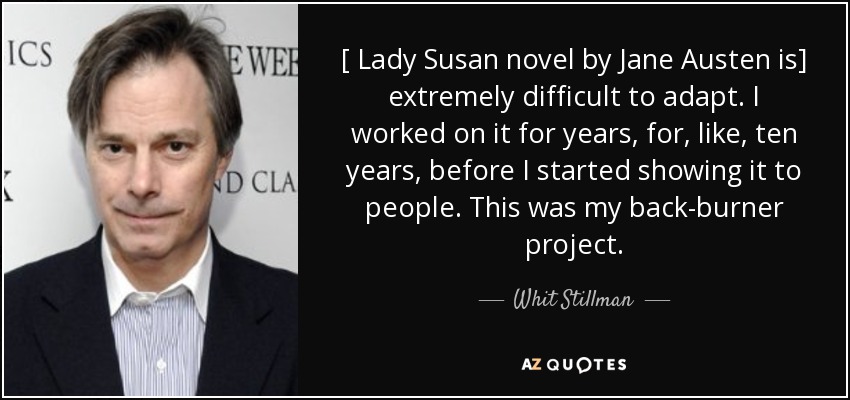
[ Lady Susan novel by Jane Austen is] extremely difficult to adapt. I worked on it for years, for, like, ten years, before I started showing it to people. This was my back-burner project.
A part of that [timewrap] for me was growing up in a culture that violence had always been a part of. It wasn't an aberration, though I realize that in retrospect. I grew up in the part of the U.S. where all of Cormac McCarthy's novels are set and that's a pretty violent place.
A novel is a performance you have to plan.
I turned to the Partition experiences, which were churning in my mind. Then came my first novel Train to Pakistan.
My job on The Gunslinger Born was to take Stephen King's novel and transform it into a detailed, seven issue, scene-by-scene story.
In order to capture Mid-World for new readers, I had to streamline the original tale [ The Gunslinger Born], but I also had to incorporate scenes from earlier Dark Tower novels.
I suppose that, for me at least, the biggest difference betweenThe Gunslinger Born and the next two story arcs (The Long Road Home and Treachery), is that while Gunslinger Bornwas a translation of an existing novel, the next two arcs are really the stories that I've been weaving since I first started working with Steve King on the Dark Tower back in 2000/2001.
I'm working on a young adult novel. I've been working on it for a while, because I don't know how to write a novel and I'm teaching myself. For that reason, I've been reading a lot of YA [young adults], which I never have before. It's totally new to me.
Sometimes someone will tell me about an author I've never heard of before and that will send me to that person. That's how I discovered Thomas Bernhard, an Austrian novelist whose novels tend to be one long rant.
I was a teenager when General Zia took power in the Pakistan; I was in my twenties when I went there during the late 1980s and I saw then not only the novel punishments that he was introducing - because they were novel, and this is again something that's very important to understand, it's only in the last thirty, forty years, since 1979 in fact, that these penalties have been revived anywhere in the world apart from Saudi Arabia.
Maybe you could even think 100,000 people are inside each human being. And you drop a novel on that person, and a certain number of those sub-people come alive or get reenergized for some finite time.
The novel leads you places that you never could have gotten to otherwise.
I never bought the idea of individual genius from which the novel spews forth. It's always an act of curation.
It's not in good taste to have talking ghosts in a grown-up novel.
For me, George Saunders novel [Lincoln in the Bardo] is about a problem of pain.
With a novel, you have the reader with you a lot longer, and you owe him a lot more. Obviously you have to have a plot - I say "obviously," although I think a lot of fiction doesn't, and nothing seems to happen. But to me, there should be something that happens, and it should be at least vaguely plausible. And because the readers are going to be with these characters for a long time, you have to get to know them and like them and want to know what happens to them.
The Holocaust is not a cheap soap opera. The Holocaust is not a romantic novel. It is something else.
People who wrote literary novels about the past probably didn't want them pegged as historical fiction. Certainly that was true in England.
For a while Australians were desperately trying to be cosmopolitan. I think it is a pointless exercise. Australian novels are those rooted in Australia, with Australian landscapes and colours. My work has always had bits of Western Australia in it. It is always here. The world comes to us.
At Princeton I wrote my junior paper on Virginia Woolf, and for my senior thesis I wrote on Samuel Beckett. I wrote some about "Between the Acts" and "Mrs. Dalloway'' but mostly about "To the Lighthouse." With Beckett I focused, perversely, on his novels, "Molloy," "Malone Dies," and "The Unnamable." That's when I decided I should never write again.
I would say recently I've gotten back to perusing [Samuel] Beckett's novels. Listening to the way Donald Trump speaks without saying anything has made me think about language.
I'm not reading currently because I'm getting revisions of a novel. If I read while I'm writing I will unconsciously plagiarize and go to jail.
I will read biographies or autobiographies while I'm writing, but mostly I put books in a to-read queue, like Rachel Cusk's new novel, "Outline."
In Italian, the word for novel is romanzo, "the romance." The English is "novel" - something new. Both of those elements, experimentation and love, are fundamental to the form.
I've read the Bible. I think the Bible's a great book, but it's a novel. It's beautifully written and la-di-da, but people really took it the wrong way.
Follow AzQuotes on Facebook, Twitter and Google+. Every day we present the best quotes! Improve yourself, find your inspiration, share with friends
or simply: