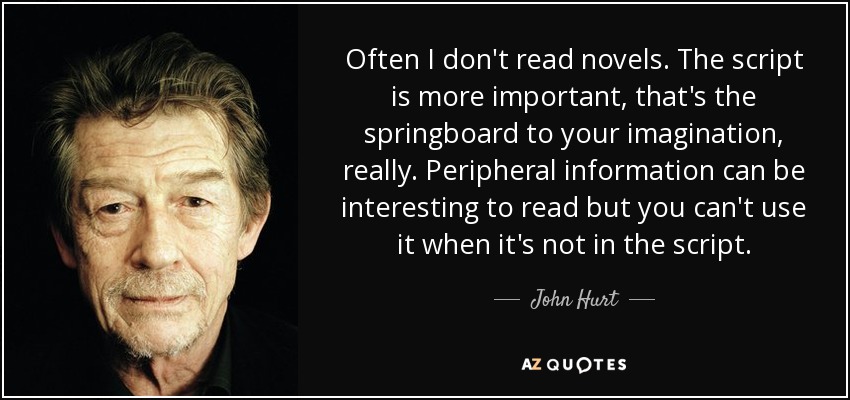
Often I don't read novels. The script is more important, that's the springboard to your imagination, really. Peripheral information can be interesting to read but you can't use it when it's not in the script.
You cross a border and the policeman or the frontier policeman look at you, What are you doing here? Why are you coming? How long will you stay? Well, if I had nearly enough years, I would write a novel about being a refugee.
[ Lady Susan novel by Jane Austen is] extremely difficult to adapt. I worked on it for years, for, like, ten years, before I started showing it to people. This was my back-burner project.
A part of that [timewrap] for me was growing up in a culture that violence had always been a part of. It wasn't an aberration, though I realize that in retrospect. I grew up in the part of the U.S. where all of Cormac McCarthy's novels are set and that's a pretty violent place.
Jim Harrison is someone I always enjoy, one of the great contemporary writers. I like Tim Ferris' Big Boom Theory. I'm getting into a different kind of reading, not straight novels.
I try to write in the morning when I'm working on a novel. You get up, you have breakfast, you read the paper, you make a couple of phone calls, and then you sit on the couch and start. I use felt pen and white notepaper.
My job on The Gunslinger Born was to take Stephen King's novel and transform it into a detailed, seven issue, scene-by-scene story.
As you know, transforming such a big book [The Gunslinger Born] into graphic novel format is really a process of translation.
In the earlier novels, Steve King tells us that John Farson, and perhaps even the Crimson King himself, are but other names and faces that belong to Walter O'Dim. However, in The Dark Tower, he tells us very clearly that Walter, John Farson, and the Crimson King are actually separate individuals.
Reading a good poem can give me a far bigger kick than a novel. But it's not something I can keep doing. It would be like shooting up 10 times a day.
I read novels for entertainment rather than for edification, so I tend not to read the sort of novels that are said to illuminate the human condition.
Everything that I write comes when it wants to, out of its own need and it dictates its form. I don't say, "I am going to write a novel."
The novel leads you places that you never could have gotten to otherwise.
I never bought the idea of individual genius from which the novel spews forth. It's always an act of curation.
For me, George Saunders novel [Lincoln in the Bardo] is about a problem of pain.
Every novel starts with a theme, and I am constantly looking for big ideas.
With a novel, you have the reader with you a lot longer, and you owe him a lot more. Obviously you have to have a plot - I say "obviously," although I think a lot of fiction doesn't, and nothing seems to happen. But to me, there should be something that happens, and it should be at least vaguely plausible. And because the readers are going to be with these characters for a long time, you have to get to know them and like them and want to know what happens to them.
The Holocaust is not a cheap soap opera. The Holocaust is not a romantic novel. It is something else.
I don't think I'll write a large novel again because it was like being in jail for me. Even though that's the funniest book I've ever written, it was the saddest period of my life.
Tradition has to be retaken by the liberal forces, so that they can show their values of tolerance and democracy not as novel western ideas but as ones indigenous to Pakistan, as a part of its very creation.
It is impossible to do a movie exactly the way a comic book is written and drawn, just as it's impossible to do a movie exactly like a novel or exactly like anything else. When you go to different forms of media, you have to adapt.
At Princeton I wrote my junior paper on Virginia Woolf, and for my senior thesis I wrote on Samuel Beckett. I wrote some about "Between the Acts" and "Mrs. Dalloway'' but mostly about "To the Lighthouse." With Beckett I focused, perversely, on his novels, "Molloy," "Malone Dies," and "The Unnamable." That's when I decided I should never write again.
I'm not reading currently because I'm getting revisions of a novel. If I read while I'm writing I will unconsciously plagiarize and go to jail.
I will read biographies or autobiographies while I'm writing, but mostly I put books in a to-read queue, like Rachel Cusk's new novel, "Outline."
We think of the romance novel as a lesser form of literature, but I don't think that's true. Love is a very important aspect of human life and worth exploring.
Follow AzQuotes on Facebook, Twitter and Google+. Every day we present the best quotes! Improve yourself, find your inspiration, share with friends
or simply: