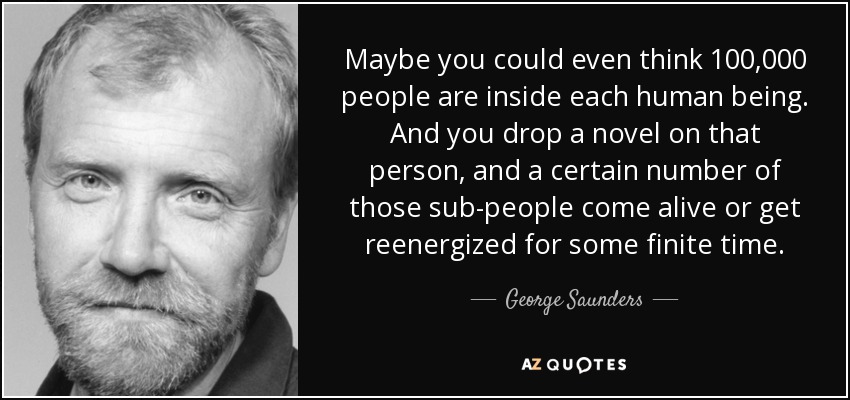
Maybe you could even think 100,000 people are inside each human being. And you drop a novel on that person, and a certain number of those sub-people come alive or get reenergized for some finite time.
First of all, all writing includes some part of the self. The relationship of the self and the other exists in writing, whether autobiographical or novel. There is a self and an other.
There's a perception that novels can't usually allow for your kind of absolute attention to detail.
It's not in good taste to have talking ghosts in a grown-up novel.
Every novel starts with a theme, and I am constantly looking for big ideas.
I love James Baldwin essays, but also his novels. I recently read "Another Country." I couldn't believe how ahead of his time he was.
My first book was a historical novel. I started writing in 1974. In those days, historical novels meant ladies with swelling bosoms on the cover. Basically, it meant historical romance. It was not respectable as a genre.
People who wrote literary novels about the past probably didn't want them pegged as historical fiction. Certainly that was true in England.
Everything that I write comes when it wants to, out of its own need and it dictates its form. I don't say, "I am going to write a novel."
I can't do a linear novel. I'm just going to write what I need to write.
Comics are stories; they're like novels or anything else. So the first thing you have to do is become a good storyteller.
It is impossible to do a movie exactly the way a comic book is written and drawn, just as it's impossible to do a movie exactly like a novel or exactly like anything else. When you go to different forms of media, you have to adapt.
I would say recently I've gotten back to perusing [Samuel] Beckett's novels. Listening to the way Donald Trump speaks without saying anything has made me think about language.
I'm a big Philip Roth fan. I think "American Pastoral" is the great American novel of the past 30 to 40 years. It's a novel about what happened in the 1960s, and I think America is still dealing with what happened then. It's devastatingly sad.
TV was the boogey man when I was growing up. Video games are the boogey man now. The novel was once a boogey man. Books about lowborn people doing lowborn things were once considered a real assault on people's morals. Maybe some day video games will be looked on as a good thing, but personally I don't see it.
I've read the Bible. I think the Bible's a great book, but it's a novel. It's beautifully written and la-di-da, but people really took it the wrong way.
In my experience, writing a novel tends to create its own structure, its own demands, its own language, its own ending. So for much of the period in which I'm writing, I'm waiting to understand what's going to happen next, and how and where it's going to happen. In some cases, fairly early in the process, I do know how a book will end. But most of the time, not at all, and in this particular case, many questions are still unanswered, even though I've been working for months.
This was my first novel [The Dissemblers ]. I've never seriously written short stories, and actually find short stories much more intimidating as an art form than novels.
I'd always hoped to write the story as a novel, but there was a long period when the [Bridget Jones's Baby: The Diaries] movie was stalled and in confusion. I felt frustrated creatively, and just couldn't work on the Baby material till the movie was sorted out.
People don't like to say comic so they say Graphic Novel, despite the fact that I don't think the true Graphic Novel has been written anywhere.
I got into my usual obsessive writing frenzy, using all the material I'd worked on for so long and crafting it into a little novel [Bridget Jones's Baby: The Diaries].
From beginning to end, the novel [Dissemblers] took about three and a half years to write. I didn't write it chronologically.
That's when the idea for Mad About the Boy arrived. It wasn't even a Bridget [Jones] story initially - then I realized I was writing in Bridget's voice and it grew from there into a Bridget novel.
I think I'm succinct to the point of trying to write the two-word novel. Editing my work almost never means taking anything out but rather adding, because I'm always stripping down. I tend to under-write rather than over-write.
It really does feel, partly because of graphic novels kids read, like there's a lot of freedom with how you can use both images and words, because we think in both of those ways.
Follow AzQuotes on Facebook, Twitter and Google+. Every day we present the best quotes! Improve yourself, find your inspiration, share with friends
or simply: