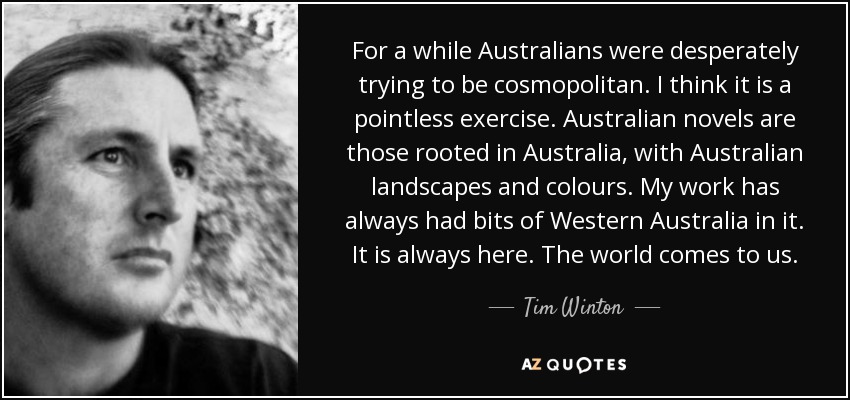
For a while Australians were desperately trying to be cosmopolitan. I think it is a pointless exercise. Australian novels are those rooted in Australia, with Australian landscapes and colours. My work has always had bits of Western Australia in it. It is always here. The world comes to us.
I believe a good memoir should have all of the narrative elements of a novel: character development, dialogue, descriptive language, and metaphor.
Writing grew out of the pleasure of escape. My novels are very much outside of my personal experience. That is why I love writing fiction. It allows me to leave my existence and inhabit other lives.
I think I've learned a lot about how to make movies, and particularly about how to edit movies by thinking about how similar problems are resolved in other forms. The issues in all forms are the same in an abstract sense, aren't they? Characterization, abstraction, metaphor, passage of time... Whether it's a movie, a novel, a play, or a poem, those issues exist. And each person resolves them differently.
Strip away the morphing landscapes and rips in the space-time continuum, and my stories are about things that novels have always been about: love and sex and identity and memory and history and redemption.
Shamefulness is always a huge part of my characterizations. I like protagonists that reveal, either through "honesty" in their various thought processes or via their actions, perhaps telling us things they're not so keen on disclosing through their interactions with the outside world. Probably both during the duration of a novel.
I think fiction allows you to inhabit new domains and it's you, the reader living in that domain for a few days that results in a deeper understanding as opposed to the novel proclaiming this is what it is right and this is what is wrong.
I always was interested in prose. As a teenager, I published short stories. And I always wanted to write the long short story, I wanted to write a novel. Now that I have attained, shall I say, a respectable age, and have had experiences, I feel much more interested in prose, in the novel. I feel that in a novel, for example, you can get in toothbrushes and all the paraphernalia that one finds in dally life, and I find this more difficult in poetry.
I can see myself wanting to write a historical novel - you don't need to worry about references to reality TV or pop music, you can just get on with the basics of story and character.
I've always got a book in my hands, a novel in my hands. The more I get into film, the more paranoid I get that I'm going to stop seeing things.
Somebody said, 'Hey, there is a lull in your career. Why don't you write books about your [dyslexia]?' We are currently writing our 34th novel.
Graphic novels might really speak to one child who's struggling with the other kinds of reading and might help them discover that storytelling is joyful and personal and illuminating. They might find your way in auditorily by listening to audio books in the car instead of playing Game Boys or watching DVDs.
I feel engaged with young people in Pakistan. But that said, it's still a small minority that reads novels, literary fiction. But it isn't necessarily a small minority of the wealthy elite in the city of Lahore. It can often be and I often do meet at literary festivals students who've ridden a bus 12 hours from a very small town just to hear some of their favorite writers come and speak.
Novels function and the power of novels function because of their stories.
One of the most difficult things in writing a novel or anything at all is to choose the point of view from which it's going to be told.
I'm not typing. I write only by longhand. I've always written first drafts by hand and then once I was into a second or third draft I wrote insert pages on a typewriter. But I got rid of all my typewriters about three or four novels ago and now I do everything by hand. I write by hand because it makes me go slow and going slow is what I like.
The concept of writing a novel and not knowing where it's going - I don't know how to do that. Novels are plot- and character-driven, so if I don't know what becomes of people, how can I know where it should begin?
When writing a novel, I'm not smart enough to know how to foreshadow something if I don't know what it is.
In an episodic treatment, such as a teleplay is, you have the ability to do what you can do in a novel, which is flash back and flash forward in the same instant, in the same scene, in the same voice.
It's not an accident that, while bookstores are all in a tizzy, one of the more lively and alive sections is the so-called "graphic novel" section, because those are harder to replace.
There were [in Wilson] a lot of clues in it that you don't normally get, you know, normally you use your imagination or whatever, you get some clues in the script, of course, but yeah, it was really helpful, and I really like the graphic novel. There's stuff in there, there's a couple things in there I really wanted to use that they couldn't get in the movie, but it's definitely, he's a unique guy, you know, I never read a character like this before.
When I am writing novels I don't read a lot of novels so I try to catch up in-between.
I want to write novels. I want to write stories. I want to do the stuff that I became a writer to do.
I don't like to think in terms of writing ten or twelve pages a day. Usually I'm writing a scene, and it's always with the idea, "I wonder what is going to happen." Or sometimes I write about something that affected me emotionally the day before and that I don't want to lose. I'm very unorganized at first; but finally it comes into a structure where consciously I'm working on a novel per se.
I follow my own nose. So I read things that are different. People will always say to me, "Have you read Robert S. Bosco's latest novel?" or "Have you read so and so's history of Peru, which is reviewed in the New York Review of Books and the New York Times and has a buzz about it?" I don't even know what you're talking about. I'm like from another planet. I'm a pygmy from the jungle.
Follow AzQuotes on Facebook, Twitter and Google+. Every day we present the best quotes! Improve yourself, find your inspiration, share with friends
or simply: