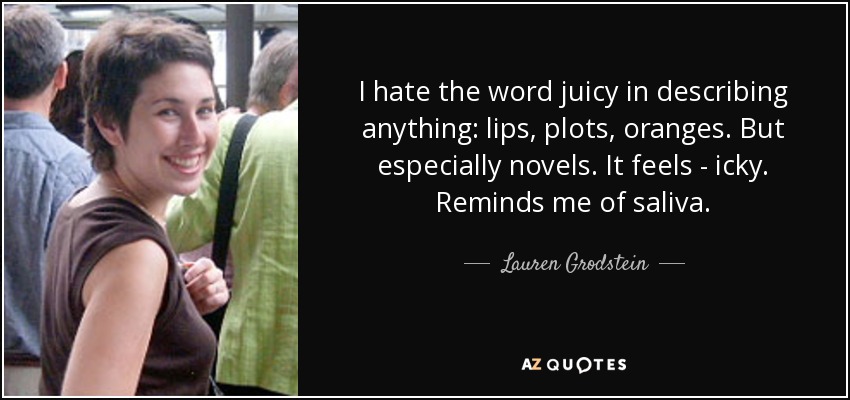
I hate the word juicy in describing anything: lips, plots, oranges. But especially novels. It feels - icky. Reminds me of saliva.
I write with the idea that nobody will care about what I've written; I publish with the idea that nobody will care either. Which is why every time somebody cares enough to read a novel of mine, or respond to it - a reader, a reviewer, even my own editor - I'm a little bit amazed, and so hugely grateful.
I don't yet know what style will be required for my next novel, but my sense is that each book will involve a new relationship to language.
I love short stories. They're like small imploding universes. They are very tightly bound and controlled. I'd been wanting to write one for ages but just got tangled up in novels. The novel is the same in the sense that it is also a universe, but it explodes outwards with all that shrapnel going in several different directions. I don't see too much difference in the forms except for the fact that writing short stories is like sprinting rather than long-distance running.
The reason I did the name change is simple. I wrote a bunch of autobiographical material and I was really enjoying myself doing it, and in two of the songs I quote two different people (referring to me as Mr. Stace). And it just hit me at some point that it was ludicrous for me to think of myself as Wesley Stace, publish novels as Wesley Stace, be Wesley Stace and not have it released as Wesley Stace.
Novels may have taken care of the emotional business for me, which has allowed music to be more emotional for me.
In the earlier novels, Steve King tells us that John Farson, and perhaps even the Crimson King himself, are but other names and faces that belong to Walter O'Dim. However, in The Dark Tower, he tells us very clearly that Walter, John Farson, and the Crimson King are actually separate individuals.
What usually happens is that when I'm nearing the end of one novel a vague idea about what I want to do next begins to present itself to me in terms of theme. And I would say over about the next six to eight months, usually as I'm out power walking in the morning, or when I'm cooking at night, or when I'm driving in the car, the people who might embody those themes take on a sharper and sharper focus. And there comes this sort of critical mass moment when they actually start to do things in my head.
The condition of visibility as it relates to black people was crucial. Connected to that, I've always been interested in science fiction and horror films and was acutely aware of the political and social implications of Ralph Ellison's description of invisibility as it relates to black people, as opposed to the kind of retinal invisibility that H.G. Wells described in his novel Invisible Man.
I'm reading "Team of Rivals'' I'll probably ending up reading a bunch of books about the Civil War. But I think my all-time favorite book about the war is the novel, "The Killer Angels'' by Michael Shaara.
I first told the idea to an editor I had met who, after reading one of my novels for adults that was set in a high school, had an idea that I might write something for children.
When I was researching my very first novel, "The Basic Eight," I was calling right-wing political and religious organizations and asking them to mail me their material so that I could mock them in my novels.
A part of that [timewrap] for me was growing up in a culture that violence had always been a part of. It wasn't an aberration, though I realize that in retrospect. I grew up in the part of the U.S. where all of Cormac McCarthy's novels are set and that's a pretty violent place.
Jim Harrison is someone I always enjoy, one of the great contemporary writers. I like Tim Ferris' Big Boom Theory. I'm getting into a different kind of reading, not straight novels.
I turned to the Partition experiences, which were churning in my mind. Then came my first novel Train to Pakistan.
I am concerned that people who admire [Ayn] Rand are not often critical enough of the extent to which she has abridged the implications of [her] novels.
I don't know what people think they're trying to do with literary novels, but they're trying to do something. They're trying to change the world, although that's so crazy. That's just delusional. But I recognize that it's crazy. It will be a little dinky change.
My job on The Gunslinger Born was to take Stephen King's novel and transform it into a detailed, seven issue, scene-by-scene story.
In order to capture Mid-World for new readers, I had to streamline the original tale [ The Gunslinger Born], but I also had to incorporate scenes from earlier Dark Tower novels.
I suppose that, for me at least, the biggest difference betweenThe Gunslinger Born and the next two story arcs (The Long Road Home and Treachery), is that while Gunslinger Bornwas a translation of an existing novel, the next two arcs are really the stories that I've been weaving since I first started working with Steve King on the Dark Tower back in 2000/2001.
I'm working on a young adult novel. I've been working on it for a while, because I don't know how to write a novel and I'm teaching myself. For that reason, I've been reading a lot of YA [young adults], which I never have before. It's totally new to me.
Sometimes someone will tell me about an author I've never heard of before and that will send me to that person. That's how I discovered Thomas Bernhard, an Austrian novelist whose novels tend to be one long rant.
What was fun for me with this book [Lincoln in the Bardo] was to start out with the principle that went, "We're going to fight every day to make this not a novel; make it too short to be a novel." And then with that principle in place, the book sort of starts to say, "Okay, but I really need this. I really need some historical nuggets." And you're like, "All right, but keep it under control."
Maybe you could even think 100,000 people are inside each human being. And you drop a novel on that person, and a certain number of those sub-people come alive or get reenergized for some finite time.
One thing you learn about the novel as a form is that it's always smarter than you are.
Follow AzQuotes on Facebook, Twitter and Google+. Every day we present the best quotes! Improve yourself, find your inspiration, share with friends
or simply: