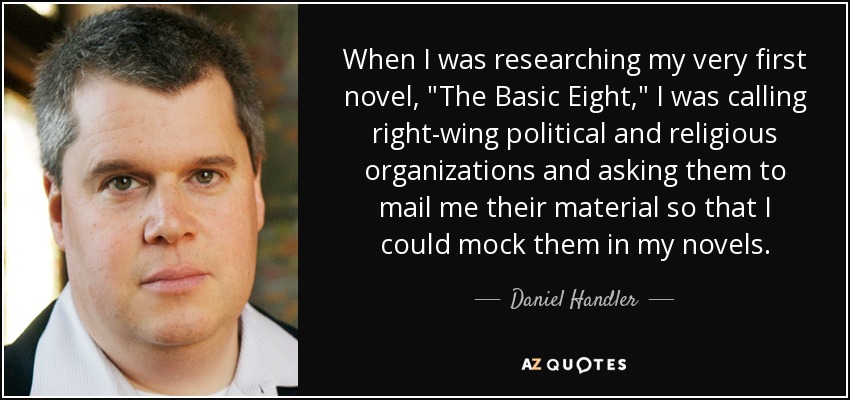
When I was researching my very first novel, "The Basic Eight," I was calling right-wing political and religious organizations and asking them to mail me their material so that I could mock them in my novels.
Often I don't read novels. The script is more important, that's the springboard to your imagination, really. Peripheral information can be interesting to read but you can't use it when it's not in the script.
Decline and Fall was a very depressing Evelyn Waugh novel, I think it was his first. I didn't get it at all, and then I got to love Waugh. And I think that maybe "Cosmopolitans" has a bit of an Evelyn Waugh vibe to it at some point.
My novels are very much the same, as I think many people's novels are.
[My maternal grandmother ] was a teacher in London and elsewhere during the war, although the children she taught were not the "lost children" who feature in the novel - those come from my research.
A police procedural novel can be even funnier if the police include Trolls and Dwarves and things like that. You start looking at the whole basis of the cop novel. You get the cop moving in a different way when you've actually set it in a fantasy city.
People don't like to say comic so they say Graphic Novel, despite the fact that I don't think the true Graphic Novel has been written anywhere.
I mistrust the term graphic novel because it sounds like a good thing to put on a tee-shirt. That's why the French like them.
From beginning to end, the novel [Dissemblers] took about three and a half years to write. I didn't write it chronologically.
I'm working on a novel about a girl who grows up in the circus and her relationship with her father, who grew up in Hungary when it was under Soviet control and left during the 1956 revolution. It is told from both of their perspectives, and has been a joy (and very frustrating) to research and write. Needless to say, I am very excited about my next project!
I have a different purpose in writing each novel. Some of them seem more similar than others, but the purposes are always different.
I think the recent cluster of WWII novels is so good because we have reached an optimal distance from the war. Just as a lens has its focal length, the novel also has its best distance from the action.
I'm very secretive. I'll write a whole novel and revise it, which might take me two years or more, and the people I know best don't know what I'm writing about.
I get to a certain point, and I think in a novel it's about the third draft, when I want other eyes on it.
I think people feel for a long time that they ought to know how to write a novel in two drafts.
The question I hate the most is "How did you DO it - write novels and raise your children simultaneously!" I mean, do MALE authors get asked that??
Movies and novels, the two things that informed and taught me the most, are forms of escapism. I thought that was how life could look if you wanted it to.
I hate it when people tell me the end of the story because my mother always read the last page of a novel first to see whether she wanted to read it. It was a strange reading habit.
I try to stick with what moves me or teaches me about myself, same thing I hope the novels do for others.
I won't read novels while writing novels.
Novels may have taken care of the emotional business for me, which has allowed music to be more emotional for me.
The book that really, really shaped my politics and has forever is Arthur Koestler's "Darkness at Noon," which is a novel based on terrible fact about what it was like in Russia during Stalin's time when people actually believed that to get to the point where the Proletariat would triumph, anything that was necessary to be done should be done; the means didn't count.
Of course, there are hundreds of novels and authors that have influenced me. But to choose three, they are: Stephen King/The Stand (and really most of his books); Anne Rice/The Witching Hour; and Pat Conroy/The Prince of Tides. These authors write my favorite kind of book - epic feel, gorgeous prose, unique characters, and a pace that keeps you turning the pages. From them, I learned a lot about characterization, pacing, prose, voice, and originality.
I think The Nightingale is my best, most mature, most moving novel, but maybe that's just because I love these characters. I love the setting.
I hate the word juicy in describing anything: lips, plots, oranges. But especially novels. It feels - icky. Reminds me of saliva.
Follow AzQuotes on Facebook, Twitter and Google+. Every day we present the best quotes! Improve yourself, find your inspiration, share with friends
or simply: