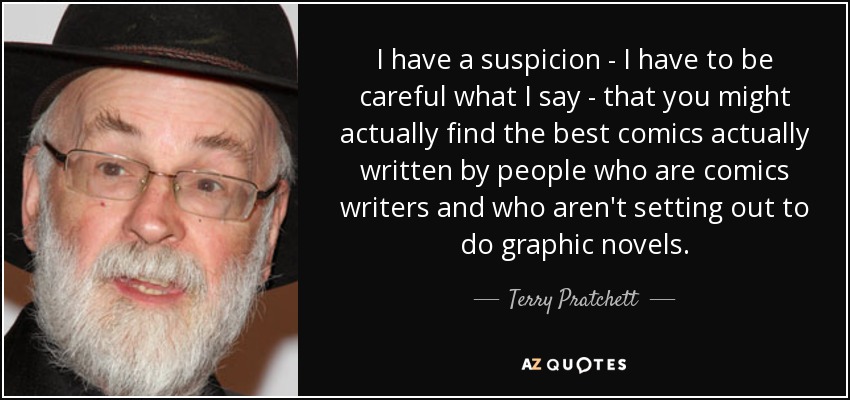
I have a suspicion - I have to be careful what I say - that you might actually find the best comics actually written by people who are comics writers and who aren't setting out to do graphic novels.
I got into my usual obsessive writing frenzy, using all the material I'd worked on for so long and crafting it into a little novel [Bridget Jones's Baby: The Diaries].
That's when the idea for Mad About the Boy arrived. It wasn't even a Bridget [Jones] story initially - then I realized I was writing in Bridget's voice and it grew from there into a Bridget novel.
People don't like to say comic so they say Graphic Novel, despite the fact that I don't think the true Graphic Novel has been written anywhere.
I've read about eight or ten of the original novels, and one of them is where Maigret's in bed for the entire story! His wife is running around and solving the case!
Movies and novels, the two things that informed and taught me the most, are forms of escapism. I thought that was how life could look if you wanted it to.
I read novels for entertainment rather than for edification, so I tend not to read the sort of novels that are said to illuminate the human condition.
I knew the basic outline of the novel [The Dissemblers] and would write whatever scene of the book I felt particularly excited about at the time.
I hate it when people tell me the end of the story because my mother always read the last page of a novel first to see whether she wanted to read it. It was a strange reading habit.
I have a different purpose in writing each novel. Some of them seem more similar than others, but the purposes are always different.
My novels are very much the same, as I think many people's novels are.
I write in the novel's afterword that our recent wars "finish not with victory or defeat but with a calendar draw-down date and a presumption that we shall never be reconciled with the enemy".
We have to diversify, we have to find work we can do that helps other people while helping ourselves, work that has to do with writing that isn't necessarily just writing saleable novels or getting huge advances.
I'm working on a novel about a girl who grows up in the circus and her relationship with her father, who grew up in Hungary when it was under Soviet control and left during the 1956 revolution. It is told from both of their perspectives, and has been a joy (and very frustrating) to research and write. Needless to say, I am very excited about my next project!
One of the most difficult things in writing a novel or anything at all is to choose the point of view from which it's going to be told.
From beginning to end, the novel [Dissemblers] took about three and a half years to write. I didn't write it chronologically.
I mistrust the term graphic novel because it sounds like a good thing to put on a tee-shirt. That's why the French like them.
A police procedural novel can be even funnier if the police include Trolls and Dwarves and things like that. You start looking at the whole basis of the cop novel. You get the cop moving in a different way when you've actually set it in a fantasy city.
My idea of a good novel was one you made enough money out of to buy a greenhouse.
I'd always hoped to write the story as a novel, but there was a long period when the [Bridget Jones's Baby: The Diaries] movie was stalled and in confusion. I felt frustrated creatively, and just couldn't work on the Baby material till the movie was sorted out.
The woman who led [downed airmen] was named Andrée De Jongh and her story - one of heroism and peril and astounding courage - became the inspiration for my novel.
In my experience, writing a novel tends to create its own structure, its own demands, its own language, its own ending. So for much of the period in which I'm writing, I'm waiting to understand what's going to happen next, and how and where it's going to happen. In some cases, fairly early in the process, I do know how a book will end. But most of the time, not at all, and in this particular case, many questions are still unanswered, even though I've been working for months.
I knew from previous books not to count on anything in terms of sales. My first novel - -The Raven's Bride, about Sam Houston's disastrous first marriage - -sold well and got attention, but my second book - -Promised Lands, about the Texas Revolution - -didn't.
My Italian-American heritage, of which I'm very proud and with which I identify strongly, surfaces in several of my novels.
The question I hate the most is "How did you DO it - write novels and raise your children simultaneously!" I mean, do MALE authors get asked that??
Follow AzQuotes on Facebook, Twitter and Google+. Every day we present the best quotes! Improve yourself, find your inspiration, share with friends
or simply: