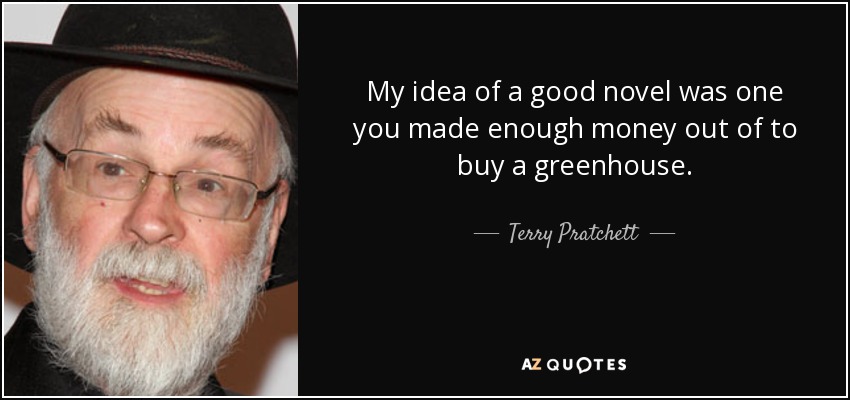
My idea of a good novel was one you made enough money out of to buy a greenhouse.
We have to diversify, we have to find work we can do that helps other people while helping ourselves, work that has to do with writing that isn't necessarily just writing saleable novels or getting huge advances.
I think people feel for a long time that they ought to know how to write a novel in two drafts.
I had read [Charles] Dickens's novels were often published serially. I thought it would be fun to write a book, just sitting down and writing a chapter every day, not knowing what would happen next. So that's how I wrote the first draft. And then of course I had to go back and make sure everything worked and change things.
The book that really, really shaped my politics and has forever is Arthur Koestler's "Darkness at Noon," which is a novel based on terrible fact about what it was like in Russia during Stalin's time when people actually believed that to get to the point where the Proletariat would triumph, anything that was necessary to be done should be done; the means didn't count.
My Italian-American heritage, of which I'm very proud and with which I identify strongly, surfaces in several of my novels.
I'm easily persuaded that a really good novelist who gets inside somebody else's head could be serving a valuable purpose. I enjoy satirical novels that take a wry, humorous, ironic look at modern life.
I've read about eight or ten of the original novels, and one of them is where Maigret's in bed for the entire story! His wife is running around and solving the case!
I knew from previous books not to count on anything in terms of sales. My first novel - -The Raven's Bride, about Sam Houston's disastrous first marriage - -sold well and got attention, but my second book - -Promised Lands, about the Texas Revolution - -didn't.
Of course, there are hundreds of novels and authors that have influenced me. But to choose three, they are: Stephen King/The Stand (and really most of his books); Anne Rice/The Witching Hour; and Pat Conroy/The Prince of Tides. These authors write my favorite kind of book - epic feel, gorgeous prose, unique characters, and a pace that keeps you turning the pages. From them, I learned a lot about characterization, pacing, prose, voice, and originality.
Jim Harrison is someone I always enjoy, one of the great contemporary writers. I like Tim Ferris' Big Boom Theory. I'm getting into a different kind of reading, not straight novels.
A part of that [timewrap] for me was growing up in a culture that violence had always been a part of. It wasn't an aberration, though I realize that in retrospect. I grew up in the part of the U.S. where all of Cormac McCarthy's novels are set and that's a pretty violent place.
I hate the word juicy in describing anything: lips, plots, oranges. But especially novels. It feels - icky. Reminds me of saliva.
I don't yet know what style will be required for my next novel, but my sense is that each book will involve a new relationship to language.
I love short stories. They're like small imploding universes. They are very tightly bound and controlled. I'd been wanting to write one for ages but just got tangled up in novels. The novel is the same in the sense that it is also a universe, but it explodes outwards with all that shrapnel going in several different directions. I don't see too much difference in the forms except for the fact that writing short stories is like sprinting rather than long-distance running.
A creative person can suddenly realize it's not 90 minutes. They haven't got to do three acts, they haven't got to do the arc, but they can do other things. I think just as novellas turned into novels, I think that television series can begin to have that depth.
I'm not suggesting that ours [series] is unique in that, but they can begin to have that depth, that gravity, they can spend some time, so it's a bit more like reading a good novel, if you like.
What usually happens is that when I'm nearing the end of one novel a vague idea about what I want to do next begins to present itself to me in terms of theme. And I would say over about the next six to eight months, usually as I'm out power walking in the morning, or when I'm cooking at night, or when I'm driving in the car, the people who might embody those themes take on a sharper and sharper focus. And there comes this sort of critical mass moment when they actually start to do things in my head.
I think books in which people are really happy and things are going well are probably the most challenging novels there are to write, and there are very few of them.
I'm halfway through a novel set in two time frames - Austin in the 1960's and Alpine (Texas) in present day. It started out to be a small, lighthearted, humorous book about family relationships; I was tired of writing war stories and tragedies.
I'm reading "Team of Rivals'' I'll probably ending up reading a bunch of books about the Civil War. But I think my all-time favorite book about the war is the novel, "The Killer Angels'' by Michael Shaara.
When I was researching my very first novel, "The Basic Eight," I was calling right-wing political and religious organizations and asking them to mail me their material so that I could mock them in my novels.
Often I don't read novels. The script is more important, that's the springboard to your imagination, really. Peripheral information can be interesting to read but you can't use it when it's not in the script.
Decline and Fall was a very depressing Evelyn Waugh novel, I think it was his first. I didn't get it at all, and then I got to love Waugh. And I think that maybe "Cosmopolitans" has a bit of an Evelyn Waugh vibe to it at some point.
[ Lady Susan novel by Jane Austen is] extremely difficult to adapt. I worked on it for years, for, like, ten years, before I started showing it to people. This was my back-burner project.
Follow AzQuotes on Facebook, Twitter and Google+. Every day we present the best quotes! Improve yourself, find your inspiration, share with friends
or simply: