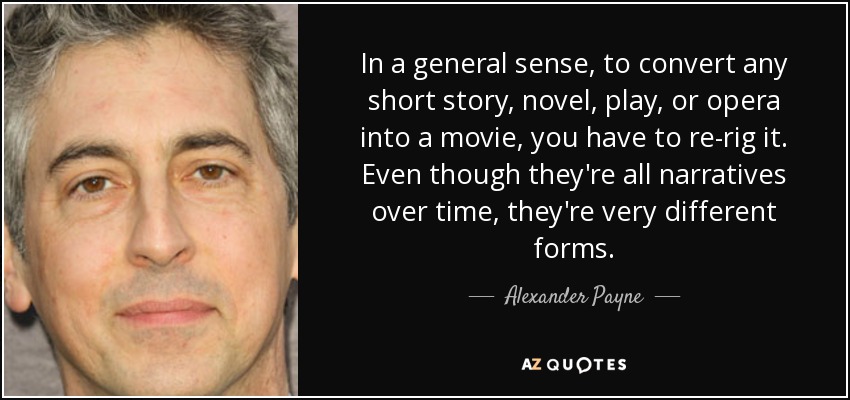
In a general sense, to convert any short story, novel, play, or opera into a movie, you have to re-rig it. Even though they're all narratives over time, they're very different forms.
All my novels are rooted in their time and in their place. The place of my novels is Israel, almost without exception. Almost without exception, my novels are rooted in Israel because that's the place I know well. And, that's my gutsy advice to any young writer: write only about what you know well. Don't write about that which you don't know.
We have this huge discourse on family in this country, but no one deconstructs it the same way. People talk about "the American family." The right wing has this thing - Focus on the Family. What the hell is that? I don't want to just discuss the issues - I want family to be a real part of the character of the novels I write, and I don't like to write things that feel like issue books.
I want to view my own efforts to write a novel as a function of my own artistic aspirations rather than a good career move. And I need to learn how to commit to characters for a longer time, to confront the limits of my own capacities for attention and compassion. That's what a writing career does, in the best instance: it allows you to keep after what you can't do.
I'm writing a novel about the Syrian war. It will be completely different from my short stories. I have to address my feelings directly because I cannot avoid the war. It's something in my soul, in my blood.
When I need to take a side, I write a newspaper article and I tell my government, "You should not do that, you should do this." They don't listen to me, but I've been doing this for sixty years now. But, when I write a novel, I am not in that business. I follow the way people change. I follow the way people, who are very antagonized to one another become very close to one another and vice-versa. Sometimes I follow the way people who are intimately close to each other move apart.
Black Box is not a statement about injustice committed against Sephardi Oriental Jews or about the extremism of religious Jews or the lack of imagination of the old Israeli elites. It's a human story, in my view, first and foremost about a mystical communion between enemies. This is the inner story of the novel. This is my business as a novelist. It is not about positions and ideas.
Israel is a fulfilled dream. Nothing that exists here existed here a hundred years ago. "The State of the Jews" was not a title of a country. It was a title of a futuristic novel. A little more than a hundred years ago, "Tel Aviv" was not a city. It was a title of another novel written by the same author. The "Return to Zion" was a name of another novel. There was a bookshelf. There was no state. There was no nation. All you can see, if you look through the window - everything you see is a fulfillment of dreams, different dreams.
Film has changed vastly in the time that I've been an actor, and it's, I think, very much for the better. I think there are just magnificent films now, and they're blossoming in the way that the novel did years ago.
I wish I could go back and re-write my first novel for the first time. Because I really didn't know what I was doing, and although it was published, it is, after all this time, kind of an embarrassment.
The truth about being a writer is you do not choose the stories you tell, but stories choose you. You do not choose, therefore, characters either. Novels are like dreams you dream with your eyes open; they are books which appear in your head with the same apparent immediateness as they appear in your dreams at night. A writer always writes their obsessions and the truth is that all throughout life we end up writing the same thing in different ways.
I've always believed that poetry must speak of realities as least as complicated as those spoken of in prose. I've read books of poems, even single poems, which are, for me, at least the equivalent of a short story or a novel. Martin Amis, in an interview with Saul Bellow in the early eighties, quotes Bellow asking, "Why not address 'the mysterious circumstance of being', say what it's like to be alive at this time, on this planet?" This has been and still is my ambition.
The other thing that I got back then - the Parker novels have never had much of anything to do with race. There have been a few black characters here and there, but the first batch of books back then, I got a lot of letters from urban black guys in their 20s, 30s, 40s. What were they seeing that they were reacting to? And I think I finally figured it out - at that time, they were guys who felt very excluded from society, that they had been rejected by the greater American world.
I'm always tempted in the back of my mind to continue to write things in the Star Trek universe, in the novels or the comics, just because I don't get to play in that universe and I don't get to hang out with those characters any more. You spend hours upon hours of your life, day after day sitting in writers' rooms, talking about these people and these situations, and it becomes very real to you. They're friends of yours, in a lot of ways.
I am a big gamer. I am kind of in the beginning stages of creating a graphic novel entity that would encompass a game and a movie. I would die happy if I could be a voice in a game that I would actually play and create easter eggs with the team. That's my dream.
I think about some of the novels I love - The Stranger, Disgrace, Quicksand and Passing, Giovanni's Room, The Talented Mr. Ripley. I think I'm more intrigued by characters who don't do the right thing and where we are allowed to identify with their shame/dishonesty/envy... whatever.
In terms of music, each novel is different but I usually find my way into an era through the music. In this novel the New People, I listened to a lot of 90s hip-hop, which was just so genius. Also, all the musical references in the book from the Peoples Temple one and only album to Luther Vandross.
In some ways I spend longer at non-fiction because there are a lot of different threads to bring together. But non-fiction is more reflective than immersive. The problem with fiction sometimes is that you have to leave the real world to enter the fictional one. And that takes so much, goes into your head for so long . . . I don't know, I just feel less inclined toward that these days, and more inclined to remain in my own life. I do like really good fiction, but it's getting harder to hold my attention in a novel.
As an artist your first loyalty is to your art. Unless this is the case, you're going to be a second-rate artist. I don't mean there's never any overlap. You learn things in one area and bring them into another area. But giving a speech against racism is not the same as writing a novel. The object is very clear in the fight against racism; you have reasons why you're opposed to it. But when you're writing a novel, you don't want the reader to come out of it voting yes or no to some question. Life is more complicated than that. Reality simply consists of different points of view.
I've always felt that the writing I responded to most - the novels and stories that compelled me, that felt like they described the world I live in, with all of its subjectivity, irrationality, and paradox, were those which made free use of myths and symbols, fantastic occurences, florid metaphors, linguistic experiments, etcetera - to depict the experiences of relatively 'realistic' characters - on the level of their emotions and psychology, rather than in terms of what kinds of lives they led or what kind of events they experience.
A Good Soldier is one of my favorite novels, for various reasons. But the class question is a good one, because it's not always easy to empathize with privileged people.
We're a culture that's obsessed with people who make and who squander ridiculous amounts of wealth, which seemed an obsession well worth interrogating in a novel. That probably accounts for what some have called the book's "sweeping" feel, but I don't know that I set out to be cinematic. I wouldn't know how to do that in a novel, specifically.
I don't like novels that tie everything up in a plot-y way. I always think that's not really true of life, particularly of people in power.
I think the term "artist's novel" for me has referred to writing which supports an art practice or a more specifically a particular artwork or project. The nonfiction novellas and nonfiction novel I have written play a role in my artwork as objects - which I will return to, but I write the books to exist autonomously.
I was a lot dumber when I was writing the novel. I felt like worse of a writer because I wrote many of the short stories in one sitting or over maybe three days, and they didn't change that much. There weren't many, many drafts. That made me feel semi-brilliant and part of a magical process. Writing the novel wasn't like that. I would come home every day from my office and say, "Well, I still really like the story, I just wish it was better written." At that point, I didn't realize I was writing a first draft. And the first draft was the hardest part.
Follow AzQuotes on Facebook, Twitter and Google+. Every day we present the best quotes! Improve yourself, find your inspiration, share with friends
or simply: