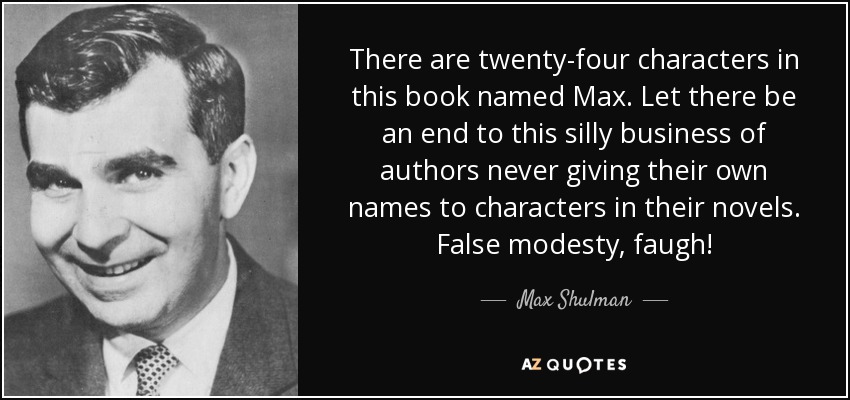
There are twenty-four characters in this book named Max. Let there be an end to this silly business of authors never giving their own names to characters in their novels. False modesty, faugh!
I love a novel that’s funny, and The Taxman Cometh is very funny, delightfully well-written, yet with a serious message about how government bureaucracy affects us all. Read. Enjoy. And if a comparison to Catch 22 pops into your mind, that’s not surprising.
Nothing (at least that can be done by humans) immortalizes anyone. The Fault in Our Stars will hopefully have a long and wonderful life, but it will eventually go out of print, and eventually the last person ever to read it will die, and then the characters will no longer live in any consciousness.Also, that is okay. That is good, actually. That is how it should be. One of the things the characters in this novel have to grapple with is the reality of temporaryness. What Gus in particular must reconcile himself to is that being temporary does not mean being unimportant or meaningless.
I review novels to make money, because it is easier for a sluggard to write an article a fortnight than a book a year, because the writer is soothed by the opiate of action, the crank by posing as a good journalist, and having an air hole. I dislike it. I do it and I am always resolving to give it up.
There is romance, the genuine glinting stuff, in typewriters, and not merely in their development from clumsy giants into agile dwarfs, but in the history of their manufacture, which is filled with raids, battles, lonely pioneers, great gambles, hope, fear, despair, triumph. If some of our novels could be written by the typewriters instead of on them, how much better they would be.
The novel form is about the protagonist's struggle to transform his arbitrary, fragmented, given experience into a narrative as meaningful as his favorite books.
For a subject worked and reworked so often in novels, motion pictures, and television, American Indians remain probably the least understood and most misunderstood Americans of us all.
Letting a maximum number of views be heard regularly is not just a nice philosophical notion. It is the best way any society has yet discovered to detect maladjustments quickly, to correct injustices, and to discover new ways to meet our continuing stream of novel problems that rise in a changing environment.
Truly novel inventions emerge only in one's youth. Later one becomes ever more experienced, famous-and foolish.
Fiction allows us to see the world from the point of view of someone else and there has been quite a lot of neurological research that shows reading novels is actually good for you. It embeds you in society and makes you think about other people. People are certainly better at all sorts of things if they can hold a novel in their heads. It is quite a skill, but if you can't do it then you're missing out on something in life. I think you can tell, when you meet someone, whether they read novels or not. There is some little hollowness if they don't.
It’s the ability to bring events and characters to a resolution that draws me to writing, especially writing for children. I don’t want to ever be didactic, but if there’s something I do want to say, it’s that you can bring things around. You can make a change. Adult novels are about letting go. Children’s novels are about getting a grip.
Write a novel if you must, but think of money as an unlikely accident. Get your reward out of writing it, and try to be content with that.
I feel that whatever virtues the novel may have are very much connected with the limitations you mention. I am not writing a conventional novel, and I think that the quality of the novel I write will derive precisely from the peculiarity or aloneness, if you will, of the experience I write from.
The first thing you have to consider when writing a novel is your story, and then your story - and then your story!
Yes sir. You can be more careless, you can put more trash in [a novel] and be excused for it. In a short story that's next to the poem, almost every word has got to be almost exactly right. In the novel you can be careless but in the short story you can't. I mean by that the good short stories like Chekhov wrote. That's why I rate that second - it's because it demands a nearer absolute exactitude. You have less room to be slovenly and careless. There's less room in it for trash.
The whole process of writing a novel is having this great, beautiful idea and then spoiling it.
A novelist can shift view-point if it comes off. ... Indeed, this power to expand and contract perception (of which the shifting view-point is a symptom), this right to intermittent knowledge - I find one of the great advantages of the novel-form ... this intermittence lends in the long run variety and colour to the experiences we receive.
It’s a rare reader who doesn’t go to the novel looking for a kind of encouragement to live.
The novel is a prose narrative of some length that has something wrong with it.
There is only one expert who is qualified to examine the souls and the life of a people and make a valuable report - the native novelist. ... And when a thousand able novels have been written, there you have the soul of the people; and not anywhere else can these be had.
I have no liking for novels or stories - none in the world; and so, whenever I read one - which is not oftener than once in two years, and even in these same cases I seldom read beyond the middle of the book - my distaste for the vehicle always taints my judgment of the literature itself, as a matter of course; and also of course makes my verdict valuless. Are you saying "You have written stories yourself." Quite true: but the fact that an Indian likes to scalp people is no evidence that he likes to be scalped.
We could live like counts. ... If all that money is out there, I might as well hack a little on the side and put the novel off.
The monotony of staying in one place is the best thing for writing a novel. Having regular habits, a kind of security, but especially no big surprises, no shocks.
The only thing I can say that is not bullshit is that you do have to learn to write in a way that you would learn to play the violin. Everybody seems to think that you should be able to turn on the faucet one day and out will come the novel. I think for most people it's just practice, practice, practice, that sense of just learning your instrument until - when you have an idea on the violin, you don't have to translate it into violin-speak anymore - the language is your own. It's not something you can think your way into, or outsmart. you've just got to do it.
This fact was something I also learned from this first novel that I needed personal experience to invent, to fantasize, to create fiction, but at the same time I needed some distance, some perspective on this experience in order to feel free enough to manipulate it and to transform it into fiction. If the experience is very close, I feel inhibited. I have never been able to write fiction about something that has happened to me recently. If the closeness of the real reality, of living reality, is to have a persuasive effect on my imagination, I need a distance, a distance in time and in space.
Follow AzQuotes on Facebook, Twitter and Google+. Every day we present the best quotes! Improve yourself, find your inspiration, share with friends
or simply: